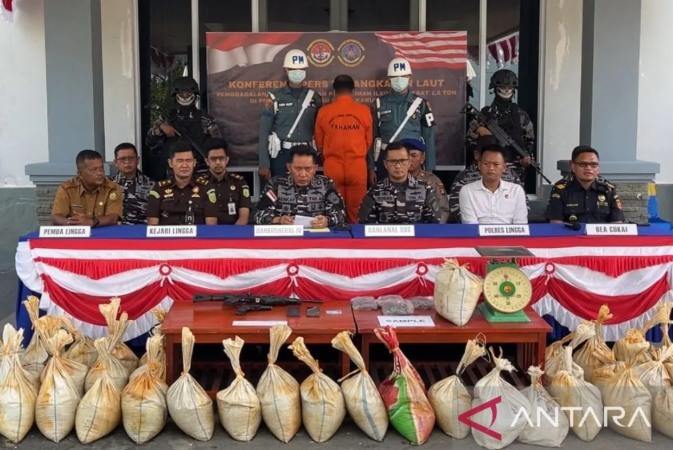
The Indonesian Navy has dealt a significant blow to organised mineral smuggling networks operating in the resource-rich waters of Southeast Asia, intercepting approximately 75.7 tonnes of illegally extracted tin sand apparently bound for Malaysian markets. The contraband, recovered through a series of coordinated operations across the Bangka Belitung Islands off eastern Sumatra, carries an estimated value of Rp76.04 billion—equivalent to roughly US$79,300—and represents the latest in a recurring pattern of illicit mineral trafficking that has long plagued Indonesia's maritime borders.
The operation commenced on August 2 when Indonesian naval personnel discovered a truck laden with roughly eight tonnes of tin sand at a jetty in East Belitung, an initial discovery that would eventually unravel a far more extensive trafficking network. Rather than treating this as an isolated incident, Fleet Command authorities recognised the find as a potential entry point into a larger smuggling pipeline and systematically expanded their investigation. The methodical approach yielded significant results: a subsequent raid on Lenggang village three days later uncovered approximately 50 tonnes, followed by the seizure of another 10 tonnes, tightly packed into 200 sacks, and a final cache of five tonnes recovered on August 8.
Vice Admiral Denih Hendrata, commander of the Indonesian Fleet Command, outlined the investigative strategy during a live-streamed press conference held in Tanjungpandan, Belitung on Wednesday, emphasising that the naval response transcended a single interception. "We did not stop there. The operation was expanded to uncover the network and other parties involved," he stated, signalling that authorities intended to identify the supply chains, middlemen, and end recipients implicated in what appears to be an organised enterprise. This intelligence-driven approach reflects a maturing understanding among Indonesian security agencies that dismantling trafficking operations requires tracing entire networks rather than merely confiscating cargo.
The investigation has currently expanded across five separate locations, suggesting the smuggling apparatus involved multiple collection points, processing sites, and distribution hubs spread throughout the tin-rich region. The Bangka Belitung Islands have long been a focal point for both legitimate tin mining and clandestine extraction, given the exceptional mineral concentrations in the area and the relative difficulty in monitoring expansive maritime territories. Illegal mining operations in Indonesia have generated substantial environmental degradation and have consistently diverted revenues away from the state, making enforcement operations like this one strategically important for both revenue protection and environmental stewardship.
To establish the quality and exact mineral composition of the seized material, Indonesian authorities have initiated comprehensive laboratory analysis. This technical assessment serves multiple purposes: it establishes the authenticity of the contraband as processed tin sand rather than benign mineral matter, determines commercial value more precisely, and may provide forensic evidence linking the seized cargo to specific mining operations or processing facilities. Such scientific corroboration strengthens any eventual prosecutions and helps authorities understand whether the operation involved sophisticated processing or merely crude extraction and minimal refinement.
The absence of named suspects at this stage of the investigation suggests authorities are conducting a careful, methodical inquiry rather than pursuing hasty arrests. This deliberate pace may reflect the complexity of tracing ownership and operational control through intermediaries and shell entities commonly employed in transnational smuggling rings. Maritime smuggling networks frequently employ multiple layers of insulation between primary extraction points and final recipients, making it challenging to establish direct culpability for senior organisers.
Vice Admiral Denih acknowledged that determining the full scope of the conspiracy and identifying Malaysian recipients would necessitate cross-border cooperation and intelligence sharing. Indonesia and Malaysia maintain established diplomatic and law enforcement channels, though inter-agency coordination on maritime crimes sometimes encounters friction due to jurisdictional sensitivities and resource constraints. The transnational dimension of this case means that tracking the smuggled materials through to their Malaysian destination markets will require formal channels of interstate engagement, likely involving both nations' customs authorities and maritime enforcement agencies.
The seizure carries broader implications for regional mineral security and organised crime patterns across Southeast Asia. Malaysia's industrial sector, particularly electronics manufacturing and smelting operations, generates substantial demand for tin products, creating market incentives for suppliers willing to traffic in illegally sourced material. By disrupting supply chains serving these downstream industries, Indonesia's enforcement actions indirectly pressure Malaysian authorities and industrial stakeholders to verify supply chain legitimacy and sourcing legality.
The incident also underscores the persistent challenge of controlling extraction and export of natural resources across Indonesia's sprawling archipelago. Despite substantial naval and customs resources, enforcement agencies acknowledge that the sheer expanse of maritime territory, limited surveillance capabilities, and financial incentives driving illegal mining create conditions favouring smuggling operations. This particular seizure, while significant, likely represents only a fraction of illicit mineral flows transiting regional waters. The continued effectiveness of such operations suggests that addressing the underlying economics—particularly income disparities in mining communities and the price differentials between legally taxed and untaxed mineral sales—remains essential for comprehensive supply-side reduction.

