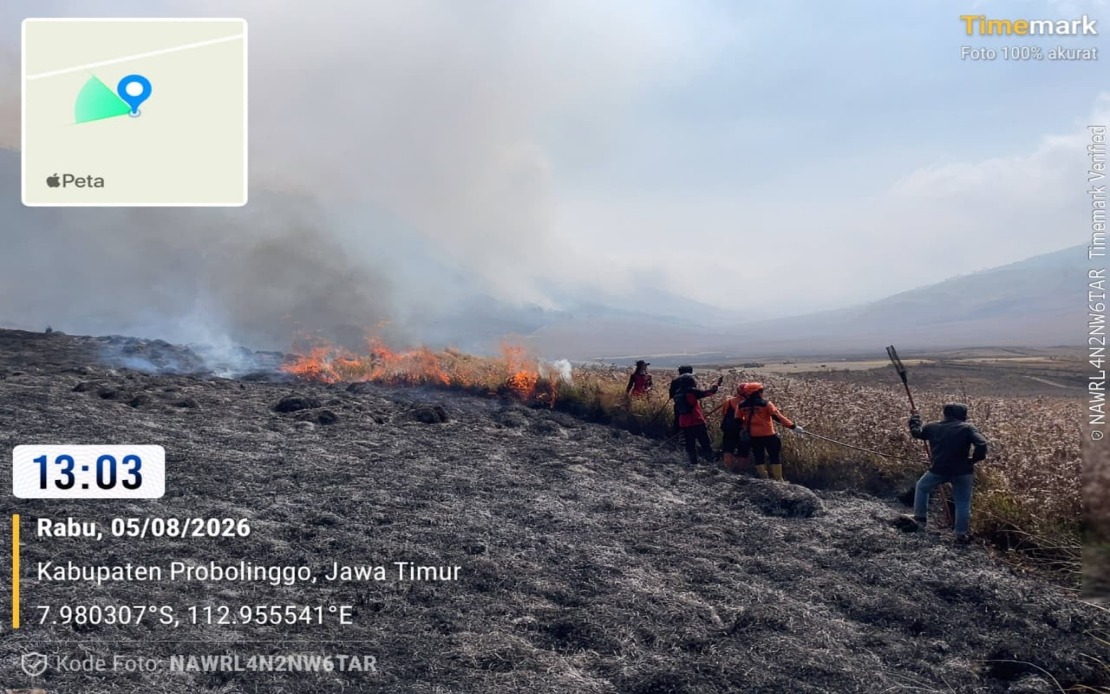
Indonesian authorities have intensified their response to a growing wildfire at Mount Bromo by deploying aerial assets to supplement ground-based firefighting operations. The fire, which ignited on Monday and has since expanded to cover roughly 60 hectares across East Java's Probolinggo and Malang regencies, prompted officials to call in two water-bombing helicopters to target hotspots in especially challenging terrain. The affected areas include approximately 10 hectares within Probolinggo Regency and a further 50 hectares within the Bromo Tengger Semeru National Park located in Malang Regency.
Abdul Muhari, head of the National Disaster Management Agency's Disaster Data, Information and Communication Centre, indicated that while significant progress had been achieved by Wednesday afternoon, the complexity of the landscape continued to present obstacles. The terrain surrounding Mount Bromo, characterised by steep slopes and difficult-to-access ravines, severely limited the effectiveness of conventional ground-based firefighting methods. This geographical challenge necessitated the aerial intervention to reach hotspots that remain beyond the reach of personnel on foot or standard emergency vehicles. The decision to deploy helicopters underscores the agency's strategic adaptation to environmental constraints that often characterise wildfire responses in mountainous regions.
The timeline of containment efforts reveals a measured escalation in response intensity. Although emergency teams achieved substantial progress within the first 24 hours of intensive work, several persistent hotspots continued to flare up in particularly inaccessible locations. Ground crews maintained continuous surveillance and engagement with these remaining fire sources throughout the operation. The positioning of personnel across the affected zones required considerable coordination, as teams had to navigate the volcanic landscape while maintaining safety protocols and operational efficiency.
Beyond helicopter support, Indonesian disaster authorities have begun preparations for weather modification operations that could further assist suppression efforts. These cloud-seeding initiatives, which remain subject to prevailing atmospheric conditions, represent an additional tool in the comprehensive response strategy. The coordination between ground personnel and aerial resources demonstrates the multi-faceted approach necessary when combating wildfires in complex mountainous terrain. Such integrated operations require substantial resource allocation and careful timing to maximise effectiveness.
The impact on tourism and visitor access has been immediate and comprehensive. The Bromo Tengger Semeru National Park Authority implemented a temporary closure affecting portions of the Mount Bromo tourist region to prioritise firefighting operations and safeguard public welfare. This decision reflects the potential danger posed by active fire zones to visitors and the necessity of keeping emergency personnel and equipment unobstructed. Mount Bromo represents a significant draw for both domestic and international tourists, making such closures consequential for local tourism operators and the broader regional economy dependent on visitor spending.
Investigations into the fire's origins have pointed toward recreational activities as the probable trigger. Preliminary findings suggest that hikers may have inadvertently left a campfire unextinguished at the site, a scenario that underscores recurring challenges in managing human activity within protected natural areas. However, authorities have emphasised that investigation continues, and a definitive determination of causation remains pending. The incident highlights ongoing tensions between facilitating public access to iconic natural landmarks and preventing unintended environmental damage.
The Mount Bromo incident occurs within a broader context of wildfire vulnerability across Indonesia's volcanic regions. The nation's tropical climate, combined with periodic dry seasons and the presence of combustible vegetation, creates conditions where fires can spread rapidly across significant areas once ignited. East Java, home to numerous volcanic peaks and mountainous terrain, has experienced recurrent wildfire challenges that tax regional emergency resources. Recent years have demonstrated the frequency and scale of such incidents, prompting ongoing discussions about prevention strategies, resource allocation, and visitor management in protected areas.
For Malaysian observers, the Mount Bromo situation carries relevance beyond Indonesia's borders. Similar volcanic landscapes and environmental conditions exist throughout Southeast Asia, including Malaysia's own protected mountain regions. The operational lessons emerging from Indonesian disaster response protocols—particularly regarding the integration of aerial support, ground operations, and weather-based interventions—offer insights applicable across the region. Furthermore, the incident illustrates how transnational environmental challenges, including air quality impacts from smoke dispersion, potentially affect neighbouring nations depending on wind patterns and fire intensity.
The response capability demonstrated by Indonesian agencies reflects significant institutional development within disaster management frameworks. The National Disaster Management Agency's coordination of multiple resources, from personnel deployment to helicopter logistics and weather modification preparations, indicates sophisticated crisis management infrastructure. Such capabilities have been refined through experience gained from numerous prior incidents, representing institutional knowledge that continues to evolve with each major emergency response undertaken.
Looking ahead, the resolution of this particular emergency will likely inform subsequent policy discussions regarding wildfire prevention and tourist management at Mount Bromo and similar sites. Park authorities may implement enhanced visitor education programmes, stricter campfire regulations, or expanded monitoring systems to reduce recurrence risks. These administrative adjustments reflect lessons learned from operational responses and represent preventive evolution in park management approaches. The balance between providing public access to treasured natural sites and implementing effective safety measures remains an ongoing challenge for Indonesian environmental authorities and their counterparts throughout Southeast Asia.

