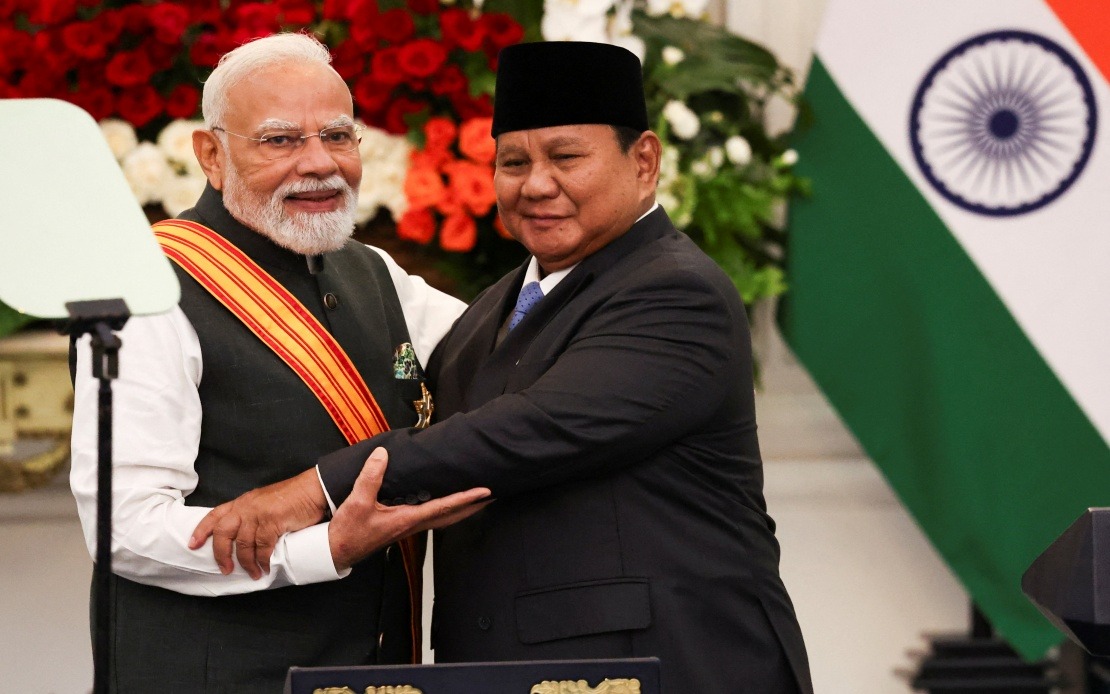
President Prabowo Subianto of Indonesia conferred the country's most prestigious state decoration upon Indian Prime Minister Narendra Modi on Tuesday, honouring the leader's instrumental role in elevating bilateral relations and fostering regional cooperation. The award ceremony took place at the Merdeka Palace in Jakarta following high-level bilateral discussions between the two leaders, with proceedings broadcast live to the public through digital media platforms.
The Indonesian president articulated that the recognition reflects Modi's distinguished stewardship and his tangible contributions toward advancing the Indonesia-India Comprehensive Strategic Partnership, a framework that has positioned the two nations as key regional collaborators. Prabowo highlighted that Modi's unwavering commitment to expanding mutual initiatives has yielded concrete outcomes that benefit both populations, extending from diplomatic coordination to developmental projects that have strengthened Indonesia's capacity across multiple sectors.
The visit constitutes a reciprocal engagement in a pattern of high-level exchanges between Jakarta and New Delhi. Modi's current journey follows Prabowo's official visit to India earlier in the calendar year, demonstrating the consistent political commitment both governments maintain toward consolidating their partnership. This cyclical exchange of state visits underscores how seriously both nations regard their bilateral relationship and their intention to sustain momentum in collaborative endeavours.
Historical precedent lends additional weight to Monday's ceremony. Prabowo referenced that Indonesia previously bestowed the identical honour upon Jawaharlal Nehru, India's founding prime minister, recognising Nehru's pioneering contributions to Indonesia-India relations and his foundational role in establishing the Non-Aligned Movement during the decolonisation era. The parallel between Nehru's and Modi's recognition illustrates Indonesia's acknowledgement of continuity in India's regional leadership across decades, from independence-era statesmanship to contemporary great-power positioning.
Beyond bilateral concerns, Prabowo articulated Indonesia's appreciation for India's backing of Indonesia's membership aspirations within BRICS, the influential economic bloc comprising Brazil, Russia, India, China, and South Africa. Indonesia's potential entry into BRICS represents a significant diplomatic achievement, potentially expanding the developing-world coalition's weight in global economic governance. India's support for this strategic objective carries considerable implications for Indonesia's positioning within broader Asian and multipolar frameworks.
The foundation for contemporary Indonesia-India engagement rests upon centuries of cultural and civilisational interchange. Prabowo underscored the deep historical resonances that bind the two nations, rooted in shared Hindu-Buddhist heritage, maritime trade traditions, and philosophical affinities developed through the Non-Aligned Movement's principles. These civilisational connections provide a durable substrate upon which modern strategic cooperation is constructed, distinguishing the relationship from transactional arrangements and infusing it with enduring cultural legitimacy.
For Malaysia and the broader Southeast Asian region, the strengthening of Indonesia-India ties carries multifaceted implications. Indonesia remains the region's largest economy and most populous nation, wielding considerable influence within ASEAN. India, meanwhile, has increasingly repositioned itself as an Indo-Pacific power through its strategic doctrine and infrastructure investments across Southeast Asia. The consolidation of Indonesia-India partnership signals that regional dynamics will increasingly reflect major-power competition and cooperation centred on the Indian Ocean littoral and extended Asian maritime domains.
The Comprehensive Strategic Partnership framework that Prabowo emphasised represents an evolution beyond conventional bilateral relations. Such partnerships typically encompass defence cooperation, intelligence sharing, economic integration, and coordinated responses to transnational challenges ranging from maritime security to climate adaptation. Within this architecture, both nations pledge collaborative approaches to regional stability and prosperity, positioning themselves as interconnected stakeholders rather than isolated actors.
Modi's state visit demonstrates India's deliberate cultivation of relationships with major Southeast Asian economies as part of its broader Indo-Pacific strategy. Through personalised engagement with Indonesian leadership and reciprocal high-level visits, India seeks to entrench itself as a consequential regional power rather than remaining primarily focused on South Asian affairs. For Indonesia, closer alignment with India offers counterbalance within regional great-power competition while enabling access to Indian technological expertise, defence capabilities, and market opportunities.
The ceremonial dimensions of the state honour carry symbolic weight beyond formal recognition. Public acknowledgement of Modi's contributions through Indonesia's most prestigious award signals to international audiences that Jakarta regards Indian leadership as deserving of the highest diplomatic esteem. Such gestures influence perceptions among regional partners and global actors regarding the relative weight and trajectory of Indonesia-India relations within Asian geopolitics.
Looking forward, the momentum generated by this visit will likely translate into concrete institutional developments. Defence collaborations may deepen, trade negotiations could accelerate, and coordinated positions on regional security matters may become more pronounced. Malaysian policymakers and business interests should monitor these developments attentively, as Indonesia-India cooperation patterns may reshape competitive and cooperative dynamics throughout Southeast Asia.

