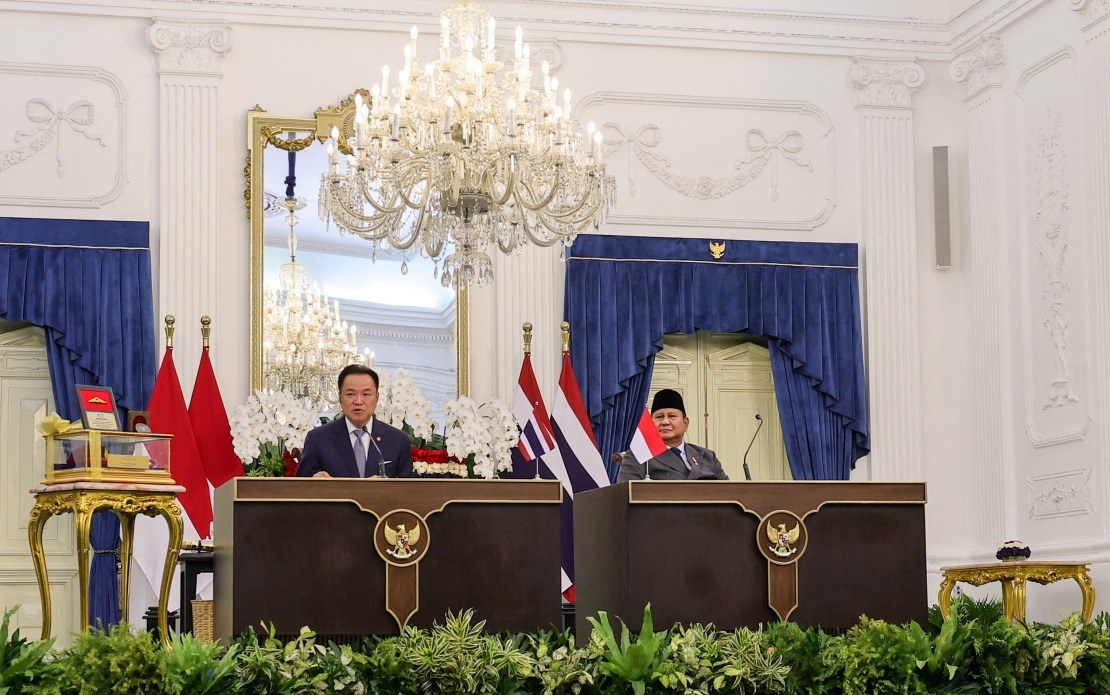
Indonesia and Thailand have jointly committed to advancing ASEAN's efforts to restore stability in Myanmar, signalling renewed regional focus on implementing the Five-Point Consensus through sustained dialogue and expanded humanitarian channels. The pledge emerged from a high-level meeting between Indonesian President Prabowo Subianto and Thai Prime Minister Anutin Charnvirakul at Jakarta's Merdeka Palace, marking a significant diplomatic moment as the two Southeast Asian powers align on critical regional challenges.
Prabowo emphasised that maintaining ASEAN's collective voice and central role remains essential for achieving lasting peace and development across the region. The two leaders underscored their shared conviction that Indonesia and Thailand must work in tandem to strengthen ASEAN's capacity to play a constructive role in Myanmar, where a military coup in 2021 has triggered ongoing conflict and a humanitarian crisis. This coordinated approach reflects broader recognition within ASEAN that unilateral approaches have proven ineffective, and that the bloc's credibility depends on demonstrating unified commitment to the Five-Point Consensus, which centres on dialogue, ceasefire efforts, and humanitarian assistance.
Beyond Myanmar, the Jakarta talks revealed an ambitious agenda to deepen security cooperation on issues that increasingly preoccupy both nations. Indonesia and Thailand have agreed to strengthen intelligence sharing mechanisms, conduct joint investigations into criminal networks, and coordinate financial tracking efforts to dismantle transnational organised crime syndicates. This represents a significant upgrade in operational security collaboration, moving beyond traditional diplomatic engagement to create concrete mechanisms for cross-border law enforcement action.
Online scam operations emerged as a priority concern, reflecting the scale of Southeast Asia's vulnerability to cybercriminal networks. Thai Prime Minister Anutin specifically acknowledged Thailand's role in facilitating the repatriation of nearly 1,000 Indonesians victimised by these syndicates, a practical demonstration of bilateral cooperation. For Malaysian observers, this cooperation carries direct relevance, as the region has witnessed similar online scam operations exploiting citizens across multiple countries. The establishment of a Transnational Referral Mechanism aims to accelerate victim identification and safe repatriation, creating a template for regional efforts that could eventually benefit Malaysian authorities tackling equivalent challenges.
The scope of security cooperation extends beyond cybercrime to encompass human trafficking and narcotics trafficking, long-standing concerns that require coordinated responses. Enhanced law enforcement coordination and capacity building initiatives signal that both nations recognise these threats demand sustained, intelligence-driven approaches rather than ad hoc interventions. This multilayered approach acknowledges the interconnected nature of transnational crime in Southeast Asia, where criminal networks routinely exploit porous borders and weak coordination between national authorities.
Anutin's proposal for expanded defence industry collaboration introduces a commercial dimension to the security partnership. The supply of 36 amphibious wheeled armoured vehicles to Indonesia suggests Thailand views defence manufacturing as both an economic opportunity and a means to strengthen interoperability between the two nations' armed forces. This kind of equipment standardisation facilitates joint operations and demonstrates confidence in long-term security alignment, potentially creating the foundation for more integrated ASEAN military cooperation in the future.
The visit itself carries symbolic weight as Anutin's first official journey to Indonesia since assuming office as Thailand's 32nd prime minister in September 2025. More significantly, it marks the first visit by a Thai prime minister to Indonesia in 15 years, highlighting how political transitions can either strengthen or weaken regional relationships. Anutin's choice to prioritise Indonesia signals Thailand's commitment to rekindling high-level engagement with its largest ASEAN neighbour, reversing a period of diplomatic distance that may have weakened bilateral coordination on shared challenges.
Regular joint military training and maritime security cooperation form the operational backbone of the expanded partnership. Maritime security cooperation holds particular importance given both nations' extensive coastlines and shared interest in freedom of navigation through critical sea lanes. Indonesian waters, in particular, represent zones of significant strategic interest, and closer Thai-Indonesian maritime coordination could contribute to broader regional stability efforts.
For Malaysia and other ASEAN members, this bilateral deepening carries implications for collective regional capacity. A stronger Indonesia-Thailand partnership potentially enhances ASEAN's ability to address internal security challenges and maintain order within the bloc. Simultaneously, the Myanmar peace focus demonstrates continued commitment to the Five-Point Consensus framework, even as its implementation faces persistent obstacles. The mechanism's success depends partly on whether leading ASEAN nations maintain consistent pressure on Myanmar's military government and all conflict parties to respect humanitarian access and pursue genuine dialogue.
The fight against online scam operations deserves particular attention given its transnational character and rapid evolution. Criminal networks operate across borders with ease, recruiting victims and operatives across multiple countries while laundering proceeds through complex financial channels. Indonesia and Thailand's commitment to intelligence sharing and joint investigations could establish precedents for similar cooperation within ASEAN, potentially extending to Malaysia, Singapore, the Philippines, and Vietnam, which all face comparable threats.
Looking forward, the Jakarta meeting suggests that bilateral relationships within ASEAN remain crucial vehicles for advancing regional objectives. While ASEAN's consensus-driven approach provides institutional legitimacy, bilateral partnerships like Indonesia-Thailand can develop operational capacity and political will that multilateral forums sometimes struggle to mobilise. The test will be translating these commitments into sustained implementation, particularly regarding Myanmar peace efforts, where momentum has historically fluctuated based on international attention and the military government's willingness to negotiate.
The comprehensive nature of the partnership—spanning Myanmar peace initiatives, transnational crime, defence cooperation, and maritime security—reflects recognition that regional stability requires multifaceted approaches. Neither diplomatic engagement on Myanmar nor law enforcement against crime operates in isolation; both depend on sustained political commitment and institutional coordination. Indonesia and Thailand's willingness to deepen ties on these fronts sends a message that ASEAN's leading nations remain invested in regional order, despite challenges that sometimes create divergent national interests.

