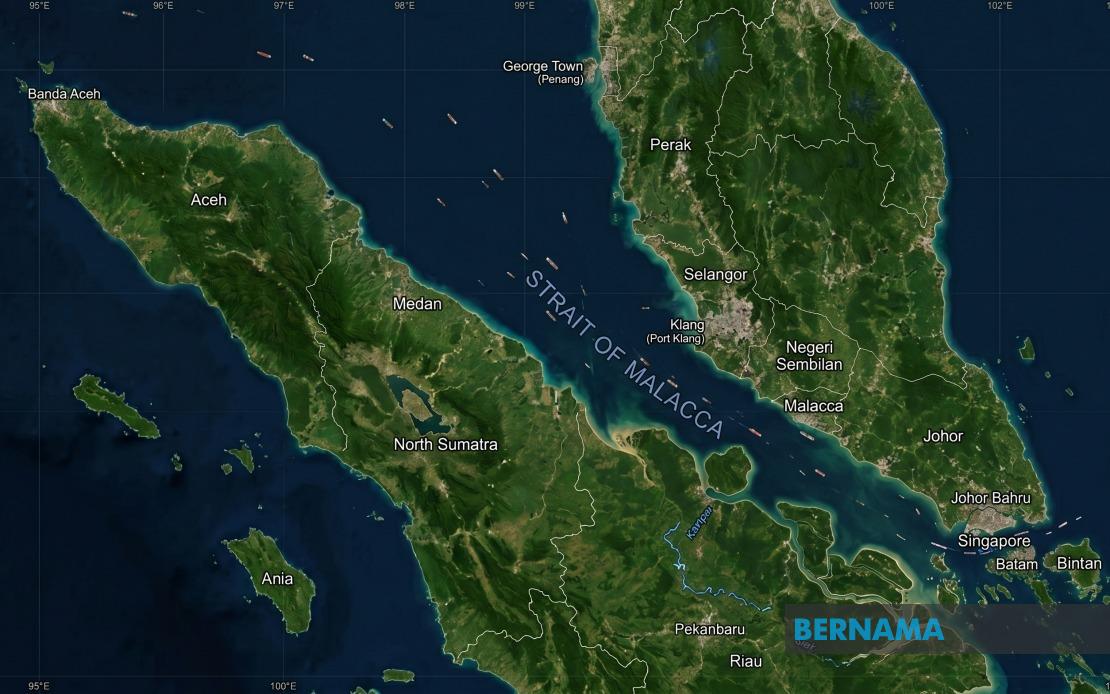
Indonesia and Singapore have jointly reaffirmed their determination to safeguard the Strait of Malacca, one of the world's most strategically important maritime passages, with both nations committing to sustained coordination alongside Malaysia and Thailand to preserve security, safety and unhindered navigation through the channel. The commitment emerged during high-level discussions between Indonesian President Prabowo Subianto and Singapore Prime Minister Lawrence Wong at the Istana Merdeka in Jakarta, marking the second annual Indonesia-Singapore Leaders' Retreat and underscoring the deepening strategic partnership between Southeast Asia's two most economically advanced nations.
President Prabowo emphasised that Indonesia and Singapore, as countries with direct borders onto the Strait of Malacca, share fundamental interests in maintaining the waterway as an open passage accessible to all maritime users. Both leaders grounded their commitment in the 1982 United Nations Convention on the Law of the Sea, the internationally binding framework governing maritime conduct and usage rights. This legal foundation is particularly significant for Malaysia and other Southeast Asian nations reliant on predictable, stable maritime governance in a region increasingly vital to global trade flows and geopolitical stability.
Beyond the ceremonial aspects of bilateral relations, the two leaders identified multiple practical security concerns demanding coordinated attention. Prabowo highlighted maritime piracy, pollution incidents and shipping accidents as interconnected threats requiring urgent cooperative management among littoral states. These challenges reflect evolving security dynamics in Southeast Asian waters, where traditional piracy has transformed into organised criminal networks targeting commercial vessels, whilst environmental degradation from maritime accidents poses ecological risks to some of the world's most biodiverse coastal ecosystems and fishing grounds upon which millions depend for livelihoods.
The discussions encompassed broader regional and global dimensions beyond the Strait's immediate security architecture. Both leaders reaffirmed ASEAN's foundational principle that international disputes must be resolved through peaceful dialogue and diplomatic channels rather than coercive means. This positioning carries particular resonance given current geopolitical tensions affecting Southeast Asia, particularly disputes in the South China Sea where competing territorial claims have occasionally erupted into diplomatic friction and military posturing.
The leadership meeting served as a platform for addressing potential misunderstandings between Jakarta and Singapore before they crystallise into diplomatic tensions. Wong's arrival in Jakarta on Sunday evening for the retreat reflected the structured, institutionalised nature of Indonesia-Singapore relations, a marked contrast to more volatile partnerships elsewhere in the region. Prabowo characterised the annual retreat format as instrumental not merely for managing immediate bilateral issues but for constructing long-term partnership architecture capable of adapting to evolving regional circumstances.
Perhaps most symbolically, both leaders flagged the approaching 60th anniversary of Indonesian-Singaporean diplomatic relations in 2025. This milestone offers opportunity for regional reflection on how bilateral partnerships underpin broader Southeast Asian stability and prosperity. Indonesia, as ASEAN's largest economy and most populous nation, and Singapore, as a crucial financial and logistical hub, together exercise outsized influence over regional maritime security governance and economic flows.
The Strait of Malacca's strategic importance cannot be overstated for Malaysian and regional stakeholders. Approximately one-third of global maritime trade transits this narrow channel, worth trillions of dollars annually. Disruptions to traffic flow or security incidents can reverberate across regional supply chains and global commodity markets within hours. The commitment to joint safeguarding frameworks thus carries economic implications extending far beyond the immediate geopolitical calculation, directly affecting shipping costs, insurance premiums and delivery schedules for businesses throughout Southeast Asia.
Malaysia's explicit inclusion in the coordination framework, mentioned alongside Thailand, reflects the institutional maturity of Strait governance mechanisms. The Strait's narrowest point lies within Malaysian territorial waters, giving Kuala Lumpur particular responsibility and leverage in maritime security arrangements. Continued tripartite or quadrilateral coordination between Indonesia, Singapore, Malaysia and Thailand through formal and informal channels remains essential for preventing individual nations from pursuing narrow security interests that might compromise collective stability.
The emphasis on combating maritime pollution and shipping accidents addresses often-overlooked security challenges that have demonstrated capacity to generate humanitarian and environmental crises. Recent years have witnessed several major incidents involving container ship collisions and bulk carrier groundings within Southeast Asian waters, resulting in crew fatalities, pollution spills affecting marine ecosystems and coastal communities. Coordinated search and rescue protocols, environmental response systems and maritime traffic management represent practical manifestations of bilateral commitment that extend beyond military-security frameworks to encompass civilian maritime safety governance.
The retreat format itself merits attention as reflecting evolved diplomatic practice in Southeast Asia. Rather than episodic crisis-response engagements, institutionalised annual meetings between major regional powers enable sustained policy dialogue, relationship maintenance and early warning mechanisms. This structured approach contrasts with earlier eras when regional diplomacy relied more heavily on ad hoc encounters at multilateral forums, often dominated by external powers' agendas rather than Southeast Asian nations' own priorities.
Both nations' emphasis on peaceful dispute resolution carries implicit messaging directed toward other regional powers, particularly amid ongoing geopolitical competition affecting Southeast Asian strategic space. By visibly reinforcing commitment to dialogue-based frameworks, Indonesia and Singapore reaffirm regional agency in maintaining stability absent external military intervention. This positioning protects regional autonomy whilst acknowledging genuine interdependencies requiring cooperative governance structures.
Looking forward, the bilateral partnership architecture appears positioned to deepen as both nations face convergent challenges from climate change affecting maritime ecosystems, transnational maritime crime evolution and shifting global trading patterns. The approaching 60th anniversary presents opportunity for renewed institutional commitments and potentially enhanced mechanisms for managing emerging maritime security challenges. For Malaysian observers, the Indonesia-Singapore coordination frameworks offer both reassurance regarding Strait governance and invitation for deepening trilateral or multilateral engagement on maritime security architecture.

