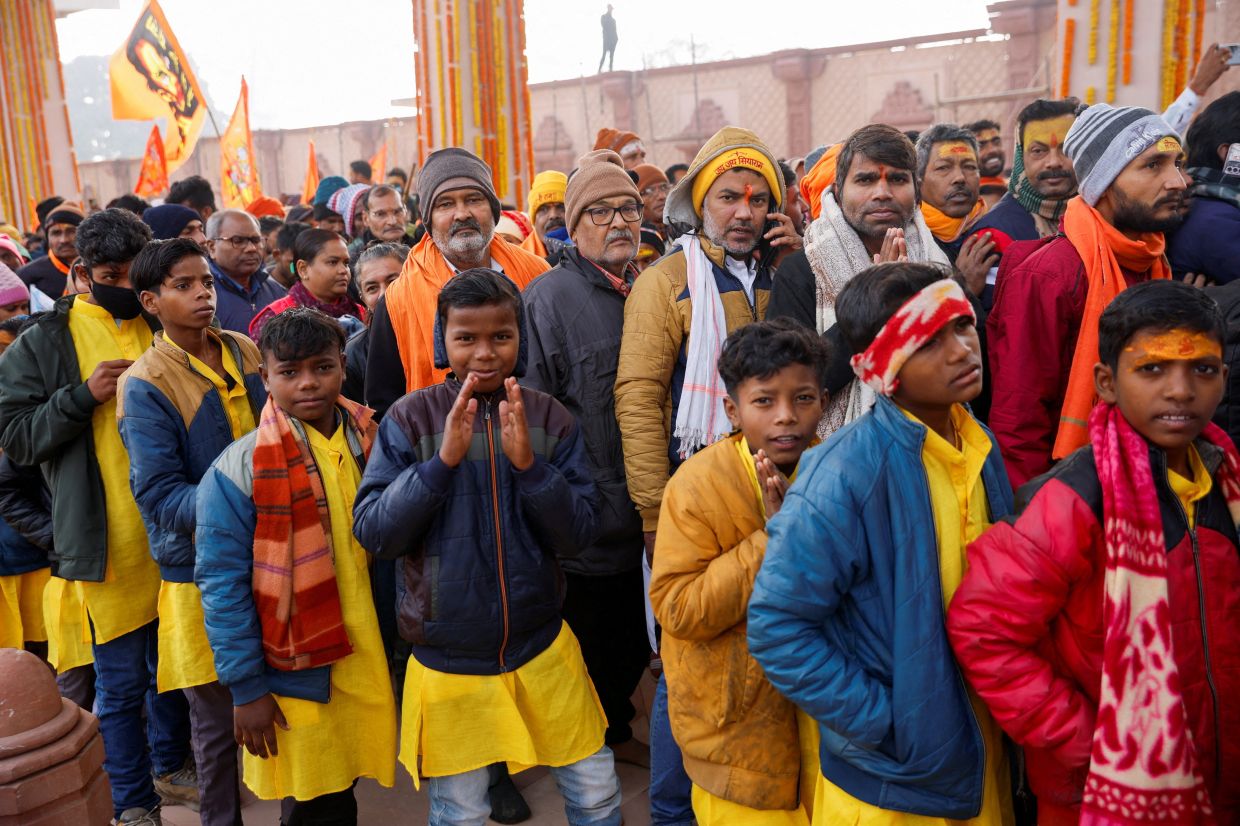
Police in India have opened an investigation into allegations that donations were misappropriated from the Ram temple in Ayodhya, one of the country's most prominent Hindu pilgrimage sites. The probe, which commenced in June, has resulted in eight arrests among staff responsible for handling donations at the shrine. Though authorities have not publicly confirmed the exact sum involved, media reports suggest the alleged theft may amount to 30 million rupees, equivalent to approximately US$314,000. The case represents a troubling development for a temple that was only inaugurated in 2024 by Prime Minister Narendra Modi and has already established itself as a major religious attraction, drawing roughly 90,000 visitors daily from across India and beyond.
The incident has struck a sensitive chord among devotees, many of whom contribute from limited personal resources in the belief that their offerings support sacred work. Ashok Prasad Kushwaha, an auto-rickshaw driver from Delhi who has made three trips to the Ram temple over the past two years, articulated the emotional dimension of the scandal. "When we donate, we believe the money is going for God's work," he explained, underscoring how breach of trust at religious institutions cuts deeper than simple financial loss. For millions of ordinary Indians who view temple donations as acts of faith rather than mere transactions, such revelations undermine confidence in the institutions entrusted with their contributions.
This latest scandal at Ayodhya forms part of a broader pattern of financial irregularities at major Indian temples. Previous cases have implicated other celebrated pilgrimage sites, including the Badrinath shrine and the Tirumala Tirupati Devasthanams, a temple trust of extraordinary scale whose assets are valued at approximately US$31 billion. These institutions have evolved into religious and commercial enterprises of considerable complexity, managing resources that rival those of major corporations. The scale and frequency of such incidents suggest that the problem is not isolated mismanagement but rather systemic deficiencies in how religious organisations across India are structured to handle donations and ensure accountability.
Experts point to weak internal controls as a central factor enabling such thefts. The alleged perpetrators at the Ram temple reportedly exploited vulnerabilities in donation-counting procedures and gaps in surveillance systems, indicating that basic safeguards were insufficient. Rahul Easwar, a Hindu activist and descendant of a former chief priest at Kerala's Sabarimala temple, has highlighted the fundamental disconnect between the scale of modern religious institutions and their governance frameworks. "The core systemic problem is the lack of transparency and accountability," Easwar noted, emphasising that contemporary temples require institutional architecture far more rigorous than traditional administrative models.
To address these vulnerabilities, experts advocate for comprehensive reforms encompassing multiple dimensions. Mandatory receipt-issuing systems would create documentation trails for all donations, while digital accounting platforms would replace manual record-keeping prone to errors or manipulation. Closed-circuit television monitoring of donation-collection areas would serve as both deterrent and evidence mechanism. Equally important is independent oversight, whether through external audits or dedicated committees comprising devotees and financial professionals. These measures would bring temple administration closer to standards observed in corporate entities and major non-profit organisations that handle comparable sums.
The governance challenges are compounded by India's fragmented regulatory environment. Religious institutions operate under multiple overlapping legal frameworks and tax regimes that vary by state and by religious community, resulting in inconsistent standards of financial transparency. Sonam Chandwani, managing partner at KS Legal & Associates, observed that no unified national framework exists to prescribe consistent financial disclosure requirements across all religious institutions. This regulatory fragmentation allows temples and shrines to operate with widely divergent accountability standards, from transparent operations to minimal oversight, depending on local jurisdiction and institutional commitment.
The Ram temple's particular significance renders the donation scandal especially consequential. The site itself was the focal point of one of India's longest and most contentious religious disputes. Hindu traditions hold that the deity Ram was born there over seven thousand years ago, while history records that the Babri mosque occupied the location from the sixteenth century onwards. This dispute culminated catastrophically in 1992 when Hindu mobs demolished the mosque, triggering widespread communal violence that claimed more than two thousand lives. Following a 2019 Supreme Court verdict, the land was awarded for temple construction, initiating a major fundraising campaign that ultimately accumulated approximately US$341 million from donors nationwide. The temple's inauguration in 2024 represented, for many Hindus, a symbolic resolution of a historical injustice and a culmination of sustained religious mobilisation.
Against this backdrop, allegations of donation misappropriation carry heightened emotional and political significance. Devotees who contributed believing they were building a temple on one of Hinduism's holiest sites feel betrayed when such funds are allegedly diverted through theft. The case also raises questions about governance at a shrine that has received extraordinary national attention and resources. The temple's prominence makes it a focal point for public scrutiny, yet the alleged weaknesses in its internal controls suggest that even high-profile institutions can suffer from basic administrative failures.
India's religious sector operates at extraordinary scale relative to global peers. Market analysts valued the country's religious and spiritual economy at US$70.14 billion in 2025, with projections indicating expansion to US$135.41 billion by 2034. This expansion reflects both population growth and increased affluence among Indian consumers, meaning temples and religious trusts will command ever-larger financial flows in the coming years. Without corresponding improvements in governance and transparency, the risk of further scandals will intensify proportionally.
The challenges multiply when considering major religious events like the Kumbh Mela pilgrimage, where millions of devotees congregate and collection of offerings reaches unprecedented volumes. Easwar highlighted how such mass gatherings create logistical complexities that existing systems are ill-equipped to manage. Political analyst Anurag Naidu observed that religious institutions handling routine massive cash inflows require administrative sophistication comparable to large public institutions. "Religious institutions have grown far beyond traditional places of worship," Naidu said, emphasising that temples now function as substantial economic entities requiring professional-grade financial systems, internal controls, and independent monitoring.
The Ram temple investigation thus serves as a catalyst for broader institutional reform across India's religious sector. The allegations have catalysed discussions about mandatory financial transparency standards, professional accounting practices, and independent oversight mechanisms. Whether India's religious leadership will embrace such reforms voluntarily, or whether regulatory pressure or court intervention will be required, remains to be seen. What is evident is that the relationship between religious institutions and devotees fundamentally depends on trust—trust that sacred donations are protected and employed for their intended purpose. The Ayodhya scandal demonstrates that this trust cannot be assumed, and that even the most venerated temples require robust systems to safeguard the faith placed in them.

