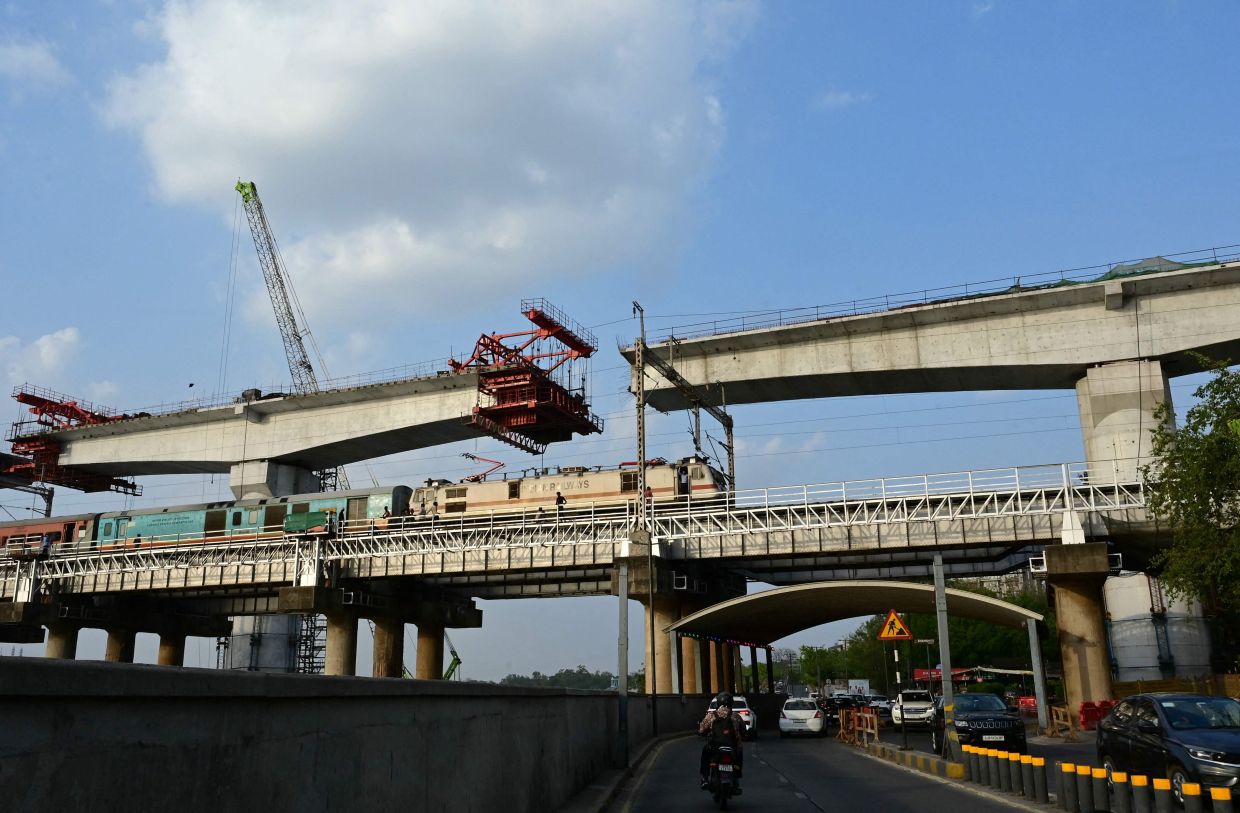
India's flagship high-speed rail initiative is finally gaining momentum, with railway officials confirming that the country's first bullet train corridor will see operational service commence in 2027 — a significant acceleration after nearly a decade of construction work that has tested both Indian and Japanese patience. The inaugural section will connect the cities of Surat and Vapi, two industrial powerhouses separated by approximately 100 kilometres along India's western coast, establishing a proof-of-concept for what New Delhi envisions as a transformative national network.
The Mumbai-Ahmedabad High Speed Rail Corridor, spanning 508 kilometres in total, represents the centrepiece of India's railway modernization ambitions and carries symbolic weight far beyond its technical specifications. Dharmendra Tewari, additional director general of Indian Railways, indicated that substantial work across the entire corridor has already progressed beyond the halfway mark, with the initial Surat-Vapi segment positioned to demonstrate viability when services begin. This phased approach, while extending the overall timeline, allows India to validate operational procedures and technology integration before rolling out the complete Mumbai-Ahmedabad connection.
The project's journey reflects the complexities of delivering mega-infrastructure in contemporary India. Originally announced in 2017 during a high-profile visit between then-Prime Minister Narendra Modi and Japanese counterpart Shinzo Abe, the initiative was optimistically scheduled for completion by 2023. That deadline proved wildly optimistic, with land acquisition complexities, cost escalations, and the technical challenges of constructing India's first genuinely high-speed rail system contributing to repeated postponements. Estimated at US$17 billion, the project receives 81 per cent financing through the Japan International Cooperation Agency, underscoring the technological and financial interdependence between the two nations, though Indian media reports suggest actual expenditure could exceed official estimates substantially.
The engineering ambitions embedded in this corridor are striking. The route necessitates a 21-kilometre tunnel burrowing through mountainous terrain and, most ambitiously, India's inaugural undersea rail tunnel — a component that remains incomplete despite the overall timeline acceleration. These engineering requirements reflect the route's geographical constraints while simultaneously positioning India alongside other technologically advanced economies capable of executing such complex infrastructure. When fully operational, the system will permit trains to achieve design speeds of 350 kilometres per hour, though operational velocity will be capped at 320 kph, dramatically reducing travel time between Mumbai and Ahmedabad from the current six hours via conventional rail to just under two hours.
This corridor's completion holds particular significance for Gujarat, Modi's home state, as it will facilitate infrastructure preparation for Ahmedabad's hosting of the 2030 Commonwealth Games. The government has explicitly positioned this sporting event as a stepping stone toward India's broader Olympic aspirations, with the 2036 Summer Games representing a potential culmination of this infrastructure-driven development strategy. Completing the full Mumbai-Ahmedabad line by the end of 2028 creates the necessary window for hosting the Commonwealth Games while showcasing India's modernized transportation capabilities to a global audience.
India's broader rail transformation provides essential context for understanding this project's significance. The nation operates one of the world's most expansive railway networks, with approximately 85,000 kilometres of track now capable of speeds exceeding 110 kilometres per hour — roughly 80 per cent of total network capacity. Last year's passenger numbers reached 7.41 billion, while freight traffic exceeded 1.67 billion tonnes, demonstrating the crushing demand placed upon India's inherited colonial-era infrastructure. The domestically engineered Vande Bharat trains, capable of 180 kilometres per hour, have already garnered acceptance among passengers, carrying nearly 40 million travellers in their first year of operation and validating India's capacity for indigenous high-speed rail development.
Yet the bullet train represents something qualitatively different — a technological and psychological watershed. India's government explicitly frames the project as generating transferable expertise that will underpin future high-speed corridors throughout the nation. This knowledge-transfer dimension addresses a persistent gap in India's infrastructure capabilities, where effective technology assimilation remains as important as initial deployment. The skills and systems developed during the Mumbai-Ahmedabad project will theoretically enable faster execution of subsequent corridors, reducing the learning curve that has characterized much of India's high-speed rail journey.
Government blueprints outline an extraordinarily ambitious vision extending far beyond this initial corridor. Seven proposed high-speed rail corridors spanning 4,000 kilometres collectively would rewire India's inter-city connectivity patterns. An east-west corridor connecting New Delhi to Varanasi — Modi's parliamentary constituency and Hinduism's holiest city — and extending to Siliguri in the northeast would integrate the country's peripheral regions with metropolitan centres. A complementary north-south route threading through Gujarat, Maharashtra, Telangana, and Tamil Nadu would link Mumbai with Ahmedabad before descending through Pune, Hyderabad, and Chennai, India's major technology and industrial hubs. These routes are framed as "growth connectors," infrastructure investments designed to catalyze economic integration and regional development.
However, ambition and implementation remain separated by significant gulfs. While the Mumbai-Ahmedabad project has achieved tangible progress despite delays, these additional corridors exist as strategic concepts without operational timelines or fully secured funding mechanisms. The success of the inaugural bullet train becomes crucial in determining whether such grandiose plans transition from policy documents to construction sites. Sceptics note that India's history contains numerous abandoned mega-projects and chronically underperforming infrastructure initiatives, suggesting that converting these seven corridor proposals into operational networks would require sustained political will, consistent funding, and technical execution at unprecedented scales.
The imminent visit of Japanese Prime Minister Sanae Takaichi to India underscores the bilateral importance of the bullet train's progress. As Abe's political protégé, Takaichi carries symbolic weight within Japan's establishment commitment to infrastructure partnerships with India, particularly as both nations navigate their respective strategic interests in the Indo-Pacific region. Japan's substantial financial and technological investment in the Mumbai-Ahmedabad corridor reflects Tokyo's broader engagement strategy with South Asia, positioning infrastructure development as a vehicle for deepening diplomatic and economic relationships. The project's trajectory will inevitably influence Japanese confidence in future collaboration with India on comparable mega-projects.
For Malaysia and the broader Southeast Asian region, India's high-speed rail evolution holds competitive implications. As India modernizes its inter-city connectivity and positions itself as a technologically advanced economy capable of executing sophisticated infrastructure, regional competitors face pressure to accelerate their own modernization timelines. The success narrative of Indian high-speed rail could influence Chinese and Japanese companies' commercial strategies throughout Southeast Asia, potentially reshaping competitive dynamics in the region's transportation infrastructure sector. Simultaneously, Indian expertise in executing such projects in tropical, densely populated environments could offer valuable lessons for Southeast Asian nations contemplating comparable investments.
The 2027 opening of the Surat-Vapi segment thus carries significance extending far beyond the immediate Mumbai-Ahmedabad corridor. It represents an inflection point in India's infrastructure modernization trajectory, potentially unlocking a generation of high-speed rail development while simultaneously validating the complex partnership between Indian ambitions and Japanese technological expertise. Whether this milestone catalyzes the broader vision of interconnected high-speed corridors or remains an isolated success story will fundamentally shape India's infrastructure landscape for decades to come.

