Across India's tech hubs, a new workforce is emerging to build the artificial intelligence systems reshaping global industries. Young professionals, many fresh from college, spend their days scrutinizing video footage frame by frame, drawing boxes around objects, and labeling actions performed by robots and autonomous vehicles. The work is unglamorous but urgently needed—and for now, it is generating thousands of jobs in a nation desperate to employ its swelling population of university graduates.
Data annotation, the practice of preparing raw information for AI systems to learn from, has evolved into a significant economic activity. Companies like Objectways Technologies, based in the small southern Indian city of Karur with 2,600 employees, are expanding rapidly to meet international demand. The firm, which hired 300 workers in a single month, primarily serves American technology companies developing artificial intelligence products. Entry-level annotators earn between US$210 to US$260 monthly—a respectable income in smaller Indian cities—while those working remotely as freelancers earn US$2.50 per hour for usable footage recorded on their smartphones.
The urgency for India to create skilled employment opportunities has intensified under political pressure. Prime Minister Narendra Modi's government faces mounting dissatisfaction from young voters, evidenced by recent protests over education and job prospects. Approximately two million Indians turn 18 each month, creating an enormous cohort requiring productive work. The data annotation sector offers a tangible, if partial, response to this demographic challenge. Yet beneath the surface of this apparent success lies a more complicated reality about India's role in the global technology economy.
S. Krishnan, leading India's information technology ministry, acknowledges both the opportunity and the risk. He envisions leveraging India's greatest resource—its 1.4 billion people—in segments of the AI economy requiring specialized human judgment, such as translation across India's numerous languages or healthcare monitoring. However, Krishnan has cautioned against over-reliance on data annotation jobs that could evaporate as rapidly as earlier back-office positions did when automation advanced. A 2025 government think tank report warns that up to 1.5 million information technology service jobs could disappear due to AI disruption, a sobering backdrop to current hiring sprees.
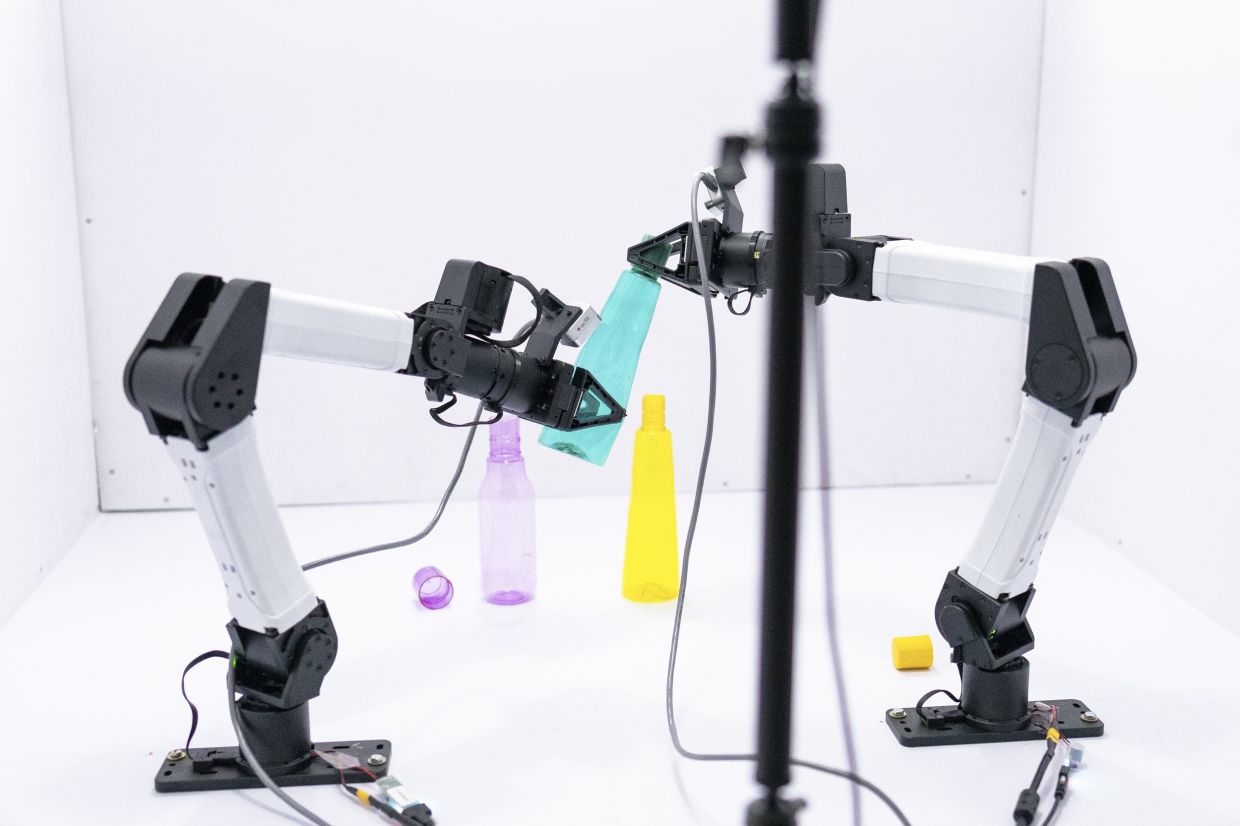
At Objectways' sprawling operations, the work unfolds in carefully designed test environments. Workers operate robotic arms equipped with cameras, performing household tasks while recording every movement for AI model training. In kitchens, bathrooms, and bedrooms constructed on-site, employees lift plates, unscrew bottles, and arrange food—seemingly mundane actions that generate the visual datasets feeding machine learning systems developing humanoid robots and autonomous vehicles. Founder and CEO Ravi Rajalingam established the company in his hometown in 2019, initially hiring 20 workers with his wife's assistance. He explicitly positions Objectways as moving beyond India's legacy as the world's back-office provider, though acknowledging that many roles do not require engineering degrees.
The scale of the operation reveals both its ambition and its constraints. Mohamed Afsar, 29, now oversees 600 employees across Objectways' Coimbatore facility, processing roughly 70 hours of video daily from robotic systems and autonomous vehicles. Yet this capacity falls short of demand—clients deliver approximately 1,000 hours of video each day, creating an enormous backlog. A 200-person team working full-time still cannot match the volume flowing in from multinational technology companies developing next-generation AI products. This imbalance underscores why Indian companies continue aggressive hiring, though it also highlights the structural limitations of relying on manual labor to fuel AI development.
Career progression offers a partial counterweight to concerns about job permanence. Afsar, who grew up in the region and became the first in his family to attend university, exemplifies how positions can lead upward mobility. Many Objectways employees transition from basic annotation roles into supervisory and analytical positions, developing genuine expertise in machine learning processes. This pathway helps justify the work to college-educated workers who might otherwise feel overqualified. Nevertheless, industry analysts project that data annotation will contribute only US$10 billion to India's economy by decade's end—meaningful but insufficient to address the scale of India's employment challenge or substantially accelerate the nation's position in global AI competition.
The psychological appeal of these roles for young workers cannot be overlooked. Hari Prasad, 25, an engineering graduate now training robots, expresses enthusiasm about contributing to technology that once seemed purely fictional. He recognizes that the fundamental work—teaching machines to perceive and manipulate the physical world—remains irreducibly human for now. This human element, the recognition of participating in cutting-edge technology development, attracts talent even when compensation remains modest by international standards. Yet this enthusiasm may mask an uncomfortable truth: annotators are essentially building the tools that will eventually eliminate their own jobs as AI systems become more autonomous and self-improving.
The Modi government's stated preference for nurturing Indian-founded AI companies with proprietary applications reflects anxiety about this cycle. Rather than India remaining a service provider executing work designed and directed by foreign corporations, policymakers hope homegrown businesses will capture greater value by developing AI applications addressing Indian problems. This strategic vision addresses deeper concerns about economic sovereignty and whether current employment gains represent genuine progress or merely a transitional phase. The distinction matters considerably for a nation of 1.4 billion people seeking not temporary relief from unemployment but sustainable pathways toward shared prosperity.
Objectways and its peers represent a genuine, if fragile, economic opportunity. Workers are acquiring technical knowledge about artificial intelligence systems while earning income in regions with limited alternative employment. The infrastructure of test kitchens and robotic facilities being constructed today may catalyze clusters of expertise that eventually support higher-value enterprise. However, the fundamental architecture of the data annotation business model—outsourcing labor-intensive tasks to low-cost regions—contains inherent vulnerability. As annotation itself becomes increasingly automated through machine learning, the current workforce faces displacement unless career development systems successfully transition workers into roles requiring deeper technical capabilities.
For Malaysia and broader Southeast Asia, India's experience offers instructive lessons about positioning in the AI economy. The region cannot compete on cost alone, nor can it assume that today's job-creation opportunities will persist. Malaysia's technology sector, like India's, must consider how to develop indigenous AI capabilities rather than serving primarily as a labor provider for foreign corporations. The data annotation boom may be temporary, but the strategic imperative to build genuine competitive advantage in artificial intelligence is permanent. How India and its regional neighbors navigate this transition over the next five to ten years will substantially determine whether they emerge as genuine participants in AI development or remain perpetually positioned at its lower-value periphery.

