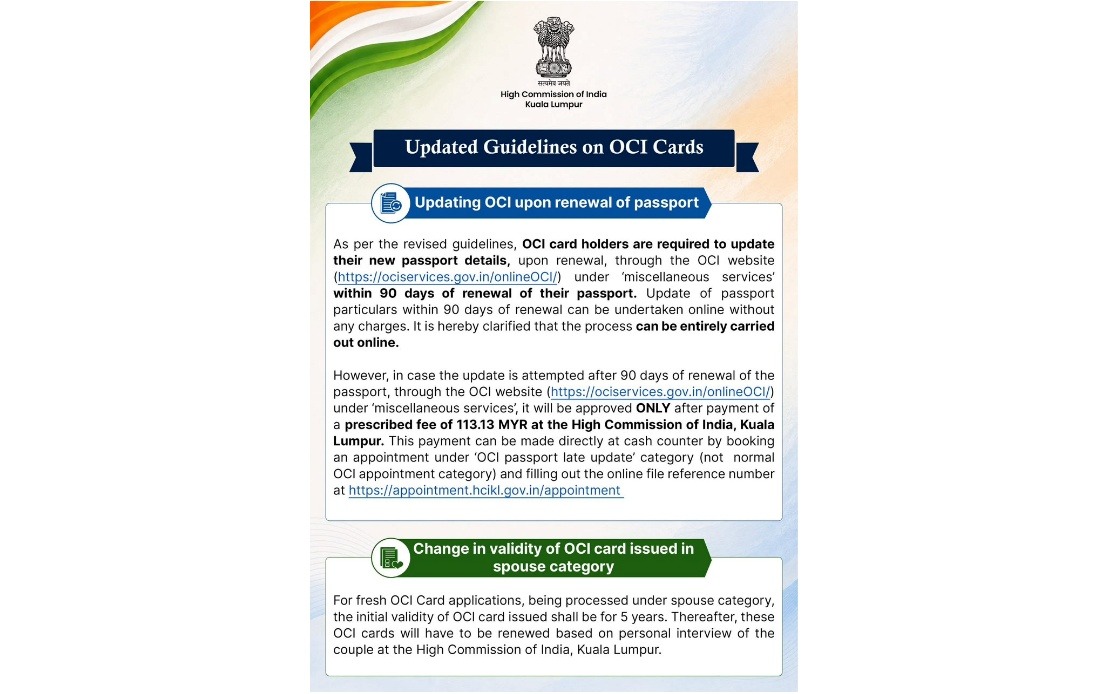
The Indian High Commission in Kuala Lumpur has rolled out revised guidelines governing Overseas Citizen of India (OCI) cardholders that introduce stricter compliance requirements and impose financial penalties for late submissions. The new framework, made public through the mission's official channels, represents a significant tightening of administrative procedures for one of the region's largest diaspora populations.
Under the updated regulations, OCI cardholders must register their new passport information with Indian authorities within a 90-day window following passport renewal. This online submission process, conducted through the dedicated OCI website under the miscellaneous services section, carries no processing fee during the grace period. The High Commission has emphasised that the entire procedure can be completed remotely, eliminating the need for in-person visits to the mission office for this particular administrative task.
The introduction of a penalty structure marks a departure from previous practice and signals India's intent to enforce timely compliance more rigorously. Those who miss the 90-day deadline face a mandatory fee of RM113.13 payable at the High Commission's cash counter in Kuala Lumpur. This financial disincentive is designed to encourage proactive record-keeping among the estimated hundreds of thousands of OCI cardholders across Malaysia who depend on maintaining current documentation for visa-free travel to India and other privileges.
For applicants seeking late updates beyond the grace period, the process requires advance appointment scheduling through a dedicated "OCI passport late update" category on the mission's booking system, distinct from routine OCI appointment slots. Individuals must provide their online file reference number when making these appointments, streamlining administrative verification. The High Commission has made both the OCI portal and its separate appointment website the central repositories for all procedural information, reducing confusion and enabling cardholders to access guidance independently.
Parallel to the passport update requirements, the High Commission has fundamentally restructured the validity framework for OCI cards granted under the spouse category. Previously, spouses of Indian citizens or OCI cardholders could secure longer initial validity periods; the new policy caps fresh applications in this category at five years from date of issue. This reduction reflects India's broader effort to maintain closer oversight of OCI status through more frequent renewal cycles, particularly for individuals whose Indian connections may differ from those holding OCI status independently.
The spouse category revision introduces an additional procedural requirement that meaningfully alters the renewal experience. Upon expiration of the initial five-year validity, couples seeking to renew their OCI cards must submit to a personal interview at the High Commission in Kuala Lumpur. Both spouses are expected to present themselves in person, a departure from the online-friendly approach now extended to passport detail updates. This interview requirement introduces a human verification element that India views as essential given the spousal category's reliance on relationship documentation and evolving family circumstances.
These changes carry practical implications for Malaysia's Indian diaspora and the growing population of foreign nationals married to Indian citizens. OCI status has served as a crucial bridge for individuals maintaining professional, business, or family ties across borders without surrendering their primary citizenship. The tighter administrative framework reflects India's modernisation of its diaspora management systems, though it simultaneously places greater record-keeping responsibilities on cardholders themselves. Malaysian residents who obtained OCI cards in previous years should review their current passport status immediately to ensure compliance with the 90-day rule, calculating deadlines from their most recent passport renewal date.
The spouse category modifications warrant particular attention given the significant population of Malaysian-Indian mixed couples and foreign spouses of Indian nationals working in Malaysia. The five-year initial validity and mandatory renewal interviews represent a more cautious approach to spousal OCI approvals, potentially reflecting scrutiny over documentation accuracy or relationship legitimacy in high-volume processing environments. Prospective applicants in this category should anticipate a more involved approval process and prepare comprehensive supporting documentation demonstrating the authenticity and continuity of their spousal relationships.
From a administrative standpoint, India's moves align with broader global trends among countries managing diaspora status programs. The combination of automated online systems for routine updates, penalty structures for non-compliance, and periodic in-person verification for sensitive categories represents a hybrid model balancing accessibility with security and accuracy. For Malaysia, home to one of South Asia's largest Indian diaspora communities outside India itself, these procedural changes will necessitate awareness campaigns and community education efforts to prevent widespread accidental non-compliance.
The High Commission's decision to publicise these changes through social media platforms rather than formal diplomatic notes reflects recognition that many OCI cardholders access official information through digital channels. However, this approach may leave gaps in awareness among older cardholders or those less digitally connected. Malaysian community organisations and diaspora networks will likely play crucial roles in disseminating accurate information and assisting members through the new procedures, particularly regarding appointment bookings and fee payments at the mission.
Looking forward, these revised guidelines suggest India may continue refining OCI procedures as its digital infrastructure capabilities improve. The relative ease of online passport detail updates positions the system favourably for future expansions into other routine administrative functions. Conversely, the retention of in-person requirements for spouse category renewals signals India's commitment to maintaining human oversight where relationship verification remains central. For Malaysian OCI cardholders and those considering the status, understanding these evolving requirements has become essential to maintaining uninterrupted access to the benefits and privileges the card provides.

