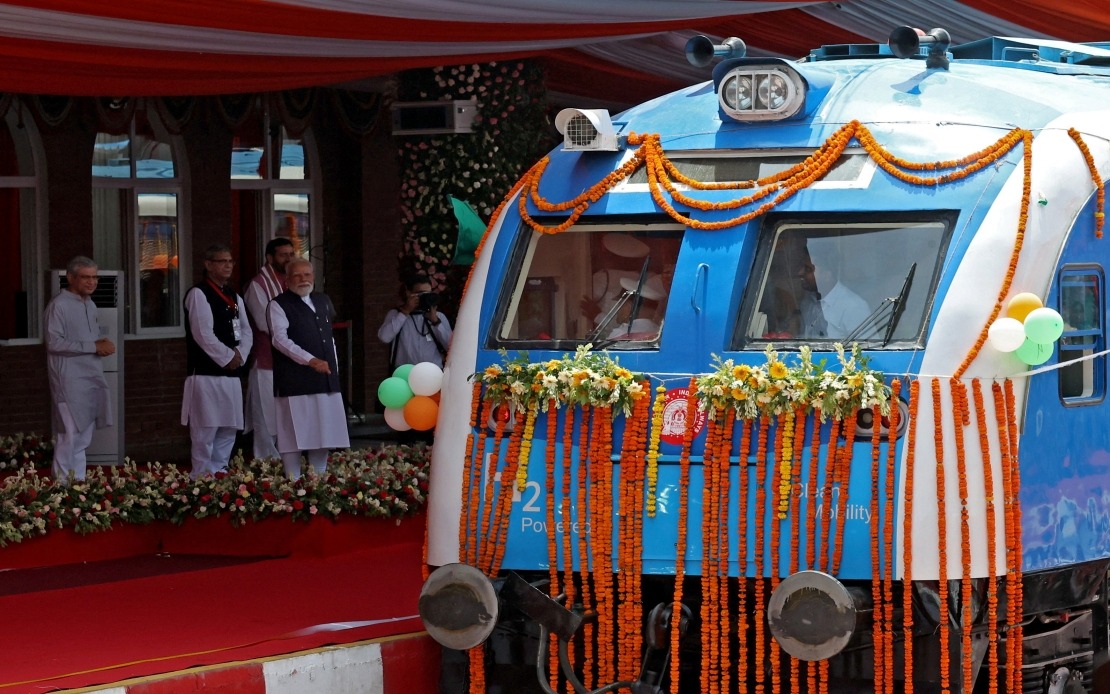
Prime Minister Narendra Modi on Friday inaugurated India's first hydrogen-powered train, a milestone that positions the country among a handful of nations pioneering clean rail technology. The 10-coach train will operate along the 89-kilometre Jind-Sonipat corridor in Haryana state, marking a significant departure from India's traditional diesel-dependent railway system that has long been a major source of transport emissions.
The introduction of this train represents a watershed moment for Indian railways, which rank among Asia's largest networks but have struggled with ageing infrastructure and environmental concerns. By deploying indigenously developed hydrogen fuel cell technology, India demonstrates domestic capability in advanced green engineering rather than relying solely on imported solutions. This locally-engineered accomplishment carries particular resonance within India's broader push for technological self-reliance and renewable energy adoption.
At the technical core of the system is a 1,200-kilowatt Proton Exchange Membrane Fuel Cell, which generates electricity through an elegant chemical reaction between stored hydrogen and atmospheric oxygen. The process produces no harmful emissions—only water vapour and residual heat escape from the propulsion system. This fundamental difference from diesel locomotives, which emit carbon dioxide and nitrogen oxides contributing to climate change and urban air pollution, underscores why hydrogen technology attracts growing international investment.
India now joins an exclusive club comprising China, Germany, Japan, and the United States in operating hydrogen-powered passenger trains. Each nation approaches the technology differently based on local hydrogen production capacity and infrastructure maturity. Germany's Coradia iLint trains have operated since 2018 on regional routes, while China has similarly invested in hydrogen rail projects. India's entry into this space, however, carries outsized significance given the nation's transportation demands and the scale of environmental challenges facing South Asian cities.
The Haryana train carries an approved maximum operating speed of 75 kilometres per hour, though its design capability reaches 110 km/h, suggesting room for future optimisation as operators accumulate operational experience. This conservative initial deployment reflects prudent engineering practice when introducing novel technologies to public transportation networks. Over time, as maintenance protocols solidify and driver familiarity increases, speeds and efficiency metrics may improve substantially.
The hydrogen fuel cell approach addresses several chronic problems afflicting Indian railways. Diesel consumption represents a massive operational cost burden, with fuel price volatility regularly pressuring state budgets. Hydrogen, if sourced from renewable electricity via electrolysis, offers long-term price stability and energy independence advantages. Furthermore, regional air quality would improve markedly if diesel locomotives operating in densely populated corridors were progressively replaced by zero-emission alternatives.
However, scaling this technology across India's extensive rail network faces formidable challenges. Hydrogen production, storage, and distribution infrastructure remains nascent in most Indian regions. Currently, most hydrogen derives from fossil fuel processing rather than renewable sources, meaning widespread adoption would require parallel investments in electrolysis capacity powered by solar or wind generation. The government must coordinate simultaneous development across energy, rail, and industrial sectors—a coordination challenge that extends beyond railways into the broader hydrogen economy.
For Malaysian and broader Southeast Asian observers, India's hydrogen train launch carries strategic implications. The region's rapid urbanisation and growing transport demands mirror India's challenges. If hydrogen rail technology proves economically viable and operationally reliable in Indian conditions—with monsoons, heat extremes, and diverse terrain—neighbouring countries might accelerate their own adoption timelines. Regional hydrogen supply chains could eventually emerge, creating new industrial opportunities and employment across Southeast Asia.
The project also reflects international pressure on major economies to meet climate commitments. India's railway sector contributes significantly to national carbon emissions, and decarbonisation targets require precisely this type of technological transformation. By demonstrating commitment through high-visibility initiatives like the Modi-inaugurated hydrogen train, India signals serious intent to international climate forums and domestic stakeholders alike.
Looking forward, success depends on rigorous operational monitoring over the coming months and years. Real-world performance data on fuel consumption, maintenance requirements, passenger reliability, and safety will determine whether hydrogen becomes a scalable solution or remains a niche demonstration project. The Jind-Sonipat corridor offers an ideal testbed—a manageable distance suitable for regional commuter traffic yet connecting significant industrial and agricultural hubs.
The hydrogen train initiative also highlights India's capacity for innovation in sustainable technology, a crucial advantage as global supply chains increasingly prioritise environmental credentials. Manufacturing hydrogen trains domestically could develop expertise exportable to other developing nations facing similar transport challenges. This positions Indian firms competitively within an emerging global market for clean rail solutions.
Ultimately, India's hydrogen train represents both practical progress and symbolic importance. While a single 10-coach train cannot transform India's entire rail sector, it proves technological feasibility, builds institutional knowledge, and demonstrates political commitment to decarbonisation. As the government pursues broader hydrogen economy development, railway electrification, and renewable energy expansion, this locomotive serves as a tangible reminder that cleaner transport futures are achievable—and India is determined to build them.

