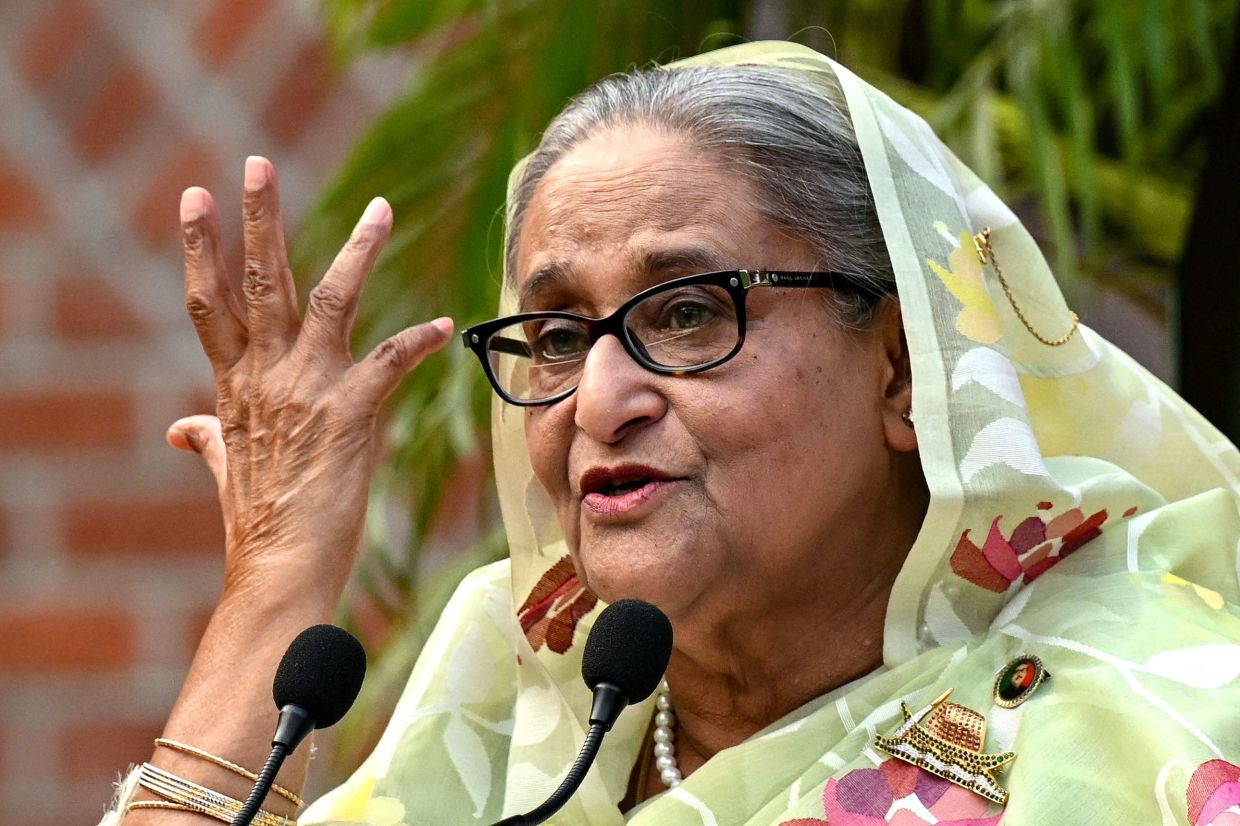
India's foreign ministry has moved swiftly to clarify that the Indian government bears no responsibility for a planned virtual address by exiled Bangladesh former Prime Minister Sheikh Hasina, seeking to defuse mounting diplomatic tensions between the two South Asian neighbours. The statement came after Bangladesh formally requested that New Delhi publicly disassociate itself from the event scheduled for August 5 at the Foreign Correspondents' Club of South Asia in New Delhi, where Hasina is expected to appear by video link alongside her son and other speakers to commemorate the second anniversary of the student-led uprising that toppled her administration in 2024.
Randhir Jaiswal, India's foreign ministry spokesperson, characterized the upcoming event as a purely private affair organized by a media organization, emphasizing during a regular media briefing that "the government has no involvement whatsoever in it, neither does it endorse any views that may be expressed at the forum." This distinction between the private and public sectors represents a careful diplomatic manoeuvre designed to maintain New Delhi's position of formal neutrality while the contentious speech proceeds without official government sanction or participation.
Bangladesh's government, under Prime Minister Tarique Rahman's administration which assumed office following February's elections, has taken an assertive stance on preventing Hasina's message from reaching domestic audiences. Information Adviser Zahed Ur Rahman issued a formal warning to Bangladesh's media establishments that broadcasting or publishing Hasina's statements would constitute a violation of a December 2024 order issued by the International Crimes Tribunal. This directive specifically prohibits media outlets and social media platforms from disseminating any speeches, statements, interviews, or audio or video content originating from the 78-year-old former premier, representing an unprecedented effort to suppress her voice within Bangladesh's information landscape.
The framing of such restrictions as enforceable legal obligations rather than merely advisory guidance signals Dhaka's determination to prevent Hasina from wielding political influence across national boundaries. The tribunal's order effectively creates a media blackout surrounding the exiled leader, preventing her from directly addressing public opinion or mobilizing supporters within Bangladesh through traditional or digital channels. For Malaysian observers, this reflects broader regional patterns of governments attempting to control political narratives and manage dissent through regulatory mechanisms, a phenomenon increasingly common across South Asia.
Sheikh Hasina has maintained residence in India since fleeing Bangladesh during the tumultuous 2024 protests. A death sentence handed down in 2025 on crimes against humanity charges related to her handling of the demonstrations has become a legal sword of Damocles, which Hasina has publicly dismissed as lacking legitimate force. Her continued presence on Indian soil has become an increasingly irritating issue for Bangladesh's foreign ministry, which views her activities there as a potential destabilizing element and has repeatedly raised concerns with New Delhi about political activities by fugitive figures and Awami League leaders operating from Indian territory.
According to remarks Hasina made to Reuters in recent weeks, she and her Awami League colleagues intend to return from exile around December and submit themselves to the Bangladeshi court system, a manoeuvre that would test precisely how the new Dhaka administration handles opposition to its authority and whether it can accommodate its most prominent political rival within a functional legal framework. Such a calculated return would represent either genuine reconciliation or a bold political gambit with potentially destabilizing consequences depending on how Bangladesh's government responds to her repatriation.
Hasina's support team has indicated that the August 5 event will proceed regardless of Dhaka's objections and media restrictions. Abu Obaidha Arin, one of her aides, declared that "Dhaka's efforts to silence dissent cannot extinguish voices" beyond Bangladesh's borders, suggesting that the exiled leadership views the virtual address as a principled stand against attempts at political suppression. This framing positions Hasina as a voice of dissent confronting authoritarianism, though such characterization depends heavily on one's assessment of her original tenure and the legitimacy of the charges against her.
The underlying tension reflects the complicated trajectory of India-Bangladesh relations since Hasina's departure from power. While diplomatic ties have become visibly strained during the past eighteen months, both governments have recently signalled renewed interest in improving bilateral cooperation and moving beyond the acrimony that characterized the immediate aftermath of her exit. Bangladesh State Minister for Foreign Affairs Shama Obaed Islam underscored that Dhaka has repeatedly conveyed its displeasure to New Delhi regarding political activities conducted by exiled Bangladeshi leaders from Indian territory, framing such actions as potentially injurious to the bilateral relationship just as both countries seek a fresh start.
India's careful disavowal of responsibility for the Hasina event can be interpreted as New Delhi attempting to balance its traditional protective stance toward political refugees with its growing desire to strengthen ties with Bangladesh under its new government. By insisting the event is purely private while simultaneously allowing it to proceed on Indian soil, India preserves technical neutrality whilst acknowledging Bangladeshi sensitivities. For Malaysia and other regional nations, this diplomatic choreography demonstrates the delicate equilibrium required when managing relations with neighbouring governments dealing with internal political upheaval and outstanding grievances from previous administrations.
The extradition issue remains unresolved, with Bangladesh continuing to pursue formal requests for Hasina's return to face justice under her new government's legal system. India has not explicitly granted her asylum status, maintaining an ambiguous position that provides practical refuge while avoiding formal commitments. This liminal status—neither officially protected nor actively extradited—reflects the genuine complications that arise when major neighbours harbour fugitive political figures with contentious legacies.
The August 5 speech therefore transcends the immediate context of a virtual address by an exile. It represents a test of whether international borders can effectively contain political messaging in the digital age, how regional powers navigate competing obligations to neighbours and individuals, and whether Bangladesh's new administration can tolerate dissenting voices operating from abroad. The outcome will likely influence how both nations calibrate their relationship going forward and whether improved bilateral cooperation can accommodate the lingering complications stemming from Hasina's sudden transition from prime minister to international exile.

