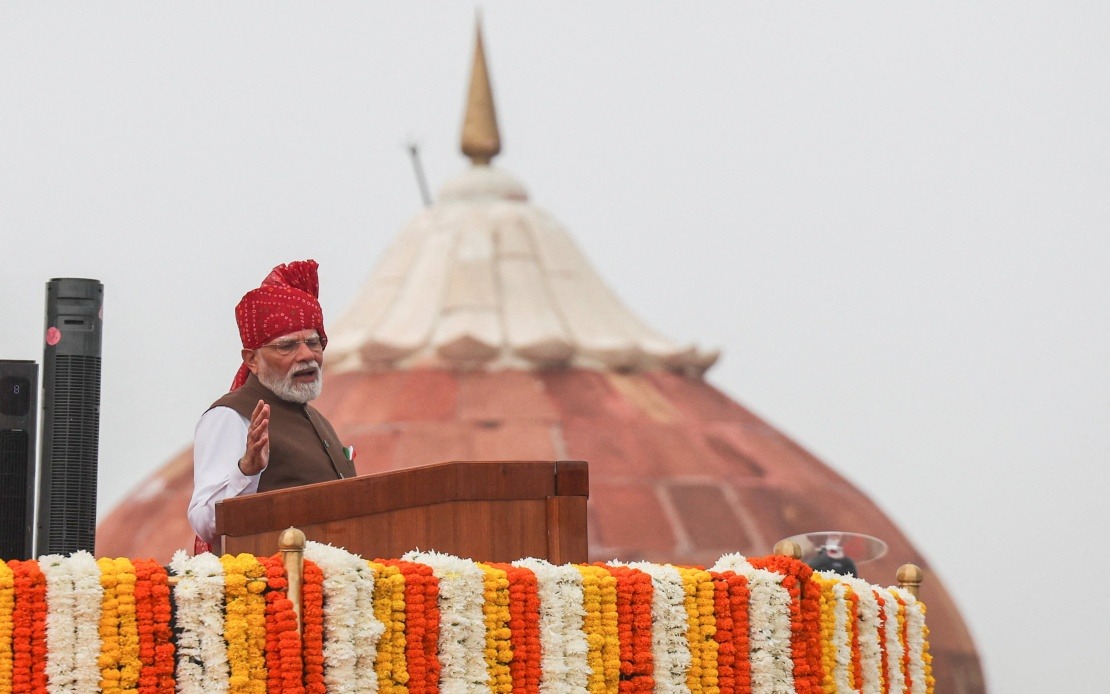
Indian Prime Minister Narendra Modi delivered an Independence Day address from Delhi's Red Fort on Saturday laying out an expansive blueprint for national self-sufficiency across critical economic and security sectors. The speech represents a consolidation of India's longstanding push toward reducing dependence on foreign imports and technologies, positioning domestic capability-building as central to the nation's ambition to reach developed-country status within the next two and a half decades. For Southeast Asian nations watching India's trajectory, the emphasis on indigenous production capacity signals both competitive pressures and potential partnership opportunities in regional supply chains.
The semiconductor industry featured prominently in Modi's remarks, reflecting its strategic importance to modern economies. Three fabrication plants have already begun operations within India's borders, he noted, with expectations that between five and eight additional facilities will commence manufacturing within seven to eight years. This expansion, if realised, would represent a significant shift in global chip production geography and reduce India's vulnerability to disruptions in Taiwan and other overseas sources. The scale of this ambition underscores India's determination to capture a meaningful share of semiconductor fabrication even as the industry consolidates around fewer manufacturing hubs worldwide. For Malaysian technology hubs and semiconductor suppliers, India's domestic expansion could reshape regional competition and create new opportunities for specialised inputs and services rather than finished chips.
Energy security commands equal strategic weight in Modi's self-reliance framework. India has set a target of reaching 100 gigawatts of nuclear power capacity by 2047, requiring five new reactors to be commissioned within this decade alone. More significantly, Modi highlighted India's recent mastery of fast-breeder nuclear technology, which enables the nation to extract substantially more energy from uranium and reduces long-term fuel import dependence. This technological breakthrough, he emphasised, represents a watershed moment in India's march toward fuel independence. The achievement carries implications beyond India's borders; successful fast-breeder deployment could provide a template for other developing nations seeking to maximise domestic nuclear resources while managing spent fuel challenges that concern the international community.
Renewable energy constitutes the third pillar of India's energy transformation strategy. Solar capacity has surged from 2 gigawatts to 160 gigawatts over the past dozen years, demonstrating the velocity of India's clean energy transition. Alongside renewables, Modi announced that India is aggressively pursuing new offshore oil and gas reserves, with 850 billion rupees—approximately USD 8.9 billion—earmarked for exploration in previously inaccessible areas. This dual-track energy approach reflects India's pragmatic assessment that the transition to renewables, while accelerating, will require conventional energy sources for decades to come. The injection of capital into offshore exploration signals confidence that India can develop these reserves itself rather than relying on costly imports or politically complicated partnerships.
Defence manufacturing emerged as another critical domain where Modi insisted India must develop indigenous capabilities rather than perpetuate reliance on foreign arms suppliers. He specifically highlighted drones, counter-drone systems, and hypersonic defence technologies as areas demanding domestic innovation and production. India's historical dependence on Russian, American, and European military equipment has constrained strategic autonomy and consumed foreign exchange; building indigenous defence industrial capacity directly addresses both concerns. The emphasis on emerging technologies like hypersonic systems suggests India's defence strategists view the next generation of military competition as distinct from Cold War-era paradigms, requiring homegrown solutions tailored to India's specific security environment.
Beyond sectoral specifics, Modi articulated a broader philosophy of consumption and national building, urging Indians to prioritise domestically manufactured goods over cheaper or faster international alternatives. His framing acknowledged the economic logic of global supply chains while arguing that such logic obscures deeper strategic imperatives. Purchasing foreign goods, in his view, forgoes the opportunity to test and strengthen domestic industrial capacity, leaving nations vulnerable when geopolitical circumstances shift. This exhortation to buy Indian resonates with nationalist sentiment but also reflects a genuine economic argument: manufacturing capability serves as both employer and strategic hedge. For Malaysia and other developing economies, India's invocation of local procurement as a nation-building tool illustrates the tension between efficiency-driven globalisation and resilience-driven self-sufficiency.
The 2047 timeframe Modi selected carries symbolic weight, marking exactly three centuries after India's independence in 1947. Framing ambitious infrastructure and technological goals within this centennial offers a unifying narrative that bridges immediate policy implementation with generational aspiration. Meeting targets like 100 gigawatts of nuclear power or commissioning multiple semiconductor fabs within two decades requires sustained political will, substantial capital allocation, and technological problem-solving at scale. Whether India can sustain this commitment across electoral cycles and economic fluctuations remains an open question; however, the consistency with which Modi's government has articulated these priorities suggests more than rhetorical posturing.
India's self-reliance drive carries implications for regional integration and trade dynamics across South and Southeast Asia. Successful semiconductor manufacturing, for instance, would create alternative sourcing options for Indian electronics assemblers and potentially for regional companies seeking to diversify supply chains away from Taiwan and China. Similarly, India's renewable energy expansion could influence technology transfer and equipment sourcing across the subcontinent. Conversely, India's inward-focused manufacturing push and emphasis on domestic procurement may create barriers for Malaysian and other foreign firms seeking market access. The strategy reflects a calculated trade-off: accepting higher short-term costs for domestically produced goods to gain long-term strategic autonomy and industrial capability.
India's articulation of self-reliance must also be contextualised within global technological competition. China's rise as a manufacturing powerhouse occurred partly through similar inward investment and preferential domestic procurement policies. The United States has more recently embraced comparable approaches through the CHIPS Act and infrastructure legislation designed to reshore critical production. India's strategy thus represents not innovation in approach but rather participation in a broader global trend where advanced economies prioritise industrial autonomy over pure efficiency. The degree to which India can execute this strategy more effectively than previous developing nations attempting similar transitions will partly determine whether 2047 aspirations become reality.
The speech's emphasis on energy diversification and security reflects India's geographical exposure and demographic scale. With over 1.4 billion people, India faces energy demands that neither foreign suppliers nor current domestic capacity can sustainably meet. Building nuclear, renewable, and fossil fuel capacity simultaneously represents a pragmatic hedge rather than ideological commitment to any single energy source. This calculus differs markedly from smaller, wealthier nations that can afford to phase out conventional energy more rapidly. For Malaysian policymakers evaluating energy transitions, India's multi-pathway approach offers lessons in managing large-scale energy systems with diverse resource bases and development priorities.
Modi's Independence Day address ultimately represents a clarification and acceleration of long-standing Indian policy preferences rather than a fundamental strategic pivot. Successive Indian governments have invested in defence manufacturing, nuclear power, and renewable energy. What distinguishes Modi's articulation is the explicit linkage to a 2047 timeline and the accompanying emphasis on accelerating development across multiple domains simultaneously. Whether this acceleration succeeds will depend on whether India can attract sufficient capital, develop adequate technical expertise, navigate bureaucratic constraints, and maintain political consensus across changing governments. The ambitious targets outlined suggest India's leadership believes the window for establishing indigenous capability in semiconductors, defence technologies, and advanced energy systems is narrowing, and that the costs of delay exceed the near-term expenses of accelerated domestic development.

