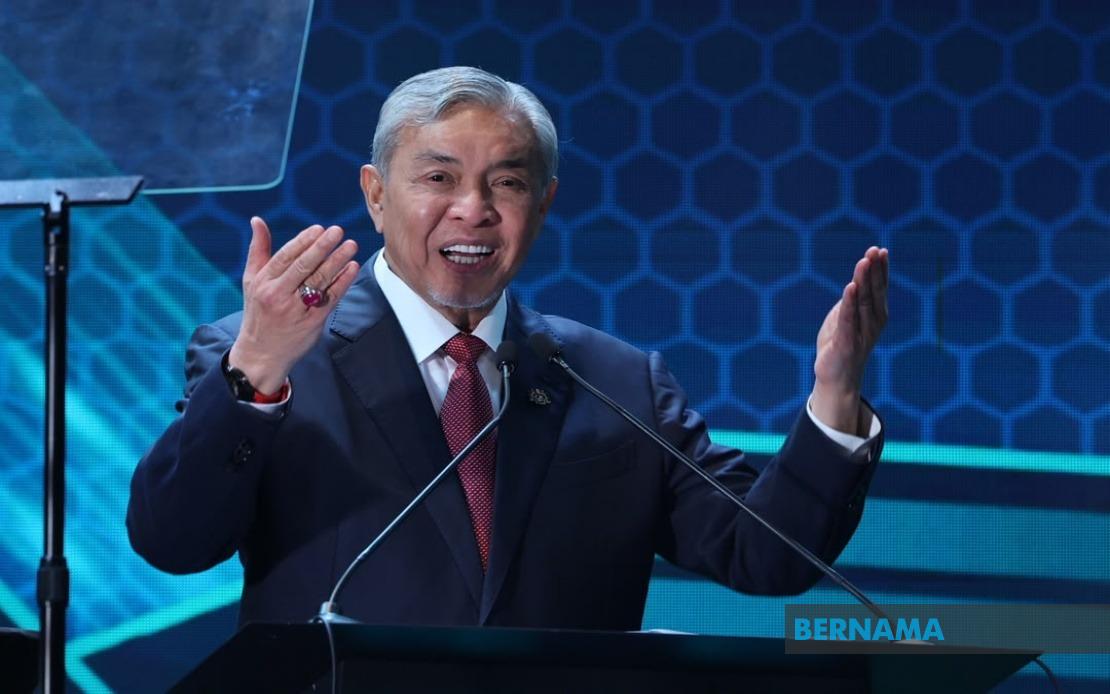
Malaysia's Immigration Department stands at a critical juncture, tasked with evolving far beyond its conventional gatekeeping function to become a catalyst for national economic expansion while simultaneously fortifying the country's security infrastructure. This ambitious reimagining was articulated by Deputy Prime Minister Datuk Seri Dr Ahmad Zahid Hamidi at the 2026 Immigration Day celebration held in Cyberjaya, where he unveiled a comprehensive four-point strategic mandate designed to fundamentally reshape how the department operates and contributes to Malaysia's future prosperity.
The traditional conception of immigration control centres on regulation and restriction—determining who enters and exits national territory. Ahmad Zahid's vision challenges this paradigm entirely. He contends that the department must recognise a fundamental economic truth: every bureaucratic impediment, each unnecessarily protracted procedure, and every layer of red tape diminishes Malaysia's attractiveness as an investment destination. In an increasingly competitive global landscape where capital and talent flow readily across borders, countries that streamline their immigration processes gain significant competitive advantage. He pointed to the United Arab Emirates as a instructive example, noting how that nation integrated immigration policy with broader economic strategy through mechanisms such as its Golden Visa programme, enabling residency periods extending to a decade. This deliberate alignment between immigration liberalisation and investment attraction has yielded tangible results, with the UAE recording foreign direct investment of RM196.6 billion in 2025 and securing the ninth position globally as an investment destination for the fourth consecutive year running.
Malaysia must similarly recognise that visa processing delays, excessive documentation requirements, and cumbersome business visitor procedures directly impact the country's economic competitiveness. When multinational corporations evaluate regional headquarters locations or when international talent assesses job opportunities, immigration efficiency becomes a decisive factor. The department's transformation toward facilitating rather than merely controlling economic flows represents essential alignment between immigration policy and Malaysia's aspirations for higher-value investment and knowledge-economy development.
The second pillar of Ahmad Zahid's mandate addresses national security with equal urgency, yet demands a fundamental operational shift. He articulated that immigration enforcement cannot remain reactive—responding only to crises or violations as they emerge. Instead, the department must embrace intelligence-led, data-driven approaches that anticipate threats before they materialise. This shift grows increasingly imperative as transnational security challenges have fundamentally transformed. Migrant smuggling operations now operate with sophisticated, organised networks rivalling professional enterprises. Human trafficking has grown exponentially more complex, leveraging technology and international coordination. These threats traverse borders with indifference to conventional sovereignty concepts, meaning traditional boundary-focused enforcement proves inadequate against challenges that originate and operate across multiple jurisdictions simultaneously.
Addressing this security paradigm requires unprecedented technological integration and inter-agency coordination. Ahmad Zahid emphasised the necessity for sophisticated systems incorporating big data analytics, artificial intelligence, predictive analytics, biometric identification, and smart border infrastructure. These technological foundations enable immigration authorities to process information faster, identify suspicious patterns with greater accuracy, and make security decisions with enhanced precision. Rather than viewing technology merely as a tool for accelerating existing processes, the department must leverage it to fundamentally enhance decision-making quality and security outcomes. Such systems can flag high-risk individuals before they reach border checkpoints, identify trafficking networks through pattern analysis across millions of data points, and coordinate real-time intelligence sharing with regional and international partners.
The third component addresses digital transformation and service innovation as standalone imperatives. Beyond the security and economic applications outlined above, the immigration system itself requires modernisation to meet contemporary citizen and business expectations. Digital identity systems, online visa applications, automated processing where appropriate, and mobile service delivery all fall within this modernisation mandate. The proliferation of digital platforms globally means that Malaysia's immigration system appears antiquated and inefficient if it forces applicants to visit physical offices, complete paper forms, and navigate fragmented databases. Young professionals and international businesses increasingly expect seamless digital experiences, making service modernisation not merely convenient but essential for competitiveness.
The fourth pillar emphasises integrity, professionalism, and humanitarian values—elements that might appear tangential to economic or security mandates yet prove foundational. Immigration officials wield considerable discretionary power affecting individuals' life circumstances, business operations, and family unity. When corruption infiltrates the system, when professionalism erodes, or when humanitarian considerations vanish, public trust deteriorates rapidly. Beyond public confidence, professional standards directly impact security effectiveness; corrupt officials become vulnerabilities through which smugglers, traffickers, and security threats penetrate borders. Ahmad Zahid explicitly urged all personnel to comply rigorously with procedures, exercise sound judgment in decision-making, and demonstrate courage in upholding what is right—language suggesting awareness that transformation faces internal resistance and temptation toward shortcuts.
What distinguishes Ahmad Zahid's articulation from typical bureaucratic rhetoric is his insistence that transformation cannot occur through fragmented initiatives or isolated improvements. He stressed that meaningful institutional change requires clear direction, shared philosophical commitment, and systematic implementation across every policy, system, and organisational action. This emphasis recognises that departments often undertake modernisation projects—acquiring new technology, training personnel, revising procedures—yet fail to achieve fundamental transformation because these initiatives remain disconnected from overarching strategic vision. Without unified direction, departments revert to traditional approaches, new systems operate within outdated frameworks, and trained personnel find themselves constrained by unchanged institutional culture.
For Malaysia, this transformation carries particular significance given the country's position as a regional economic hub and migration destination. Southeast Asia experiences substantial labour migration, tourism flows, and international business activity, with Malaysia hosting significant immigrant populations and serving as a transit point for regional migration. An immigration department that simultaneously facilitates legitimate economic and people flows while effectively deterring smuggling, trafficking, and security threats could substantially enhance Malaysia's competitive position. Conversely, an immigration system perceived as corrupt, inefficient, or unprofessionally administered becomes a liability undermining broader economic and security objectives.
The strategic mandate also reflects emerging international best practices in immigration administration. Forward-thinking nations increasingly recognise that immigration policy constitutes economic policy, security policy, and social policy simultaneously, requiring integrated rather than compartmentalised approaches. Countries competing for global talent and investment have streamlined business immigration while simultaneously strengthening security through technology and inter-agency cooperation. This dual approach—which might appear contradictory at first glance—actually proves mutually reinforcing; technology enabling faster legitimate processing simultaneously improves security screening.
Implementation challenges will undoubtedly emerge. Technological systems require substantial investment, skilled personnel, and ongoing maintenance. Inter-agency coordination demands clear authorities, information-sharing protocols, and aligned incentives across institutions with different operational cultures. Service transformation necessitates training, process redesign, and often organisational restructuring. Staff accustomed to traditional enforcement-focused work may resist transformation toward facilitation roles. These implementation obstacles explain why Ahmad Zahid framed his mandate as a long-term journey requiring sustained commitment rather than a collection of discrete projects.
The presence of senior government officials at the event—including Chief Secretary to the Government Tan Sri Shamsul Azri Abu Bakar and Public Service Department director-general Tan Sri Wan Ahmad Dahlan Abdul Aziz—signals whole-of-government commitment to this transformation. Such high-level participation typically indicates that resource allocation, inter-agency coordination, and policy alignment have received executive approval, increasing the probability of sustained implementation.
Ultimately, Ahmad Zahid's vision positions the Immigration Department not as a constraint on national development but as an enabler—a strategic institution that balances openness with security, facilitates economic opportunity while protecting sovereignty, and embraces modernisation while maintaining institutional integrity. Whether this transformation materialises as intended will significantly influence Malaysia's capacity to attract global investment, secure its borders against evolving threats, and project an image of professional, trustworthy governance. The stakes, in other words, extend well beyond immigration administration into fundamental questions about Malaysia's global competitiveness and security posture.

