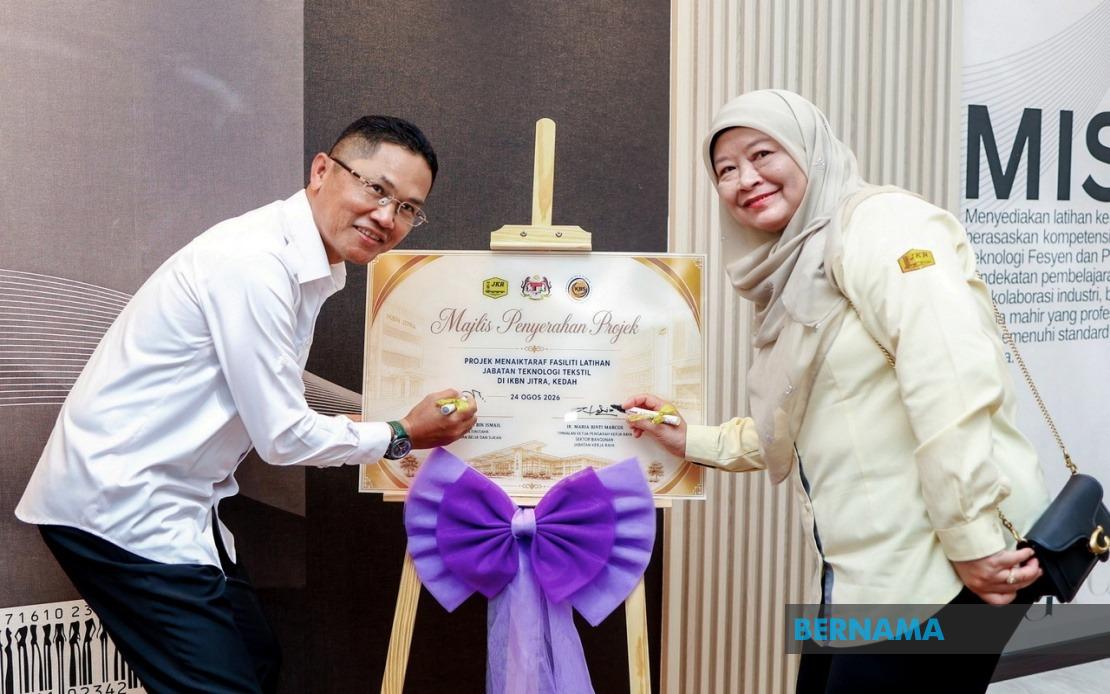
The government has formally handed over a RM3.7 million upgrading project for the Fashion and Clothing Technology Department at the National Youth Skills Institute (IKBN) in Jitra, marking a tangible step in its strategy to modernise technical and vocational education infrastructure across the country. The initiative, unveiled during a handover ceremony in the Kedah town, underscores the administration's broader commitment to ensuring that TVET institutions remain competitive and aligned with evolving industry standards.
According to Youth and Sports Ministry secretary-general Datuk Rahimi Ismail, the investment encompasses structural improvements to the facility, installation of contemporary information and communications technology equipment, and procurement of new furniture designed to create a safer and more conducive learning environment. The project was initiated under Rolling Plan 4 of the 12th Malaysia Plan, reflecting its integration into the government's long-term economic and skills development framework. The structural work itself, contracted to the Public Works Department at RM1.577 million, commenced in mid-June 2025 and formed the backbone of the broader modernisation effort.
The upgrade delivers tangible improvements that extend beyond mere infrastructure enhancement. The newly completed facilities include a Level Three fashion workshop equipped for hands-on training and a smart classroom incorporating digital learning technologies. These additions are intended to bridge the growing gap between classroom instruction and real-world industry practice, a persistent challenge in vocational education systems across Southeast Asia. By simulating authentic working conditions, students gain practical exposure that theoretical knowledge alone cannot provide.
Rahimi emphasised that quality training infrastructure is fundamental to maintaining the relevance of TVET programmes in an increasingly technology-driven landscape. The fashion industry, in particular, has undergone rapid transformation driven by technological innovation, creative demands, and shifting consumer preferences. Institutions like IKBN Jitra must therefore invest continuously in updating their capabilities to prepare graduates for workplace realities. Without such investment, the risk emerges that vocational graduates may find their skills misaligned with employer expectations, potentially limiting their employment prospects.
The minister's remarks suggest ambitions extending beyond domestic recognition. He expressed hope that work produced by IKBN Jitra students would not only gain acknowledgement within Malaysia but also achieve international competitive standing and penetrate global fashion markets. This reflects a strategic reorientation in how Malaysian TVET is being positioned—not merely as a pathway to local employment, but as a source of quality talent and products capable of succeeding on international platforms. Such aspirations, however, require sustained investment and institutional commitment beyond single projects.
For Malaysia's broader skills development agenda, the IKBN Jitra project carries several implications. The country has long recognised that technical and vocational education represents a critical pillar for economic competitiveness and social mobility, yet funding and infrastructure development have historically lagged behind conventional higher education. By allocating substantial resources to a single institution's upgrade, the government signals willingness to redress this imbalance, at least selectively. The challenge lies in ensuring such investments are replicated across other TVET institutions to create systemic improvement rather than isolated pockets of excellence.
The timing of the upgrade also reflects Malaysia's positioning within global supply chains. As regional competitors advance their manufacturing and creative industries, nations must demonstrate to investors and talent that they possess world-class training infrastructure. A modernised fashion technology programme at IKBN Jitra contributes to this narrative, particularly given Jitra's location in Kedah, a state with growing economic ambitions. The visibility of such projects within a state context can help attract both student interest and potential industry partnerships.
From a Malaysian perspective, the project embodies practical implementation of policies emphasising upskilling and reskilling. As automation and digitalisation reshape labour markets, continuous adaptation of vocational curricula and facilities becomes essential. The integration of ICT equipment and smart classroom technology at IKBN Jitra acknowledges that even traditionally hands-on trades increasingly demand digital literacy and exposure to technology-enabled processes. Graduates who lack such exposure may struggle to adapt as industries evolve further.
The fashion and clothing sector itself remains strategically important for Malaysia's economy, contributing substantially to manufacturing employment and exports. Yet the sector faces competitive pressures from regional peers offering lower labour costs. By investing in high-quality TVET provision, Malaysia attempts to compete on skill and innovation rather than price alone—a sustainable long-term positioning. Students graduating from upgraded facilities like those at IKBN Jitra may be better positioned to support value-added production, design innovation, and boutique manufacturing rather than simple assembly work.
Practical considerations also matter for student recruitment and retention. Modern, well-equipped facilities improve the attractiveness of TVET pathways to school-leavers who might otherwise pursue conventional academic routes. Many families in Malaysia still view vocational education as a secondary option, yet exposure to high-quality, contemporary training environments can shift perceptions. When prospective students observe state-of-the-art workshops and smart classrooms, they recognise that vocational training is not a consolation prize but a legitimate, professionally-oriented education choice.
The handover represents completion of one phase, yet ongoing success depends on implementation factors often overlooked in project announcements. Maintenance of new equipment, continuous updating of curriculum to reflect industry evolution, recruitment and training of instructors capable of utilising new facilities effectively, and establishment of industry partnerships remain critical. The initial capital investment must be complemented by sustained operational funding and institutional attention.
Looking forward, the IKBN Jitra upgrade should be evaluated not as an isolated achievement but as a model for broader institutional strengthening. If successful, it may justify expanded government funding for similar projects across Malaysia's TVET network. Conversely, if the facility fails to deliver measurable improvements in graduate outcomes, employment rates, or industry satisfaction, it will raise questions about investment efficacy. For Malaysian policymakers and educators, the next phase involves ensuring that infrastructure investments translate into genuine improvements in training quality and student prospects—the ultimate measure of success for any vocational education initiative.

