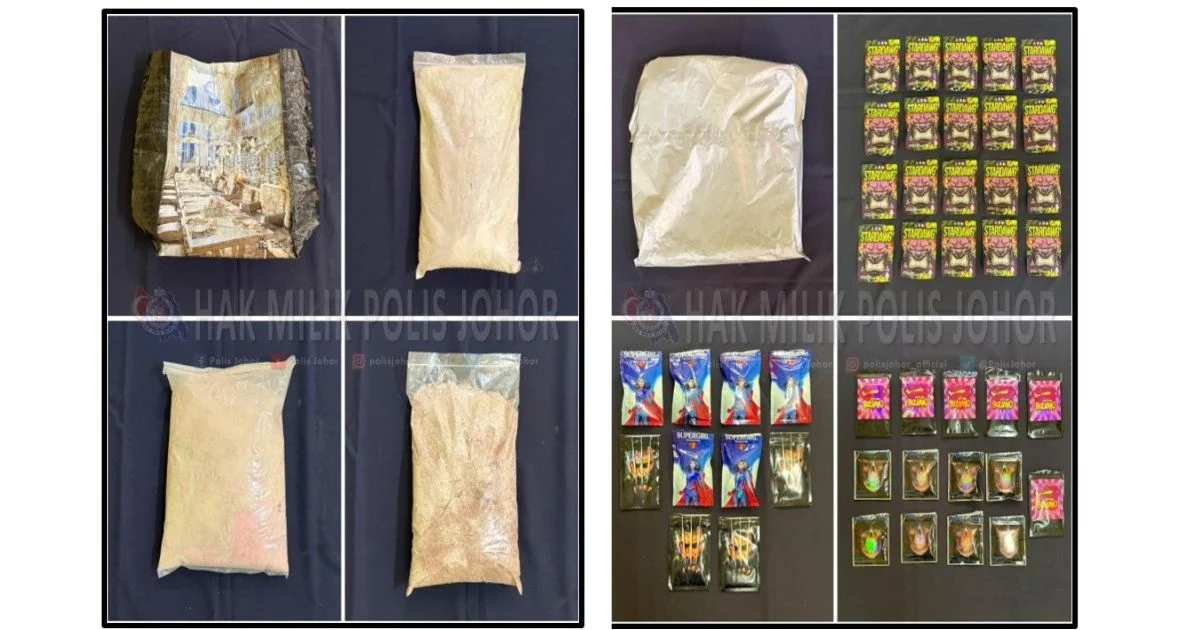
Authorities in Johor Baru have moved decisively against an illicit narcotics operation, resulting in the arrests of a husband and wife team and the recovery of drugs with an estimated street value of RM3.59 million. The operation, concluded in the Kulai district, represents one of the more substantial seizures reported in the state in recent times and underscores the ongoing challenge drug trafficking poses across Malaysia's southern border region.
The dismantling of this syndicate follows intensive investigative work by Johor police, who identified the couple as key figures in the distribution chain. The seizure of controlled substances at this scale suggests the operation may have served wider trafficking networks beyond the immediate locality, though authorities typically release limited details during active investigations. The size of the haul points to the couple's involvement in more than basic street-level dealing, indicating coordination with larger supply networks.
Kulai, located in the Johor district and serving as a gateway between Kuala Lumpur and Singapore, has historically been a focal point for law enforcement attention regarding drug trafficking. Its strategic geography makes it an attractive location for criminal enterprises seeking to move contraband between major urban centres and across national borders. The area's mix of industrial zones and residential communities provides covers for illicit operations, and police have long prioritized intelligence gathering in such locations.
This arrest aligns with a broader pattern of enforcement against organised drug operations across Malaysia. The decision to publicize the case reflects authorities' intent to demonstrate momentum in drug enforcement and deter potential offenders. Married couples or family units operating trafficking enterprises are not uncommon in regional drug networks, often leveraging family trust and household legitimacy as camouflage for their activities.
The recovered narcotics will undergo laboratory analysis to establish their precise composition and purity levels, which directly influence the valuation placed upon them. In Malaysia's legal framework, drug trafficking carries severe penalties, including lengthy imprisonment and, for certain quantities of specified drugs, mandatory death sentences. The RM3.59 million valuation suggests the couple potentially faced charges carrying substantial custodial terms regardless of execution provisions.
For residents in Johor, particularly in communities surrounding Kulai, such enforcement actions provide reassurance of police vigilance. However, they also illustrate the persistent supply issues plaguing the state, where demand from neighbouring Singapore and local consumption drive trafficking networks. The port facilities at Johor Baru and the road infrastructure connecting to Peninsular Malaysia create multiple pathways for drug importation and distribution.
The bust reflects resource allocation decisions within Johor police operations. Dismantling a syndicate of this apparent scale requires coordination between narcotics units, intelligence divisions, and ground teams—a commitment of personnel and investigative hours that underscores police prioritization of significant trafficking enterprises over street-level offences. Such operations typically culminate weeks or months of surveillance and evidence gathering.
From a Southeast Asian perspective, Malaysia's role as a transit hub for drugs destined for Australia, Singapore, and beyond makes each large seizure strategically significant. Organised criminal networks operating across the region continuously adapt their methodologies and personnel in response to enforcement. The arrest of this couple may disrupt one segment of a larger distribution architecture, though supply chains often feature built-in redundancy and replacement mechanisms.
The case also highlights the personal dimensions of drug crime. While trafficking carries significant penalties and devastating societal consequences, individuals entering such operations often do so under complex circumstances—financial desperation, family pressure, or prior entanglement in criminal networks. Whether the couple held leadership roles or served as distribution operatives remains unrevealed pending formal charges and court proceedings.
Looking forward, authorities will likely continue prioritising syndicate dismantling over isolated arrests, recognising that targeting organised networks produces greater disruption than addressing individual dealers. Intelligence sharing between federal and state agencies, together with international cooperation frameworks, strengthens such enforcement capacity. The timing and scale of this operation suggest coordinated planning rather than opportunistic intervention.
For Malaysian readers, the RM3.59 million seizure contextualises the resource flows within illegal drug markets. That sum, redirected away from criminal enterprises, represents diminished purchasing power for further acquisitions and distribution expansion. Simultaneously, it demonstrates that despite police efforts, narcotics continue flowing through Malaysian territory, suggesting ongoing challenges for public health officials and law enforcement planners addressing supply reduction and demand management strategies.

