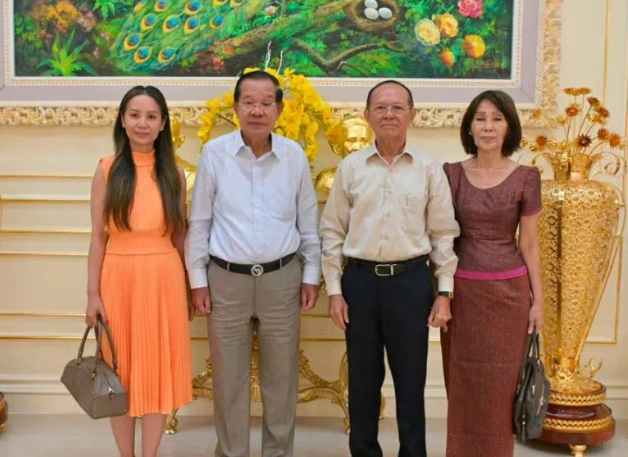
Cambodia's political landscape is undergoing a subtle but potentially significant realignment, as Senate president Hun Sen has begun openly hosting former opposition leader Kem Sokha for extended private meetings at his residence. During a three-hour Sunday morning visit in mid-August, Hun Sen publicly highlighted his discussions with Sokha and notably singled out Sokha's daughter Kem Monovithya for specific praise, describing her as an "excellent human resource for the nation" in comments posted to social media. The encounter marks the second private meeting between the two former political antagonists in recent weeks, reflecting what observers see as a thawing of relations between Cambodia's ruling Cambodian People's Party and a figure once positioned as its primary electoral challenger.
The significance of these meetings cannot be separated from Sokha's extraordinary legal and political journey over the past several years. In 2023, Sokha received a 27-year prison sentence on treason charges stemming from alleged conspiracy with a foreign power—a conviction that the Phnom Penh Appeal Court upheld in April 2026, maintaining both the sentence and imposing a five-year international travel restriction. However, a royal pardon issued on May 25 terminated his remaining prison sentence and house arrest, though political activity restrictions initially remained in place. Subsequently, a July 24 royal decree eliminated his overseas travel ban, effectively reversing much of the isolation that had constrained him since his 2017 arrest.
Sokha's gradual re-emergence into public life has accelerated in recent weeks, with the former co-founder and president of the dissolved Cambodia National Rescue Party making notable appearances in his capacity as a private citizen. On July 28, just weeks before meeting Hun Sen, Sokha travelled to Banteay Meanchey province to meet internally displaced families affected by Cambodia-Thailand border tensions. During that visit, he deliberately positioned himself as an individual acting independently rather than representing any political organization or state apparatus, though he indicated he had discussed displacement issues with international contacts. These carefully calibrated appearances suggest a strategically managed re-entry into public consciousness rather than a spontaneous emergence.
The CNRP, which Sokha co-founded and led, had represented Cambodia's most serious electoral challenge to Hun Sen's dominance in decades. The party achieved substantial gains during the 2013 national election and the 2017 commune elections, establishing itself as the country's primary opposition force. However, the Supreme Court dissolved the CNRP in November 2017, merely two months after Sokha's arrest, effectively eliminating the institutional vehicle for organized opposition to the ruling party. This dissolution occurred after the CNRP had already begun mobilizing substantial grassroots support, suggesting the degree of threat the party's growth posed to Cambodia's political establishment.
Hun Sen's recent public comments about Monovithya carry particular weight given her prominent historical association with the CNRP and her family's role in opposition politics. By describing her as possessing valuable human capital for national development, Hun Sen appears to be signalling a shift in how Cambodia's leadership views the Sokha family and, by extension, the broader opposition constituency. Yet he provided no explicit indication of whether such language presages any formal political role or whether the remarks should be interpreted primarily as a gesture of reconciliation and acceptance. This ambiguity may itself be intentional, allowing space for future political manoeuvring without premature public commitment.
The context of regional geopolitics adds another interpretive layer to these developments. Sokha's visit to border-affected civilians in Banteay Meanchey, and his indication that he raised displacement issues with international partners, occurred during a period of heightened Cambodia-Thailand tensions. Hun Sen's willingness to receive Sokha shortly thereafter, combined with his public acknowledgement of Sokha's humanitarian concerns, might reflect broader strategic considerations about managing both domestic dissent and international perceptions. Cambodian governments have historically benefited from appearing to exercise magnanimity toward former rivals while maintaining substantive control over the political system.
For Southeast Asian observers and Malaysia's political establishment, the Hun Sen-Sokha rapprochement illustrates how authoritarian systems manage the reintegration of previously marginalized figures without ceding meaningful power. Hun Sen's approach—gradual pardon, incremental restoration of freedoms, public meetings combined with ongoing political restrictions—represents a sophisticated alternative to indefinite imprisonment or exile. This model may carry particular relevance for regional governments navigating similar challenges of managing serious political opponents within frameworks that preserve ruling-party dominance while projecting legitimacy and stability.
The absence of any official announcement regarding political agreements, formal reconciliation processes, or prospective roles for either Sokha or Monovithya suggests that these meetings remain deliberately informal and exploratory. Neither party has committed publicly to any substantive arrangement, allowing both to gauge reactions from their respective constituencies and international observers. This approach provides plausible deniability if the dialogue leads nowhere while building momentum for potential future developments if circumstances align favourably.
Hun Sen's specific praise of Monovithya warrants particular scrutiny, as it represents the clearest indication yet that the ruling party may view the younger generation of the opposition family as potentially compatible with Cambodia's current political order. By contrast with her father—who built his political career explicitly in opposition to Hun Sen—Monovithya has had less opportunity to develop an independent power base or ideological profile. This generational distinction could prove significant if future political arrangements involve the Sokha family's partial reintegration into state structures while avoiding the re-emergence of organized opposition.
The timing of these developments also reflects Cambodia's broader political stabilization following years of institutional flux. The dissolution of the CNRP in 2017 eliminated the organizational competitor to the ruling party, while Sokha's extended legal proceedings and imprisonment allowed the political system to absorb the shock of opposition challenge. By 2026, with Hun Sen consolidating control and the opposition institutionally defunct, space emerges for selective rehabilitation of opposition figures who accept the fundamentally changed political parameters. Sokha's apparent acceptance of his limitations—conducting himself as a private citizen rather than a political actor—may represent precisely the kind of accommodation Hun Sen's system can accommodate.
For Malaysian and regional readers, these developments underscore the complex ways that Southeast Asian states have managed post-authoritarian transitions or sustained hybrid systems. Cambodia's trajectory—dissolving opposition parties, imprisoning leaders, then selectively restoring freedoms while maintaining political restrictions—differs from Malaysia's experience but shares structural similarities in how ruling establishments manage political dissent. The distinction between formal legal restrictions and substantive political marginalization becomes analytically crucial; Sokha remains barred from political activity even as he regains personal freedoms and social respectability. This framework permits the appearance of reconciliation and democratic renewal while preserving ruling-party dominance.
Whether Hun Sen's recent hospitality toward Sokha presages any formal political arrangement remains genuinely uncertain. The most likely scenario involves a gradual normalization of Sokha's status as a former politician and elder statesman, with his daughter potentially occupying some role within Cambodia's political or administrative system without directly threatening ruling-party dominance. Such an outcome would represent a successful management of what could have been a destabilizing conflict, allowing both Hun Sen and Sokha to claim vindication—Hun Sen demonstrating magnanimity and Sokha achieving personal rehabilitation—while the fundamental distribution of political power remains substantially unchanged from the 2017 dissolution of the CNRP.

