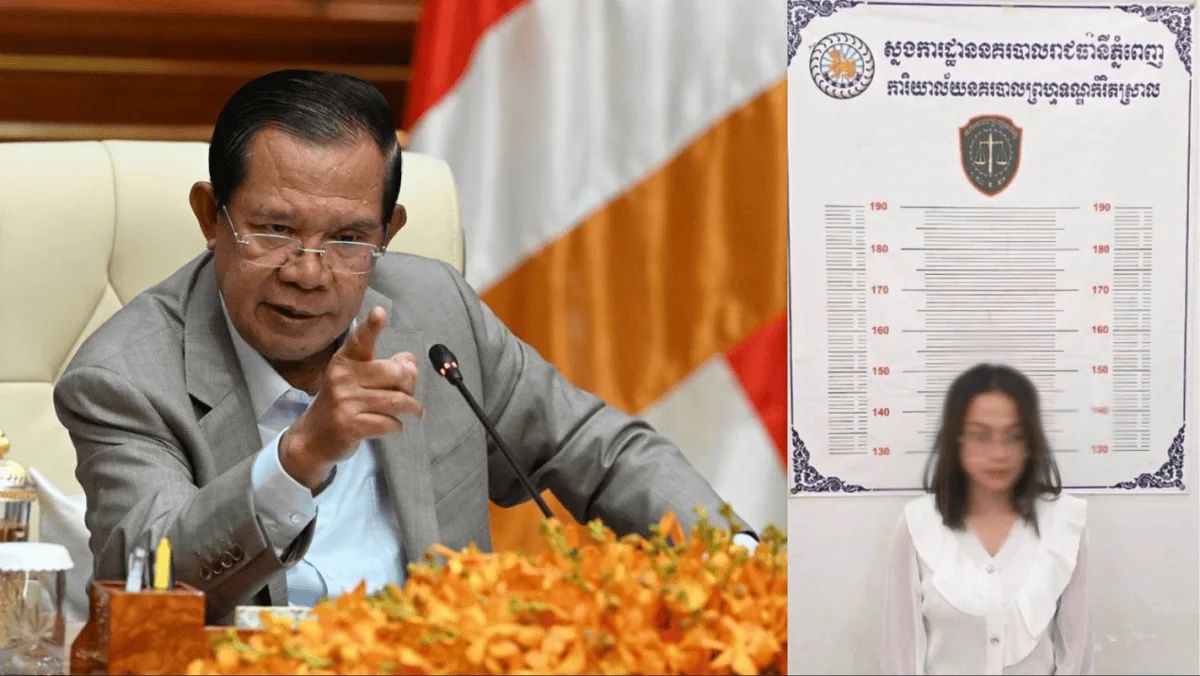
Cambodia's Senate president Hun Sen has launched a directive that will substantially broaden the government's legal reach into matters of public speech, ordering the Ministry of Women's Affairs and the National Council for Women to act as plaintiffs in court cases against those whose language is judged to demean women or violate Cambodian social standards. The announcement, made during an official meeting with council representatives on Friday (Aug 14), represents a significant expansion of state involvement in regulating discourse around gender and public decorum.
The impetus for this initiative stems from recent incidents that Hun Sen identified as particularly egregious. He referenced an unnamed woman who allegedly used profane language to insult government institutions and civil servants, noting that authorities had already compelled the woman and her husband to submit a formal letter of apology. This case appears to have catalyzed broader concerns within Hun Sen's administration about the deteriorating standards of public conduct, particularly regarding disrespect toward state apparatus and uniformed personnel.
Another case that influenced the directive involved a woman identified as Chenda Sovannary, who reportedly engaged in insulting remarks against a soldier during a commercial dispute over a mobile phone transaction. Hun Sen drew particular attention to this incident, questioning the logic of verbally assaulting a military member over what he characterized as a trivial consumer matter. His rhetorical approach extended beyond military personnel, emphasizing that demeaning language directed at any occupational group—including construction workers—should not be tolerated within Cambodian society.
The directive places significant responsibility on the courts to examine cases involving what Hun Sen termed "individuals who destroy social dignity," effectively creating a new category of legal concern centered on subjective assessments of respectful conduct. This framing suggests that Cambodian courts will be expected to apply more stringent scrutiny when evaluating cases brought under this framework, potentially lowering evidentiary thresholds or expanding interpretations of what constitutes actionable harm to social standards.
Hun Sen addressed an anticipated criticism by asserting that enforcement of these values should not be construed as authoritarian governance but rather as legitimate state protection of shared cultural standards. He drew a parallel to private sector practices, noting that commercial social media platforms independently establish and enforce community standards and ethical guidelines. This comparison, however, presents a fundamental distinction that Hun Sen did not fully acknowledge: private companies operate within contractual relationships with users who voluntarily accept terms of service, whereas state enforcement of speech codes operates through compulsory legal authority.
The infrastructure for implementing this policy involves coordinating multiple government agencies to create what Hun Sen described as a comprehensive monitoring and enforcement mechanism. He specifically instructed the National Council for Women to collaborate with the Ministry of Interior, the Ministry of Information, the Ministry of Culture and Fine Arts, and the Ministry of Post and Telecommunications. This inter-ministerial coordination suggests that social media platforms and digital communications will receive particular scrutiny, with Hun Sen explicitly referencing the need for systematic tracking of alleged insulting and profane content on Facebook.
The establishment of what Hun Sen termed "a team to track these cases" indicates that Cambodia will develop institutional capacity dedicated to identifying, cataloguing, and pursuing legal action against online speech deemed problematic. This surveillance infrastructure raises questions about the criteria for identifying violations and the transparency of decision-making processes, particularly given the subjective nature of determining what constitutes an insult to "women's values" or "social morality." The absence of clearly defined legal standards creates potential for inconsistent application and political weaponization.
For regional observers and international organizations focused on freedom of expression, this directive represents a notable development in Cambodia's governance approach. Several Southeast Asian nations have implemented various forms of speech regulation, but Hun Sen's framing presents a distinctive emphasis on protecting gender-related dignity and social standards as justification for expanded state monitoring and legal intervention. This rationale could establish precedent for similar measures across the region, particularly in contexts where governments seek to moderate public discourse without explicitly invoking national security or sedition frameworks.
The timing and specific focus on women's dignity raises additional analytical dimensions. While protecting women from harassment and demeaning language represents a legitimate policy objective pursued across democracies and authoritarian systems alike, Hun Sen's approach appears to conflate gender protection with broader state control over speech norms. The cases cited involved women as both victims and alleged perpetrators, suggesting that the policy aims to enforce gendered behavioral standards rather than specifically targeting gender-based harassment or misogyny.
Malaysian and other Southeast Asian observers will recognize similarities to speech regulation frameworks elsewhere in the region, where concepts of social morality, national dignity, and respect for institutions provide expansive grounds for legal action. Cambodia's approach, however, distinguishes itself through its explicit delegation of prosecutorial authority to women's affairs bodies rather than traditional law enforcement, potentially creating accountability questions about which women's interests these bodies represent and how enforcement priorities are determined.
The practical implications for Cambodian citizens remain uncertain, particularly regarding how courts will adjudicate cases involving allegedly offensive speech and what evidentiary standards will apply. Hun Sen's insistence that these measures represent standard practice rather than rights restrictions suggests that the government anticipates international criticism, yet the stated objective of systematic social media monitoring indicates that digital surveillance and speech policing will become increasingly routine aspects of Cambodian governance.
As Cambodia implements these directives, the effectiveness and consequences will depend substantially on how particular ministries interpret and execute the mandate. Whether enforcement focuses narrowly on extreme cases or expands to encompass broader categories of critical or irreverent speech will significantly shape the impact on public discourse and citizen confidence in state institutions.

