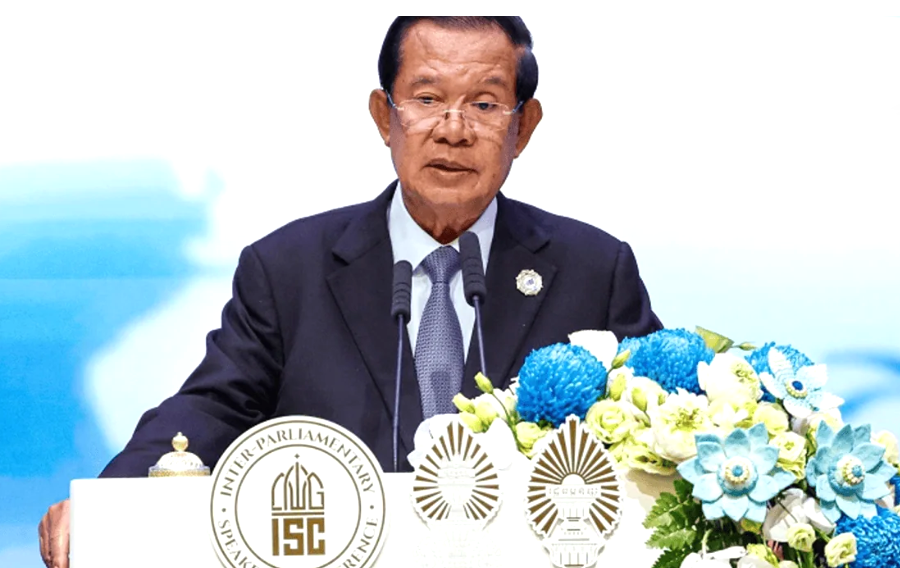
Cambodia's Senate president Hun Sen has levelled serious accusations against Thailand, claiming that Bangkok weaponised the international concern over online scams to justify what he describes as an illegal occupation of Cambodian territory. Speaking at the 2nd Inter-Parliamentary Speakers' Conference in Phnom Penh on Thursday, Hun Sen presented a sweeping critique of how contemporary interstate conflicts have evolved far beyond traditional military confrontation, now operating under layers of ostensibly legitimate justifications that mask territorial ambition and power projection.
The conference, held in the Cambodian capital, drew parliamentary delegations from across Asia and beyond, including Pakistan, Malaysia, Myanmar, Australia, and Russia. Hun Sen used this international platform to articulate his government's perspective on what he characterises as a fundamental breakdown in the international legal architecture. His remarks reflected growing frustration in Phnom Penh over the Cambodia-Thailand border dispute, a decades-old tension that periodically flares into armed clashes and diplomatic confrontation. The Senate president framed the scam allegations as a cynical manipulation of legitimate cross-border concerns, suggesting that powerful states have learned to exploit global security anxieties to achieve narrow geopolitical objectives.
Hun Sen identified what he termed "modern warfare" as a multifaceted phenomenon extending well beyond conventional military operations. He argued that contemporary conflicts increasingly target essential civilian infrastructure and public assets, transforming roads, bridges, religious sites, schools, and even industrial facilities like oil refineries into de facto battlegrounds. This characterisation reflects a broader Southeast Asian anxiety about how great power competition and technological advancement have created new vulnerabilities for smaller nations. The blurring of civilian and military targets has become particularly acute as countries grapple with cybersecurity threats, artificial intelligence capabilities, and economic interdependence that can be weaponised through trade sanctions or technology restrictions.
The Cambodia-Thailand border remains one of Southeast Asia's most sensitive geopolitical flashpoints, with previous armed confrontations occurring as recently as the 2010s. The dispute involves competing territorial claims and allegations that portions of Cambodian territory have been controlled or exploited by organised crime networks operating online scam operations. Hun Sen's accusation that Thailand has weaponised this issue to justify occupation represents an escalation in rhetoric and suggests deepening frustration with how Cambodia's concerns about its sovereignty are being dismissed or instrumentalised by larger regional players. The Senate president implied that ceasefire agreements between the two nations have been hollow, respected only in letter rather than in genuine commitment to de-escalation.
Beyond the bilateral Cambodia-Thailand dimension, Hun Sen articulated a sweeping indictment of what he sees as the systematic erosion of international law by powerful states. He highlighted how great powers increasingly invoke selective applications of international norms—particularly regarding human rights, environmental standards, and transnational crime—to justify sanctions, isolation, or intervention against weaker nations. This criticism resonates throughout the Global South, where policymakers frequently complain that wealthy nations impose standards they themselves do not consistently uphold, while simultaneously failing to acknowledge the structural disadvantages and limited institutional capacities of developing countries still recovering from historical conflicts.
Hun Sen identified trade wars and technology competition as additional vectors through which modern conflicts manifest. Customs barriers, tariff manipulation, and the strategic withholding of access to advanced semiconductors or cybersecurity infrastructure have become powerful weapons in the hands of economically dominant nations. The scramble for rare earth minerals and energy resources represents another dimension of this competition, creating what Hun Sen characterised as "systemic insecurity" for vulnerable nations unable to secure reliable access to critical materials or markets. These observations reflect genuine anxieties shared across Southeast Asia about the region's exposure to great power economic coercion and its dependence on global supply chains controlled by distant powers.
A particularly alarming aspect of Hun Sen's analysis concerns the weaponisation of security doctrines and preemptive military action. He warned that when powerful states exercise unilateral rights of self-defence and launch unprovoked strikes against perceived threats, the foundational principle of collective security through international institutions collapses. This dynamic, he argued, has triggered a destabilising global arms race as vulnerable nations recognise that international treaties alone cannot shield them from external aggression. His warning about the potential collapse of the non-proliferation framework reflects genuine concern in the region about proliferation risks and the spread of advanced weapons systems as smaller states seek security guarantees outside traditional alliances.
Hun Sen characterised Cambodia itself as a target of what he calls "pressure and attacks" conducted under various guises. By framing the scam issue alongside accusations about human rights practices and environmental standards, he suggested that Cambodia faces a coordinated campaign of external pressure designed to constrain its sovereignty and policy autonomy. This perspective, while reflecting genuine frustrations about double standards in international scrutiny, also indicates how developing nations increasingly perceive external criticism as tools of geopolitical coercion rather than legitimate expressions of international concern. The conflation of these distinct issues—criminal activity, human rights, environmental protection—into a unified narrative of external pressure reveals how smaller states experience the international system as inherently stacked against their interests.
The Senate president's call for restoration of a rules-based international order centred on the UN Charter and ASEAN Charter represents both an appeal to established norms and an implicit recognition that these norms have become hollow. By invoking these frameworks, Hun Sen positioned Cambodia as defending established international law against great power lawlessness. However, his argument also contains a paradox: he simultaneously criticises powerful nations for establishing and then destroying the rules, yet appeals to the very international order they have allegedly undermined. This tension reflects the fundamental predicament of smaller states in an era of renewed great power competition—they remain deeply invested in international institutions and norms, yet recognise these provide limited protection against determined powerful actors.
For Malaysia and other Southeast Asian nations, Hun Sen's speech carries important implications. Regional states share Cambodia's vulnerability to great power competition, economic coercion through trade mechanisms, and the challenge of managing disputes with stronger neighbours while maintaining diplomatic flexibility. The reference to how powerful nations selectively apply international standards resonates with Malaysian and other regional governments' experiences navigating between great power interests while attempting to protect national sovereignty and development space. Hun Sen's emphasis on how technological competition, resource competition, and strategic industries have become battlegrounds reflects challenges confronting the entire ASEAN region as it seeks to maintain centrality and autonomy amid superpower rivalry.
The broader implications of Hun Sen's analysis extend to how Southeast Asia collectively approaches regional security architecture and dispute resolution. His warnings about the collapse of rules-based order and the insufficiency of international treaties challenge the region's long-standing faith in multilateral institutions and ASEAN's preferred mechanisms for managing conflict through dialogue and consensus. Whether his more pessimistic assessment reflects genuine institutional decay or represents rhetorical escalation in the Cambodia-Thailand dispute remains contested. Nevertheless, his articulation of vulnerabilities facing smaller developing nations captures anxieties resonating throughout the region as states confront an increasingly multipolar, competitive international environment where traditional legal and diplomatic tools offer uncertain protection against determined power politics.

