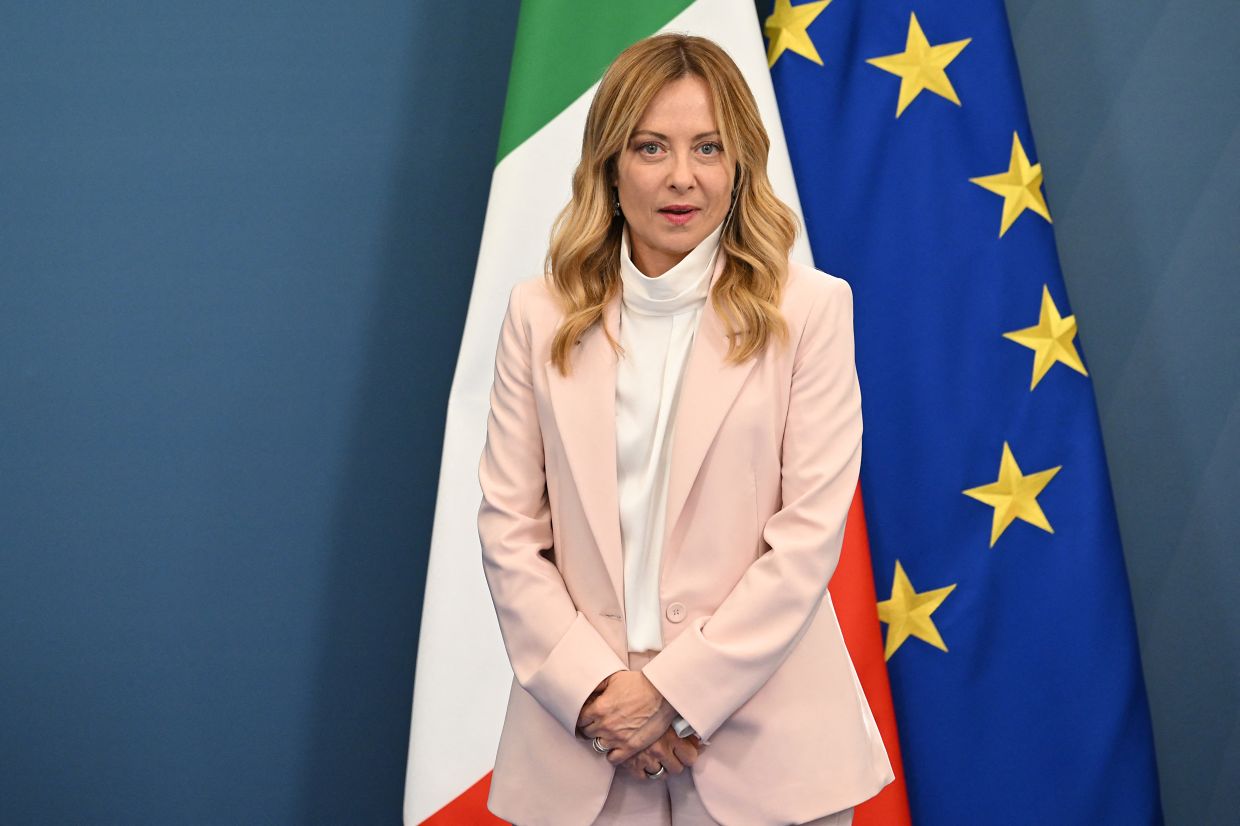
Italy's Prime Minister Giorgia Meloni has undergone a striking transformation in her public presentation, and fashion experts argue her wardrobe evolution mirrors her shifting political identity from radical outsider to pragmatic establishment figure. Since taking office in October 2022, Meloni has deliberately repositioned her sartorial image—moving away from the dark suits and heavy black boots that once symbolised her emergence from the country's far-right fringe towards pastel-coloured ensembles with loose-fitting trousers that obscure her heels. The shift represents far more than aesthetic preference; according to those who study the intersection of clothing and politics, it constitutes a deliberate communications strategy designed to convey authority whilst simultaneously projecting accessibility and reassurance to both domestic and international audiences.
The strategic nature of Meloni's wardrobe choices becomes evident when examining her trajectory as a political figure. When she assumed the premiership just over two years ago, her sartorial presentation echoed the uncompromising aesthetic of her years leading a fringe right-wing party—heavy materials, severe silhouettes, and a consistent palette of black tones that signalled distance from mainstream politics. Yet as her government has consolidated power and she has begun building a record that diverges markedly from the radical positions she once championed, her clothing has undergone a corresponding metamorphosis. Antonio Mancinelli, an instructor at Rome's prestigious Costume and Fashion Academy, observes that Meloni demonstrates acute awareness of how non-verbal communication through dress operates within political contexts, suggesting that this evolution reflects calculated decision-making rather than circumstantial change.
What renders Meloni's sartorial strategy particularly significant is the unique position she occupies as Italy's first female leader in a nation globally synonymous with fashion expertise. Stella Jean, an Italian-Haitian designer with deep roots in the Italian fashion establishment, emphasises that when a woman leading a country renowned for fashion credentials and whose textile industry forms a pillar of its economy makes wardrobe decisions, those choices acquire considerably greater weight and scrutiny than might apply to male counterparts. This amplified attention means that every colour choice, every tailoring decision, and every hemline carries potential political meaning that extends far beyond the realm of personal style into questions of national representation and cultural messaging.
Meloni's ideological repositioning since taking office provides the crucial context for understanding her fashion evolution. Upon entering government as leader of a party with post-fascist historical roots, international observers expected confrontational governance marked by hostility toward European institutions and extreme positions on foreign affairs. Instead, she has largely defied these predictions, pursuing conservative and restrictive immigration policies domestically whilst adopting a fundamentally pragmatic stance toward the European Union and emerging as a stalwart defender of Ukraine's sovereignty against Russian aggression. She has even demonstrated willingness to resist pressure from United States President Donald Trump, actions that have strengthened her standing among fellow European leaders and reinforced her credibility as a serious governing figure rather than a fringe ideologue.
Political analyst Riccardo Alcaro of Italy's Institute For International Affairs articulates the transformation clearly: when Meloni led a minor right-wing party, her political communication served a narrow electorate aligned with her confrontational messaging. Now, as head of government in a major European Union member state, her role demands that she project herself as a credible custodian of state power whose policy positions warrant substantive debate rather than reflexive rejection. This fundamental shift in her operational context necessitates corresponding adjustments in how she presents herself publicly, including the medium of fashion through which she communicates non-verbally to both domestic and international constituencies.
The specific colour palette that now dominates Meloni's wardrobe carries psychological and cultural significance that fashion scholars have long documented. Soon after assuming office, she began gravitating toward tailored suits in muted tones that critics have praised as elegant whilst simultaneously conveying gravitas and approachability—precisely the combination required when appearing with increasing frequency on the global diplomatic stage. Michela Bonafoni, who teaches fashion studies at Florence's Unicollege, explains that lighter colours communicate loyalty, tenderness and gentleness, fundamentally altering how viewers perceive the wearer's accessibility and warmth. This chromatic shift away from the unrelenting blacks of her activist years toward softer hues represents a profound recalibration of her public image, one that quietly but persistently reinforces her claim to have evolved beyond the extremism of her political origins.
The contrast between Meloni's contemporary fashion presentation and her appearance during her radical past starkly illustrates the deliberateness of her transformation. In 1996, when she was just nineteen years old, a French television crew documented the young activist entirely enshrouded in black as she coordinated activities within a far-right youth movement, during which she defended the legacy of Italian fascist dictator Benito Mussolini—comments that have persistently haunted her subsequent political career. The sartorial coding of that moment, captured on film and circulated widely, associated her personally with the darkest chapters of Italian history. Her subsequent efforts to rehabilitate her image and distance herself from extremism have accordingly required not merely rhetorical repositioning but visual transformation as well, since the symbolic associations embedded in her earlier wardrobe choices continued to inform public perception.
Meloni's evolution through various political roles illustrates how her wardrobe has gradually shifted in tandem with her career advancement. When former Prime Minister Silvio Berlusconi appointed her youth minister in 2008, she began adopting more sober professional attire—predominantly dark suits paired with white shirts—that signalled her graduation into formal governmental responsibility. However, this represented merely an intermediate stage in her longer trajectory toward broader political legitimacy. By the time she secured electoral victory in 2022, she had already undertaken significant rebranding efforts, including a memorable campaign speech in which she emotionally identified herself as a woman, mother, and Christian—language that subsequently achieved viral circulation online and significantly expanded her appeal among conservative centrists who might otherwise have regarded her background with suspicion.
As prime minister, Meloni has consciously abandoned the aesthetic markers that once defined her political identity. The all-black wardrobe combinations that formerly appeared in public contexts have essentially vanished from her official engagements, a particularly loaded decision given that within Italian cultural memory, black clothing carries associations not merely with general formality but specifically with fascism—a historical shadow that Italy has spent decades attempting to overcome. In their place, she now consistently selects tailored trousers in neutral and pastel tones, avoids dramatic patterns that might convey stridency, and deliberately obscures her high heels beneath generously proportioned trouser legs. Although she has declined to publicly discuss her wardrobe decisions or acknowledge whether fashion advisers guide her sartorial choices, the consistency and strategic nature of her colour and silhouette selections suggest a calculated approach to public presentation.
Meloni's fashion strategy assumes particular importance as she enters the final year of her current mandate whilst confronting emerging challenges from rival right-wing politicians who may seek to position her as insufficiently committed to the ideological purity her party once championed. No matter how carefully she curates her wardrobe or refines her public image, these internal party dynamics threaten to highlight the degree to which she has moderated her positions on certain issues since taking office. Fashion choices, whilst powerful communicative tools, cannot entirely overcome the fundamental tensions embedded in her political biography—the gap between her radical origins and her present role as a pragmatic EU leader. Yet by employing clothing as a medium through which to reinforce her transformation, she continues to send consistent signals about her commitment to governing as a serious establishment figure rather than a disruptive ideologue, thereby attempting to shape how both domestic supporters and international observers evaluate her political trajectory.

