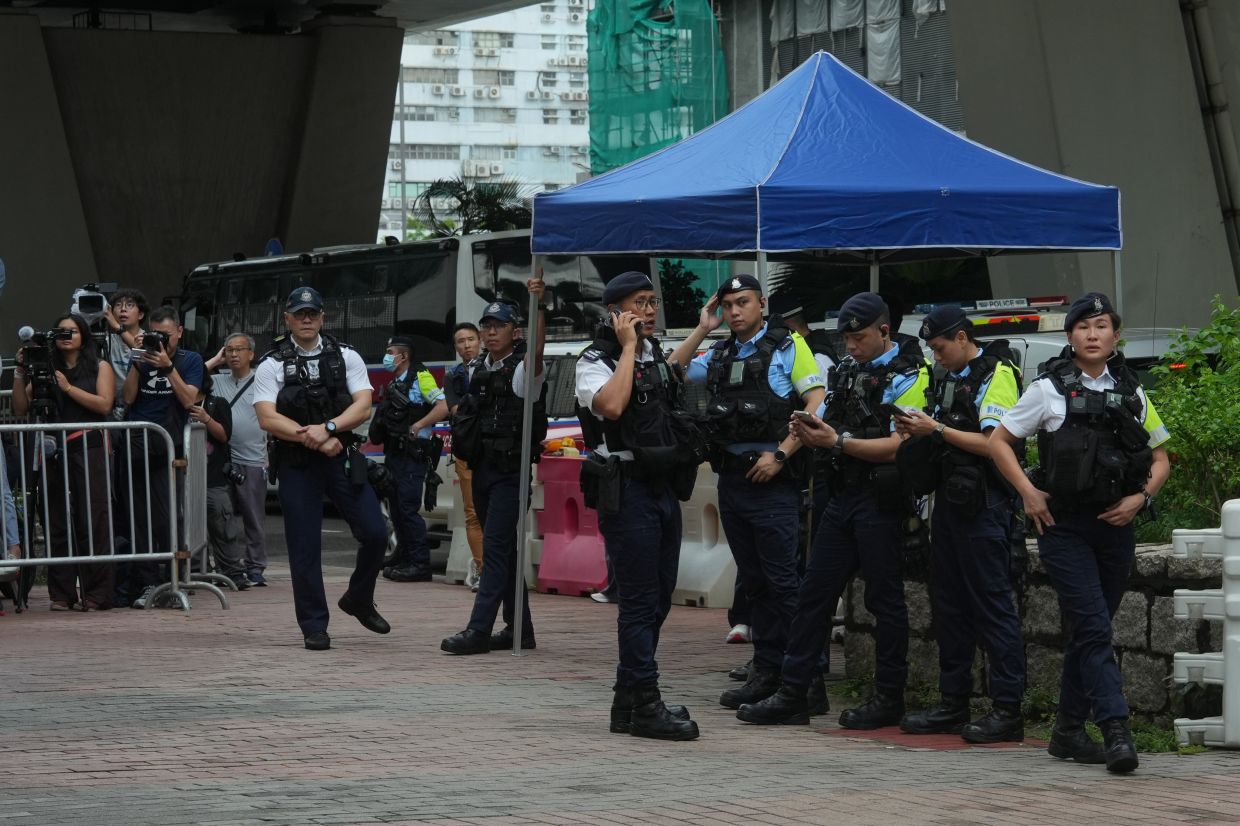
Hong Kong police have detained a woman for allegedly wearing a garment bearing seditious content outside West Kowloon Court, marking another flashpoint in the territory's increasingly restrictive security environment. The arrest occurred last week on suspicion of disorderly conduct in public, obstructing police operations, and acting with seditious intent, police confirmed on Monday night. Officials have remained characteristically opaque about the operation, stating only that it was designed to maintain public safety and order without elaborating on the specifics of the intervention or the T-shirt's contents.
The timing of the detention proves particularly significant, occurring mere hours before the court delivered guilty verdicts against two prominent figures from Hong Kong's pro-democracy movement. The incident unfolded in the early morning darkness when more than fifty people had gathered outside the courthouse from around 5am on Friday to witness or cover the judgment against Lee Cheuk-yan, former chairman of the now-defunct Hong Kong Alliance in Support of Patriotic Democratic Movements of China, and Chow Hang-tung, the organisation's former vice-chairwoman.
According to eyewitness accounts, a plainclothes police officer targeted the woman during the courthouse vigil, identifying her black T-shirt as potentially carrying seditious messaging and promptly escorting her into a police vehicle. Media personnel captured the removal on camera, with officers subsequently instructing journalists to vacate the area. A witness described the garment as bearing Japanese characters, though authorities have disclosed no further details about the specific content or its alleged seditious nature. The incident underscores how Hong Kong's security apparatus now extends to policing individual clothing and symbolic expression in public spaces.
The timing coordination between the woman's arrest and the court's verdict raises questions about whether the detention was intended to discourage or intimidate observers gathering to witness the proceedings. The removal occurred during a period when supporters of the detained activists were attempting to demonstrate solidarity through their physical presence and potentially through symbolic means, making the intervention appear strategically designed to restrict even passive forms of dissent near the courthouse.
Hours after the woman's removal, the High Court delivered its judgment against Lee and Chow, finding both guilty of inciting subversion under Hong Kong's National Security Law. The pair faced charges related to their roles in organising and promoting Hong Kong's annual Tiananmen Square vigil and their public calls to end "one-party dictatorship" in mainland China. The charges specifically alleged they violated provisions prohibiting incitement to subversion, demonstrating how the security law has been weaponised against commemorative and symbolic political activities that were previously tolerated in the territory.
The comprehensive 216-page ruling by three High Court judges established a far-reaching interpretation of subversion offences. The judges determined that any effort to overthrow or undermine the leadership of the Communist Party of China could constitute subversion under the law. Critically, the ruling held that Hong Kong's constitutional framework does not accommodate Western-style democratic systems, effectively establishing that advocacy for democratic governance represents a threat to national security. This interpretation significantly expands the scope of activities potentially prosecutable under the security law beyond conventional definitions of subversion.
The conviction carries particular weight given the prominence and credibility of the defendants. Lee, a former legislative councillor with decades of pro-democracy activism, and Chow, a qualified barrister with legal credentials, represent the intellectual and political leadership of Hong Kong's democratic movement. Their imprisonment reflects how the security law has ensnared not peripheral activists but central figures of the pro-democracy establishment, signalling a comprehensive dismantling of the movement's institutional capacity.
Both Lee and Chow have languished in custody for nearly five years, enduring an extended pretrial detention that itself serves as a form of punishment and deterrent. A third defendant, Albert Ho Chun-yan, the alliance's former vice-chairman, has been held in custody for over four years. Ho pleaded guilty to the subversion charges in January and awaits sentencing, suggesting the prosecution case against the alliance's leadership was sufficiently compelling or the pressure sufficiently intense to compel admission of guilt despite the defendants' prior denials and the contested nature of the charges.
The incident outside the courthouse and the subsequent convictions illustrate the comprehensive nature of Hong Kong's security regime, which now extends from policing political speech and assembly to regulating symbolic expression through clothing. The arrest of the woman in the T-shirt demonstrates that the authorities are willing to intervene against even unclear or ambiguous expressions of dissent, suggesting a precautionary approach that criminalises uncertainty itself. Citizens cannot reliably know which clothing or symbols might trigger police intervention, creating a chilling effect across society.
For Malaysia and the broader region, Hong Kong's trajectory offers cautionary lessons about how security laws can progressively expand to capture activities that fall far outside traditional definitions of national security threats. The conviction of figures engaged in commemorative activities and advocacy for democratic governance raises concerns about how similar legislation in other Southeast Asian jurisdictions might be applied against civil society actors and political opponents. The case demonstrates how sophisticated legal frameworks, wielded through judicial interpretations that align with executive preferences, can effectively criminalise dissent while maintaining formal adherence to rule of law.
The broader implications extend to regional stability and governance standards. Hong Kong's experience suggests that security laws adopted ostensibly to address genuine threats can metastasize into instruments of political control that suppress legitimate democratic activity and restrict fundamental freedoms of expression and assembly. For other Southeast Asian nations contemplating similar legislation or already possessing it, the Hong Kong precedent demonstrates how security laws can evolve to justify increasingly aggressive state intervention into civilian life and political participation.

