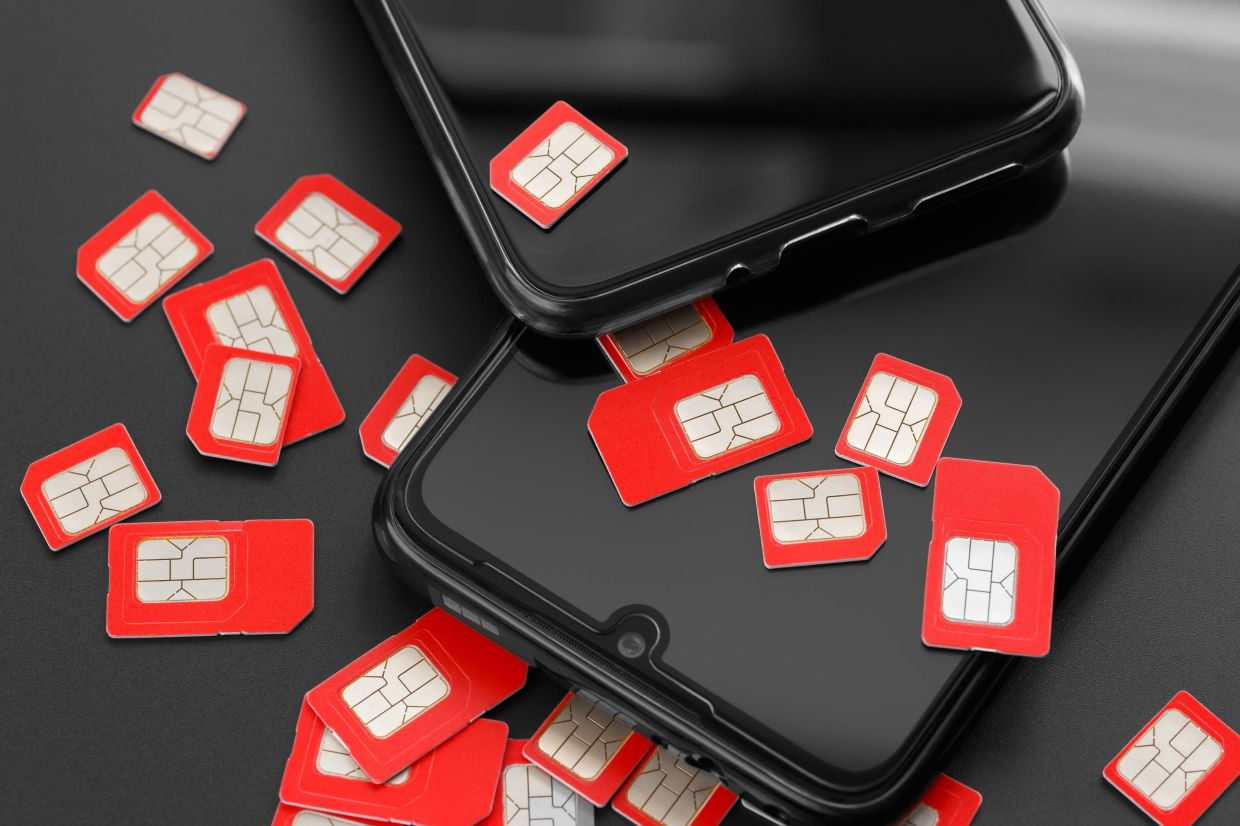
Hong Kong police have dismantled what authorities describe as a coordinated phishing operation, arresting two men suspected of swindling victims out of more than HK$500,000 through a scheme involving 110 SIM cards deployed from a hotel room command centre. The force announced the breakthrough on Saturday, revealing that the suspects, aged 31 and 44, were taken into custody the previous Thursday and face charges of conspiracy to defraud—an offence carrying a maximum 14-year prison sentence under Hong Kong law.
The operation exemplifies the evolving sophistication of cybercriminal networks in Asia, where scammers exploit readily available telecommunications infrastructure to execute mass fraud campaigns. Investigators discovered that the suspects had systematically acquired SIM cards through real-name registration under multiple individuals' identities, then installed them into a modem pool—specialised equipment designed to control multiple cards simultaneously—within their makeshift operations centre. This technological setup enabled rapid, coordinated message distribution across a broad victim population with minimal detection risk.
According to Inspector Kwan Yat-hei of the fraud division's commercial crime bureau, the network's modus operandi relied on impersonation and social engineering rather than technical sophistication. Perpetrators posed as staff members of parcel delivery companies, falsely notifying recipients of undelivered packages awaiting collection. Simultaneously, they impersonated employees of electronic payment platforms, informing targets that they had inadvertently subscribed to insurance policies requiring immediate cancellation fees. These pretexts were carefully calibrated to trigger urgency and bypass victims' natural scepticism.
The deception process unfolded in carefully orchestrated stages designed to maintain psychological pressure. Once victims responded to the fraudulent messages and dialled the fake customer service hotline number provided, operators on the other end guided them through banking transactions. The criminals employed various justifications—ranging from payment verification procedures to insurance fee cancellation—to convince targets to transfer funds into designated accounts controlled by the network. This multi-stage approach significantly increased conversion rates compared to unsophisticated scam attempts.
Detectives uncovered the scale of the operation's reach through forensic analysis of communications. The two arrested individuals had dispatched more than 2,000 suspected fraudulent messages through their network, with investigators successfully linking intercepted phone numbers to numerous recently reported cases. The confirmed losses alone exceeded HK$500,000, though authorities suspect the actual figure may be substantially higher given that many victims remain unaware of their victimisation or hesitate to report embarrassment-inducing fraud.
The physical infrastructure seized during the raid tells a revealing story about modern scam operations. Officers discovered the modem pool alongside nine mobile handsets and 110 SIM cards crammed into a single hotel room—a footprint smaller than many residential apartments yet capable of processing thousands of fraudulent transactions daily. This efficiency reflects how criminal enterprises have adapted to exploit telecommunications vulnerabilities, treating hotel rooms as temporary, disposable command centres that minimise geographic exposure while maintaining operational effectiveness.
The investigation highlights a critical vulnerability in Hong Kong's telecommunications infrastructure: the gap between real-name registration requirements and enforcement mechanisms. Although Hong Kong mandated real-name SIM card registration in March 2022—a safeguard intended to prevent anonymous fraud—the arrested suspects circumvented this protection by registering cards under multiple individuals' identities. This suggests that mere registration requirements prove insufficient without complementary surveillance protocols and penalties for individuals whose identities are misused for fraudulent purposes.
Inspector Kwan's warnings carry particular significance for the broader Southeast Asian region, where similar scam patterns operate across Malaysia, Singapore, Thailand, and the Philippines. He specifically cautioned residents against calling numbers appearing in unsolicited messages and against lending or selling SIM cards to unknown parties. More provocatively, he underscored that individuals who deliberately or negligently permit their SIM cards to be misused for fraud face potential criminal liability—a legal principle increasingly adopted across the region to address the infrastructure exploitation problem at its source.
The implications for Malaysian audiences extend beyond Hong Kong's borders. Comparable phishing operations have targeted Malaysian consumers with identical methodologies, frequently impersonating local delivery services and financial institutions. The techniques refined by this Hong Kong network—bulk SIM acquisition, modem pool deployment, and multi-stage social engineering—represent a template that criminal enterprises readily replicate across jurisdictions. Malaysian telecommunications regulators and law enforcement agencies may draw valuable lessons from this case regarding detection methodologies and preventative infrastructure hardening.
The investigation remains ongoing, with authorities signalling that additional arrests are anticipated. The commercial crime bureau's commercial crime bureau is pursuing leads suggesting that the captured network represents only one node within a larger ecosystem of coordinated phishing operations. This incremental approach to dismantling fraud infrastructure has become standard practice across regional law enforcement agencies, reflecting recognition that individual arrests rarely eliminate entire networks, only temporarily disrupting operations until remaining actors reorganise.
For telecommunications subscribers across Asia-Pacific, this case underscores several protective measures. Vigilance regarding unexpected communications claiming delivery or payment issues remains essential, particularly when such messages request urgent action or threaten account suspension. Refusing to divulge personal information or engage with provided contact numbers prevents initial information leakage that scammers exploit in downstream fraud stages. Perhaps most importantly, users must recognise that SIM card lending—however innocuous the request may appear—potentially transforms them into unwitting accomplices to organised fraud operations, with attendant legal consequences.

