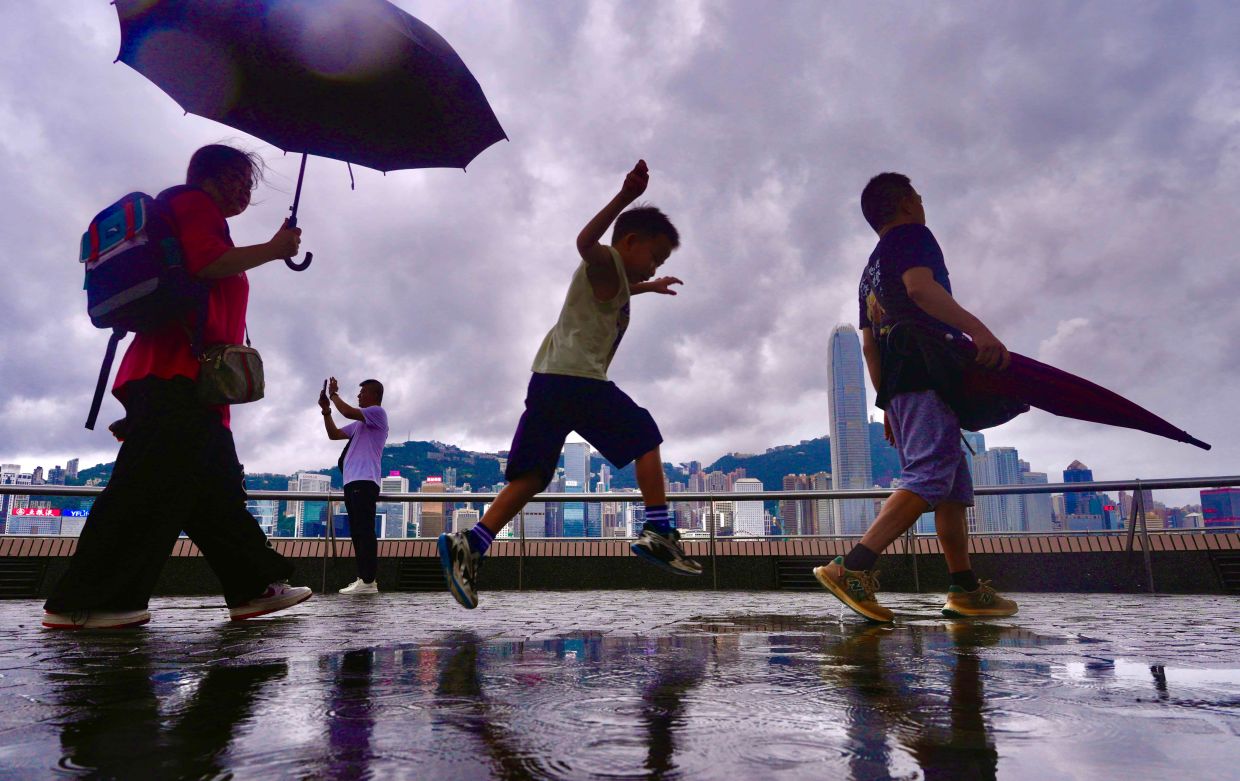
Hong Kong residents finally experienced respite from an exhausting spell of extreme summer temperatures on Friday morning when widespread rain swept across the densely populated territory, marking a dramatic shift in the city's weather pattern. The Hong Kong Observatory issued an amber rainstorm warning at 8:40 am, the lowest tier in its alert system, before lifting the alert just three hours later as the heaviest showers subsided into intermittent thunderstorms throughout the remainder of the day. The meteorological event, triggered by upper-air disturbances combined with a southwesterly airstream, ended a grueling week during which Hong Kong's urban landscape had been gripped by oppressive heat that tested residents' endurance and pushed the city's infrastructure to its limits.
The intensity of the recent heatwave distinguished itself as a particularly severe meteorological episode in Hong Kong's long weather history. Over nine consecutive days, the maximum temperature recorded at the observatory's official monitoring station remained at or exceeded 33 degrees Celsius, establishing a new record for the most prolonged sustained hot period during the month of August. This achievement, if it can be called that, surpassed all previous August records stretching back through decades of detailed meteorological documentation. The daily temperatures swung between uncomfortable and dangerous levels, with various districts across the densely built city recording peaks above 34 degrees Celsius on multiple occasions, creating the sort of persistent thermal stress that affects human health, energy consumption, and the rhythm of urban life.
The breaking point came on a Sunday when observers registered a staggering 36.9 degrees Celsius at the main observatory, representing the highest temperature ever documented since Hong Kong began maintaining systematic weather records in 1884. This figure carries profound significance not merely as a number, but as a marker of Hong Kong's changing climate patterns and the intensifying heat events that may become increasingly common in the decades ahead. The previous century-plus of recorded data provides essential context: Hong Kong's thermometer had never climbed this high in all that time, making the recent reading a genuine milestone in the territory's environmental history and a harbinger of potential future climatic patterns.
The meteorological factors driving this episode reveal the complex atmospheric dynamics at work across southern China and the broader Asia-Pacific region. Upper-air disturbances—fluctuations in wind patterns at higher altitudes—combined with a pronounced southwesterly airstream to create conditions that allowed exceptionally warm air masses to stall over Hong Kong for an extended period. The positioning of these systems effectively trapped the heat over the territory, preventing the typical cooler air movements that normally provide relief during summer months. Understanding these mechanisms matters for residents and policymakers alike, as it contextualizes whether such events represent temporary anomalies or emerging climatic norms that warrant long-term adaptation strategies.
The rainfall itself, while providing immediate relief through reduced ambient temperatures and improved air quality, was not expected to mark a sustained shift to cooler conditions. The meteorological outlook suggested that Saturday would bring some additional showers, particularly during morning hours with brief thunderstorms, before afternoon sunshine would return to parts of the territory. This pattern of intermittent wet spells separated by sunny intervals characterizes the typical late-summer transition weather for Hong Kong, marking the tail end of the southwest monsoon season. However, forecasters warned that truly hot weather would make a return during the early portion of the following week, accompanied by only scattered showers—suggesting that the broader atmospheric pattern would not fundamentally shift, merely pause.
For Malaysia and other Southeast Asian nations, Hong Kong's experience offers instructive lessons about heat wave management and the climatic stresses facing densely populated tropical and subtropical cities. The territory's experience demonstrates how modern urban environments, with their concentrations of human activity, infrastructure, and environmental modification, can amplify natural temperature variations into genuine public health emergencies. Malaysian cities such as Kuala Lumpur and George Town, which face comparable tropical heat and urban density, must contemplate whether similar record-breaking temperatures might emerge as climatic averages shift over coming decades. The adaptation strategies Hong Kong implements—from cooling centre availability to urban forestry initiatives—merit careful study by Southeast Asian urban planners and public health officials.
The broader implications extend beyond immediate weather patterns into questions of climate resilience and infrastructure adequacy. Hong Kong's achievement of record-breaking temperatures while remaining a functioning megacity of eight million people reflects both the resilience of modern urban systems and their fragility when faced with sustained thermal stress. Air conditioning systems across the territory consumed enormous quantities of electricity, grid operators managed demand carefully, and vulnerable populations—the elderly, the poor, outdoor workers—faced genuine risks. Similar scenarios are playing out across Southeast Asia as summer temperatures climb year after year, testing the capacity of aging power networks and raising difficult questions about energy sustainability and affordability.
The relief brought by Friday's rainfall, while psychologically and physically welcome, may ultimately prove temporary unless broader climate patterns shift substantially. The forecast of renewed intense heat early in the following week served as a reminder that individual weather events, however dramatic, occur within the context of longer-term climatic trajectories. Hong Kong, like cities throughout Southeast Asia, must grapple with the reality that heat waves may become not exceptional emergencies requiring extraordinary measures, but recurring features of the summer climate requiring permanent adaptations to infrastructure, work practices, and daily life patterns.

