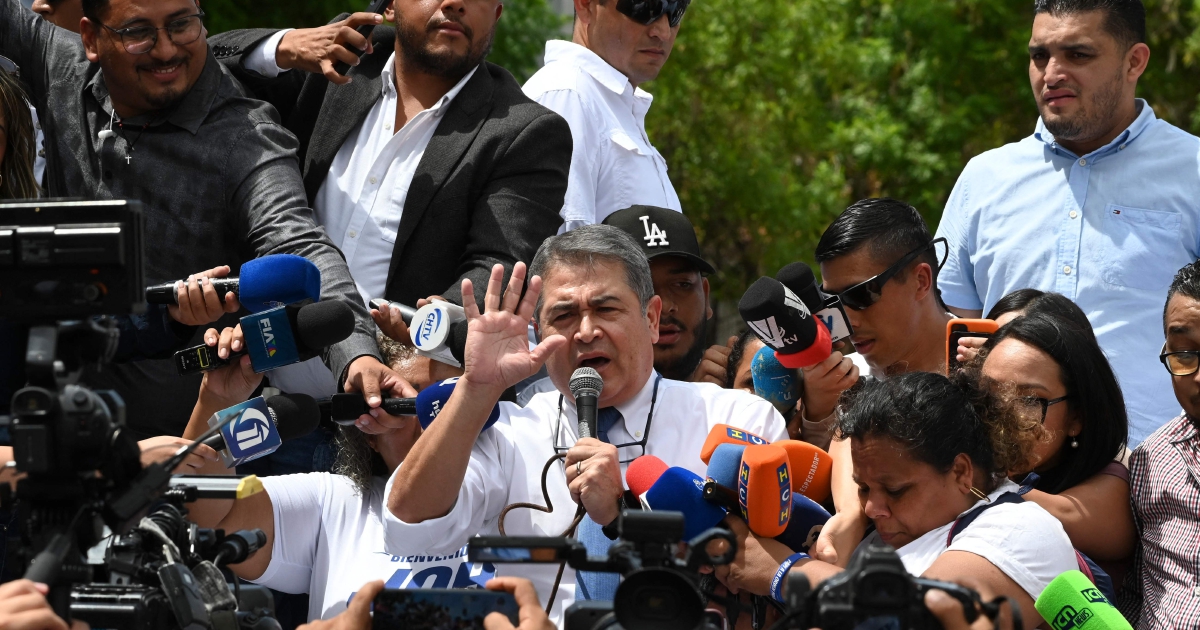
Former Honduran president Juan Orlando Hernandez will not return to prison while he defends himself against corruption allegations in his home country. A judge in Tegucigalpa made this determination on Monday, permitting the once-powerful leader to remain free as he navigates the domestic legal proceedings that threaten his legacy and freedom.
The ruling represents a significant moment in Honduras' efforts to address institutional corruption, even as it intersects with the controversial presidential pardon that reshaped Hernandez's legal standing internationally. Last year, President Donald Trump granted Hernandez a full pardon on US federal drug trafficking charges, a decision that shocked observers who had watched American prosecutors build a case portraying him as complicit in narcotics smuggling operations. That American clemency fundamentally altered Hernandez's circumstances abroad, shielding him from extradition and potential imprisonment in the United States.
However, the pardon did not insulate Hernandez from accountability within Honduras itself, where numerous investigations have documented patterns of alleged embezzlement, money laundering, and abuse of state resources during his presidency from 2014 to 2022. Domestic prosecutors have assembled evidence suggesting systematic looting of public coffers and illicit enrichment schemes that enriched Hernandez's inner circle while impoverishing state institutions. These allegations struck at the foundation of institutional legitimacy in a nation already fractured by gang violence and economic desperation.
The judge's decision to grant bail or conditional release underscores a distinction between Trump's pardon authority and Honduras' sovereign judicial independence. While the US pardon nullified federal criminal exposure, it carried no legal weight in Honduran courts, which operate under their own constitutional framework and statutory law. Observers familiar with Central American legal systems note that this separation—where international clemency does not alter domestic jurisdiction—represents one of the few remaining checks on the concentration of power that characterized Hernandez's presidency.
Hernandez's case has become emblematic of the broader struggle within Honduras to hold elite figures accountable for corruption. His administration was marked by allegations of systematic theft from educational and healthcare budgets, diversion of international aid, and protection rackets benefiting narcotics traffickers. Multiple cabinet ministers and associates have faced conviction or prosecution for related offenses, suggesting that Hernandez's conduct was part of a wider pattern rather than isolated misconduct.
The timing of the judge's ruling carries implications for Honduras' international standing and relationship with anti-corruption mechanisms. The United States has historically prioritized drug trafficking enforcement in Central America, yet the Trump pardon signaled a willingness to set aside those concerns for reasons that remain opaque to most observers. Central American governments and civil society organizations have expressed concern that such clemency could undermine regional efforts to prosecute corruption and drug-related crimes, particularly when the pardon recipient remains accused of facilitating narcotics smuggling through his official position.
For ordinary Hondurans, the case represents a test of whether domestic institutions can function independently and hold powerful figures to account. The nation's judicial system has faced persistent criticism for weakness, corruption, and political interference. A robust prosecution of Hernandez would signal growing institutional capacity, while a collapse of the case would confirm suspicions that wealth and international connections remain more decisive than evidence.
The conditions imposed on Hernandez's release remain significant to monitor. Courts typically impose restrictions such as travel bans, regular reporting requirements, or asset freezes to ensure a defendant's appearance at trial. The extent to which Honduran authorities enforce such conditions will reveal their commitment to the proceedings.
Regional observers note that the Hernandez situation reflects broader tensions within Central America over corruption prosecution. El Salvador, Guatemala, and Honduras have all attempted anti-corruption initiatives with mixed results, hampered by limited resources, political interference, and the flight of suspects to safer jurisdictions. Honduras' decision to proceed domestically against a former head of state, despite international complications, represents an unusual assertion of institutional resolve.
The corruption trial will likely extend over many months or years, given the complexity of financial crimes, the quantity of evidence, and the customary slowness of Central American judicial processes. Hernandez's ability to mount a vigorous legal defense—enhanced by resources at his disposal—means the outcome remains genuinely uncertain, even if the evidence against him appears substantial to outside observers.
As the trial unfolds, international attention will focus on whether Honduras can deliver meaningful accountability or whether Hernandez's pardon and foreign connections will ultimately spare him from serious consequences at home. The case will also test whether Trump's clemency, granted for geopolitical reasons opaque to most observers, marks a broader shift toward prioritizing diplomatic relationships over anti-corruption principles in Central America.

