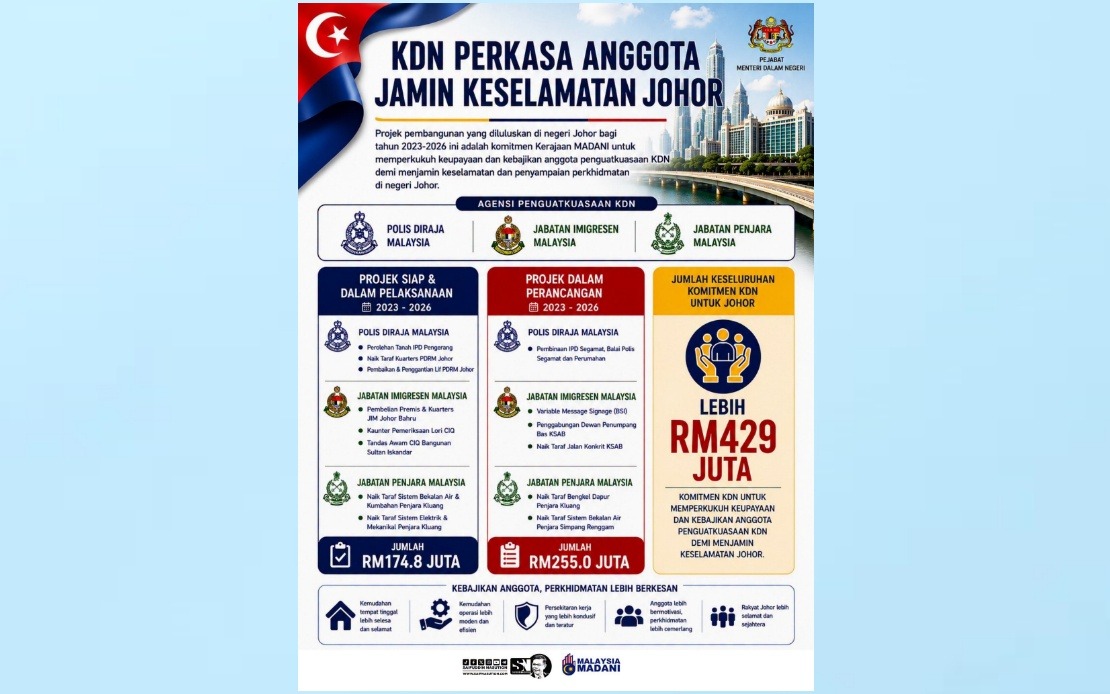
The Home Ministry has announced a substantial investment exceeding RM429 million directed at improving working conditions and operational effectiveness for enforcement agencies across Johor since 2023. The commitment targets three core institutions responsible for maintaining public order and security in Malaysia's southern state: the Royal Malaysia Police, the Malaysian Immigration Department, and the Malaysian Prisons Department. This strategic allocation reflects a broader government approach to recognising that personnel wellbeing directly translates to enhanced service delivery and stronger security outcomes for the communities these agencies serve.
Home Minister Datuk Seri Saifuddin Nasution Ismail characterised the funding as more than a routine budgetary exercise, framing it instead as a deliberate policy choice rooted in operational necessity. He emphasised that supporting enforcement officers through improved facilities, modern equipment, and comfortable working environments creates conditions under which these personnel can execute their responsibilities with greater proficiency and safety. The underlying logic reflects recognition that frontline workers operating under stress without adequate infrastructure inevitably compromise both personal welfare and public protection standards.
The ministry's financial commitment breaks down into two distinct phases. Completed or currently active projects account for RM174.8 million of the allocation, while RM255 million remains earmarked for initiatives still in planning stages. This phased approach allows for flexibility in implementation while ensuring that resources already committed demonstrate tangible results before subsequent tranche deployment. The dual-track strategy provides both immediate operational improvements and longer-term infrastructure development across Johor's enforcement landscape.
Among initiatives already underway, the Home Ministry is acquiring land for Pengerang District Police Headquarters, representing a significant commitment to decentralised policing infrastructure in the district. Simultaneously, the Immigration Department's Johor Bahru operations are benefiting from office premises and residential quarters procurement, addressing longstanding space constraints that have hampered administrative efficiency. Prison facilities are also receiving attention, with basic amenity upgrades underway at Kluang Prison, demonstrating that attention to custodial operations forms part of this broader enhancement programme.
Projected developments reveal the scope of transformation envisioned for Johor's enforcement ecosystem. The Segamat District Police Headquarters construction will establish an integrated facility combining operational police station space with residential quarters, a model addressing the geographical challenges of rural policing deployment. Infrastructure consolidation forms another component, with the bus passenger terminal relocation to the Sultan Abu Bakar Complex representing administrative streamlining. Prison facilities will see kitchen facilities modernisation and critical water supply system upgrades at Simpang Renggam, addressing both operational functionality and basic living standards.
From a policy perspective, this investment demonstrates the Home Ministry's acceptance that enforcement capacity building requires sustained resource commitment rather than sporadic funding. The allocation signals prioritisation of Johor specifically, though the framework reflects a broader national approach. For Malaysian readers accustomed to competing demands across different portfolios, the scale of this commitment—over RM429 million for a single state's three agencies—underscores internal ministry calculations regarding Johor's strategic importance and current operational deficiencies.
The timing of this announcement carries contextual significance. Johor, as Malaysia's second-largest state and a critical hub for economic activity, commerce, and cross-border movement, faces distinctive policing and security challenges that differentiate it from other regional jurisdictions. The state's proximity to Singapore, its port facilities, and its role as a transit point for national commerce create enforcement demands that generic allocations cannot address. The Home Ministry's targeted approach acknowledges these particularities rather than applying standardised funding formulas.
Minister Saifuddin Nasution positioned the allocation within the framework of the MADANI Government's broader development philosophy, emphasising equitable resource distribution calibrated to state-specific priorities and population requirements. He referenced recent parliamentary clarifications that Johor's development and management budget had expanded significantly to approximately RM14.6 billion, compared with RM10.2 billion in the previous allocation cycle. This contextualisation situates the Home Ministry's RM429 million commitment within a larger fiscal realignment favouring Johor, suggesting coordinated whole-of-government investment rather than isolated sectoral spending.
For Southeast Asian observers monitoring Malaysia's internal political dynamics, this announcement reflects confidence in the stability of the MADANI coalition and its capacity to deliver on infrastructure commitments despite previous governance challenges. The specificity of project descriptions and funding allocations suggests planning rigour and documented accountability, distinguishing this approach from historical patterns of announced allocations that underwent substantial revision or abandonment during implementation phases.
The personnel welfare emphasis carries particular weight in enforcement sector management. Recruitment and retention challenges in police, immigration, and prison services have represented persistent vulnerabilities in Malaysian security architecture. By explicitly linking welfare improvements to operational effectiveness, the Home Ministry legitimises investment in officer housing, facility upgrades, and equipment modernisation as security expenditure rather than peripheral administrative costs. This framing may influence future budget negotiations and establish precedent for similar claims from other enforcement portfolios.
Implementation challenges remain inherent to any large-scale infrastructure programme. Project timelines, cost escalations, and quality assurance will determine whether the RM429 million investment delivers anticipated security and welfare improvements. Malaysian experience suggests that announced allocations frequently encounter delays and budget pressures that compress originally intended scope. However, the phased approach adopted here—with near-term visible projects complementing longer-term infrastructure development—provides some insulation against total implementation failure whilst allowing for course corrections as circumstances evolve.

