The Home Ministry is embarking on an ambitious agenda to overhaul security infrastructure and government services throughout Johor, with Home Minister Datuk Seri Saifuddin Nasution Ismail signalling a strategic focus on the state's development priorities. Speaking in Johor Bahru on July 10, the minister framed Johor as a cornerstone of Malaysia's southern region, underscoring its significance as a major security hub, public service centre, and gateway for international traffic.
Johor's geopolitical importance as a border state and a major transit point for both land and maritime traffic has long made it a priority for federal development spending. The announcement comes at a moment when the state's infrastructure capabilities face mounting pressure from growing population flows, cross-border commerce, and the complex security demands of managing one of Southeast Asia's busiest international frontiers. The Home Ministry's coordinated approach reflects recognition that piecemeal improvements across disparate agencies will not suffice to modernise Johor's security and administrative apparatus.
The Royal Malaysia Police will receive significant capital investment under the plan. Two major police facilities are in the pipeline: a new district headquarters building for Segamat and land acquisition for a corresponding facility in Pengerang. Alongside these new structures, the ministry is funding extensive maintenance work on police quarters and lift systems at existing installations. These facility upgrades address long-standing complaints from frontline officers about ageing infrastructure, which can hamper operational effectiveness and staff morale. For a state where police operations span rapidly urbanising areas and sprawling rural zones, robust infrastructure translates directly to faster response times and more efficient resource deployment.
Border management remains a linchpin of Johor's strategic importance, and the Home Ministry is prioritising upgrades to immigration processing capacity. Two major facilities—the Sultan Iskandar Building and the Sultan Abu Bakar Complex—will undergo comprehensive facility improvements aimed at streamlining traveller flows while maintaining security standards. As Malaysia seeks to position itself as a competitive destination for regional tourism and business travel, the efficiency of border clearance at Johor's entry points directly affects the country's international standing. Better-organised immigration facilities with modern systems can reduce bottlenecks that currently frustrate legitimate travellers and businesses while strengthening the capacity to detect and deter illicit movements across borders.
The National Registration Department will establish a new office in Batu Pahat, bringing vital identity documentation and citizenship services closer to residents in that district. This expansion acknowledges Johor's demographic growth and the logistical strain on existing registration facilities. Given that identity documentation underpins access to employment, education, healthcare, and financial services, ensuring that residents have timely access to the JPN represents a foundational investment in economic participation and social integration across the state.
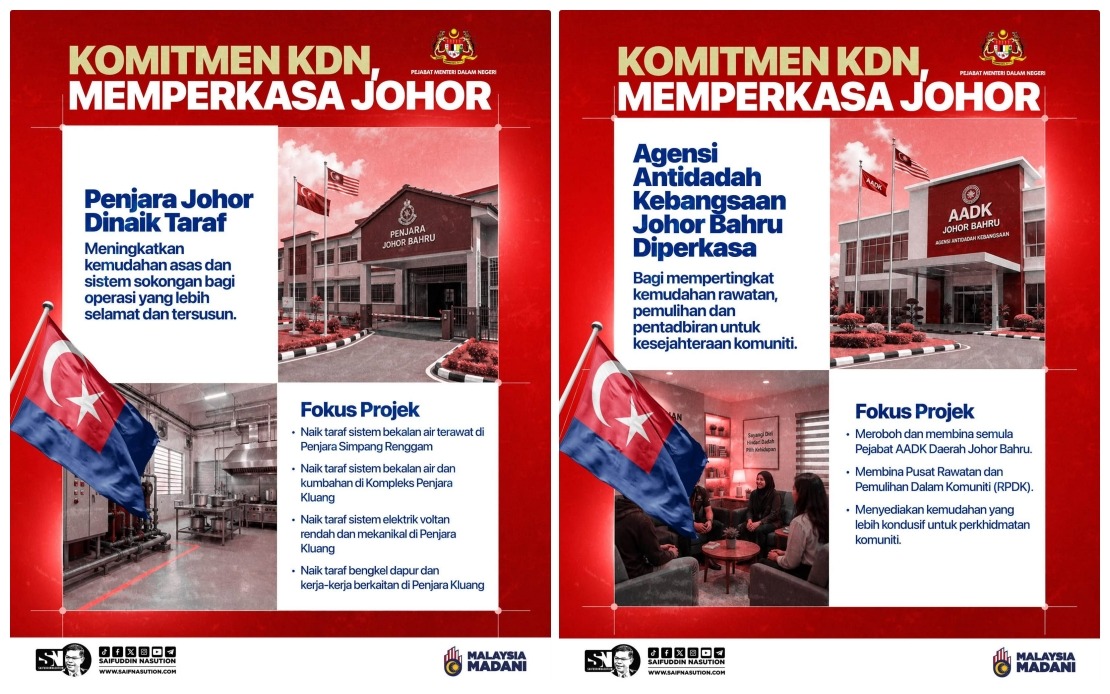
The prison system in Johor will benefit from substantial modernisation. Kluang Prison and Simpang Renggam Prison will undergo system upgrades targeting basic infrastructure—utilities, security systems, and facility management technology. These improvements serve multiple purposes: they enhance the operational capability of correctional institutions to manage inmate populations safely, improve conditions for personnel working in challenging environments, and support Malaysia's broader criminal justice objectives. Modern prison infrastructure reduces operational costs and security incidents while supporting rehabilitation programmes more effectively than ageing facilities.
Drug enforcement capacity will be substantially strengthened through redevelopment of National Anti-Drugs Agency offices and treatment centres throughout Johor. This element of the plan reflects escalating concern about synthetic drug trafficking and consumption patterns across Southeast Asia. As a major transhipment point and consumer market, Johor faces persistent drug-related challenges. Expanded and modernised AADK facilities enable more comprehensive drug intelligence gathering, improved coordination with law enforcement partners, and better access to treatment services for individuals struggling with addiction. The emphasis on treatment facilities alongside enforcement infrastructure signals a more balanced public health approach to drug control.
Maritime security capabilities will be enhanced through upgrades to Abu Bakar Maritime Base, involving jetty reconstruction and building improvements. For a state with extensive coastlines and maritime trading activity, robust maritime enforcement infrastructure is essential. The Malaysian Maritime Enforcement Agency requires modern facilities and equipment to monitor sea lanes, combat smuggling, prevent illegal fishing, and respond to maritime incidents. Johor's waters are transited by international shipping and are vulnerable to organised criminal activity; enhanced maritime base capacity strengthens Malaysia's sovereignty and territorial security.
The timing of these announcements, coinciding with Johor's state election cycle when approximately 2.7 million registered voters were preparing to elect 56 state assemblymen, inevitably frames the Home Ministry's initiatives within electoral politics. Development spending in Johor carries both practical and symbolic weight: it demonstrates federal commitment to the state's development while potentially influencing voter perceptions about which political leadership—state or federal—delivers tangible improvements in daily life. For many Johor residents, particularly those in smaller towns and rural areas, the promise of modernised government facilities and improved public services resonates directly with their lived experience of bureaucratic access and state capacity.
The Home Ministry's holistic approach across multiple agencies reflects contemporary thinking about whole-of-government service delivery. Rather than allowing individual agencies to operate from fragmented or outdated infrastructure, coordinated investment creates synergies. Police can work more effectively with immigration authorities when facilities are designed for interagency coordination. Maritime enforcement integrates better with land-based police operations when communication systems and databases are compatible. This integrated perspective positions Johor's security and administrative institutions to function more cohesively in addressing complex transnational challenges including smuggling, human trafficking, and organised crime.
For Malaysian businesses and investors, improved infrastructure in Johor's government services translates into smoother operations and reduced transaction costs. Import-export businesses benefit from faster border processing. Companies recruiting workers benefit from efficient immigration clearance. Construction and industrial sectors benefit from improved coordination between government agencies. These broader economic efficiency gains extend the impact of infrastructure investment beyond security considerations into competitive advantage and commercial productivity.
The commitment articulated by Saifuddin Nasution—that every allocation must deliver direct public benefits while strengthening security agency preparedness—represents an implicit recognition that infrastructure investment is not merely bureaucratic housekeeping but rather foundational to state capacity. Johor's rapid urbanisation, its role as Malaysia's window to the wider region, and its domestic political significance combine to make it a test case for how well the federal government can modernise state institutions. Whether these projects are executed efficiently and deliver promised benefits will influence both Johor residents' assessments of federal performance and broader perceptions about governance capacity in Malaysia.

