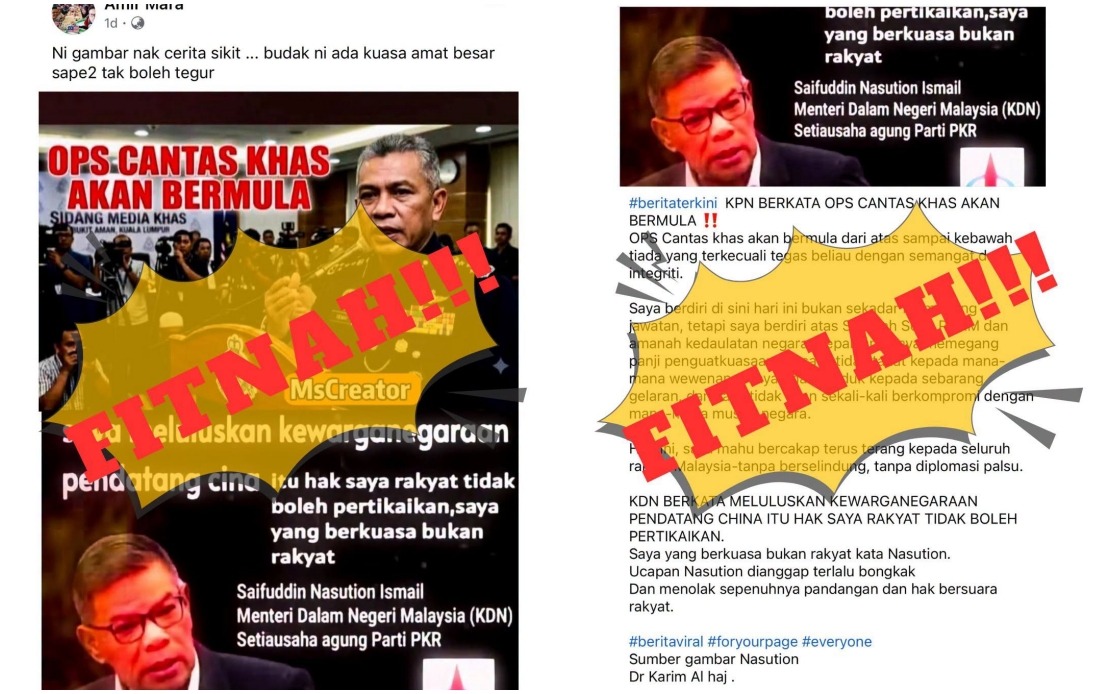
Home Minister Datuk Seri Saifuddin Nasution Ismail has pushed back sharply against recurring accusations that the Ministry of Home Affairs (KDN) conducted mass naturalisation of foreign nationals, describing the allegations as a coordinated misinformation campaign that deliberately recycles discredited narratives to sow division among Malaysians. Speaking from Putrajaya on August 19, Saifuddin addressed claims that have circulated persistently on social media, including assertions involving 1.2 million Chinese nationals remaining in the country through alleged improper citizenship grants.
The Home Minister emphasized that he has repeatedly and publicly rejected these allegations, providing factual explanations supported by official governmental data on each occasion. Yet despite his consistent denials and the circulation of corrected information through official channels, Saifuddin observed that certain parties continue to deliberately resurrect old videos, posters and narratives that have already been addressed and debunked by authorities.
In characterizing the phenomenon, Saifuddin highlighted the deliberate nature of the misinformation campaign, noting that those propagating these claims appear intent on confusing the Malaysian public and exploiting sensitive communal issues to generate racial tension and animosity. The deliberate recycling of already-corrected materials suggests a coordinated effort rather than simple misunderstanding or honest confusion about citizenship policies and procedures.
The minister stressed that the matter had been thoroughly explained through official government channels, with comprehensive facts and documentation provided in earlier ministerial statements and extensive media coverage. These official explanations represent the authoritative position on citizenship administration and should serve as the reference point for public understanding of KDN's actual procedures and policies.
Saifuddin warned of the broader dangers posed by the persistent dissemination of false claims about government institutions. Beyond the reputational damage to individuals or organisations implicated in such accusations, he expressed concern that widespread acceptance of unverified allegations could fundamentally undermine public confidence in state institutions. This erosion of institutional trust represents a significant governance risk, as it weakens the social contract between citizens and government agencies responsible for critical functions like citizenship administration and national security.
The misinformation carries potential to disrupt public order and threaten national security by stoking intercommunal tensions and exploiting legitimate historical sensitivities around citizenship and immigration policy in Malaysia. By framing citizenship administration as subject to improper political manipulation, such narratives delegitimise the formal processes through which Malaysia manages its demographic composition and legal residence status.
Saifuddin made a direct appeal to all segments of society to cease spreading such unsubstantiated claims and to resist the temptation to weaponise sensitive issues for narrow political advantage or social media engagement and attention. This plea recognises that misinformation often thrives precisely because it attracts social media engagement and visibility, incentivising its continued circulation regardless of factual accuracy.
The Home Minister called on the Malaysian public to verify information through official government sources before accepting or sharing claims about sensitive institutional matters. This recommendation reflects the importance of information literacy and responsible media consumption in an era of rapid information dissemination through digital platforms, where false claims can reach millions before factual corrections gain traction.
Saifuddin emphasised the distinction between facts established through official process and data compiled by government authorities, on one hand, and unverified allegations circulated through social media on the other. He urged Malaysians not to allow false claims and unsubstantiated narratives to displace verified information and established facts in their understanding of government policies.
The underlying concern animating the minister's statement reflects broader challenges facing government institutions across Southeast Asia, where social media has democratised information distribution but simultaneously enabled the rapid spread of misinformation capable of generating real-world social division. Malaysia's experience with citizenship-related misinformation demonstrates how historical sensitivities and demographic complexity can become fertile ground for coordinated or opportunistic disinformation campaigns.
The circulation of posters and online materials alleging mass citizenship grants represents a persistent challenge to official narratives about KDN's administration of citizenship policy. These materials have achieved sufficient circulation to warrant repeated public correction by the Home Minister, suggesting that the misinformation has found receptive audiences among segments of the Malaysian population.
Saifuddin's response reflects a conscious strategy of distinguishing between good-faith confusion about citizenship procedures, which official explanation can address, and malicious deliberate propagation of false claims designed to damage institutional credibility and generate social division. This distinction is important for understanding both the nature of the threat and the appropriate response.

