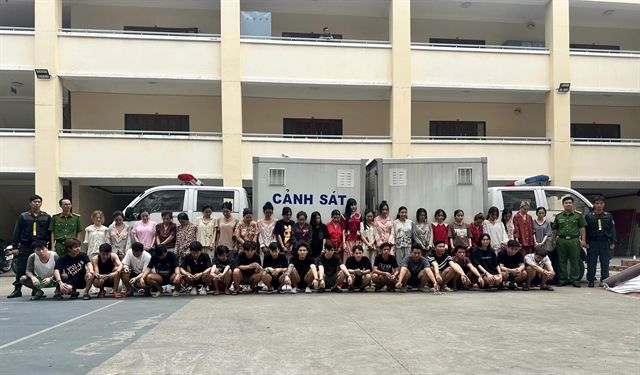
Law enforcement in Ho Chi Minh City has dismantled a sprawling criminal network distributing electronic cigarettes laced with etomidate, a controlled anaesthetic substance, following a major investigation that resulted in the arrest of 49 individuals including four foreigners. The operation revealed an alarming trend of sophisticated drug smuggling targeting young Vietnamese consumers through products marketed with deceptive, trendy names designed to appeal to nightlife venues and recreational users.
The seized materials paint a picture of a well-organised distribution system. Police confiscated 1,670 vape pods laden with the dangerous substance, alongside hundreds of grams each of ketamine and methamphetamine. The sheer volume of contraband suggests operations on a commercial scale rather than small-time peddling, indicating how effectively criminal groups have adapted traditional drug trafficking methods to exploit the growing popularity of vaping culture across Southeast Asia.
Etomidate occupies a peculiar and dangerous niche in the illicit drug marketplace. As a short-acting sedative reserved exclusively for surgical anaesthesia under strict medical supervision, its inclusion in commercial vape products represents a radical perversion of the substance's intended pharmaceutical purpose. Vietnamese authorities only designated etomidate as a controlled substance in January, meaning traffickers had a brief window before legal consequences became criminal offences. When inhaled through e-cigarettes, the drug bypasses normal absorption barriers and enters the bloodstream through lung tissue within seconds, reaching the brain with frightening speed and unpredictability.
The criminal ingenuity displayed in this operation is noteworthy. Sellers disguised etomidate within sweetening agents commonly used in vape liquid, then distributed products under carefully chosen marketing names including "chill pod", "relaxation pod", "sleep-well pod", and "fly pod" that appealed to the recreational expectations of their target audience. These products commanded premium prices, reflecting both their illicit status and the perceived desirability among consumers seeking novel psychoactive experiences. The vapes found their way into bars, karaoke establishments, rental apartments, and other venues where young people congregate, creating widespread exposure across Ho Chi Minh City's youth culture.
The investigation's breakthrough came through intelligence about a street-level dealer operating on An Duong Vuong Street in An Lac Ward, known colloquially as "Ba Giá". This led police to identify Nguyen Huu Huan, a 28-year-old from Dong Thap province, who along with his wife Ngo Thi Kim Chi was arrested on June 25 for distributing etomidate-laced vapes to customers. However, as investigators traced supply chains upward, they uncovered a far more complex ecosystem involving multiple competing networks operating simultaneously throughout the city.
Two distinct supply operations fed Huan's retail distribution. One network, managed by Huynh Ngoc Thuy Nhu with assistance from the 20-year-old Hua Tuong Vy, both Ho Chi Minh City residents, represented a purely local operation. The second network presented a cross-border dimension that fundamentally complicates Southeast Asian drug enforcement. Le Quoc Duy, a 40-year-old from An Giang province, orchestrated smuggling operations through Cambodia, moving contraband across remote border crossings before transporting it to Ho Chi Minh City for wider distribution. Police recovered 37 vape pods from Duy alongside 200 grams each of ketamine and methamphetamine, indicating he also trafficked in traditional narcotics alongside the novel etomidate products.
A third supplier network demonstrated the transnational character of contemporary drug distribution. Led by Han Kiat, a Cambodian national, this group coordinated with three additional foreign operatives to specifically target expatriate communities living in Ho Chi Minh City. This segmentation of markets—with different networks focusing on Vietnamese youth, general urban consumers, and foreign residents—suggests sophisticated commercial structure rather than chaotic criminality. The involvement of South Korean, Chinese, and Cambodian nationals underscores how regional criminal networks have integrated across Southeast Asia.
The public health dimensions of etomidate circulation extend beyond the immediate dangers of the substance itself. Users initially experience mild euphoria and hallucinations that create strong incentive for repeat use, but acute exposure produces neurotoxicity, severe drowsiness, involuntary muscle contractions, and loss of consciousness. The gravest risk emerges when etomidate combines with alcohol or other central nervous system depressants, a scenario virtually inevitable in bar and karaoke settings where the vapes are peddled. Such combinations can trigger sudden respiratory failure and death in users who may be entirely unaware they have inhaled a potent anaesthetic rather than a mere nicotine product.
A critical enforcement challenge compounds the distribution problem: conventional rapid-test drug kits available commercially cannot detect etomidate because its chemical structure differs fundamentally from traditional narcotics like heroin, cannabis, or methamphetamine. Only sophisticated police and forensic laboratory systems possess analytical capability to identify the substance, meaning users face virtually undetectable exposure. Traffickers deliberately exploit this information asymmetry in marketing materials, advertising products as "undetectable" or "100 per cent negative" on standard tests to reassure nervous customers that consumption carries minimal legal risk—a claim dangerously divorced from the actual health hazards involved.
The operation reflects broader Southeast Asian concerns about pharmaceutical and precursor chemical diversion into illicit markets. Regional borders remain porous despite intensifying enforcement efforts, and Cambodia's relatively permissive drug environment creates sourcing opportunities for Vietnamese and Thai networks. The involvement of foreign nationals suggests integration with international trafficking architectures extending beyond the region, potentially linking to broader East Asian drug markets connecting to Japan, South Korea, and China.
Ho Chi Minh City police have issued urgent public advisories targeting young people and the general population, counselling citizens to avoid e-cigarettes of unknown provenance and to reject marketing claims suggesting special properties or undetectable composition. The fundamental challenge remains that vaping represents a normalised consumer behaviour among youth populations, making deceptive products inherently appealing precisely because they appear to fit within legitimate consumption patterns. Enforcement success against individual networks proves difficult to sustain when the underlying technology and market remain attractive and widely accessible.
The bust demonstrates contemporary law enforcement's capacity for complex, multi-layered investigations tracking networks across urban and border regions. Yet it also highlights persistent structural vulnerabilities in Southeast Asia's drug control systems. As long as pharmaceutical access remains inconsistent across the region and border enforcement remains constrained by limited resources and competing priorities, novel and dangerous substances will continue circulating through increasingly sophisticated distribution channels that adapt faster than regulatory frameworks can respond.

