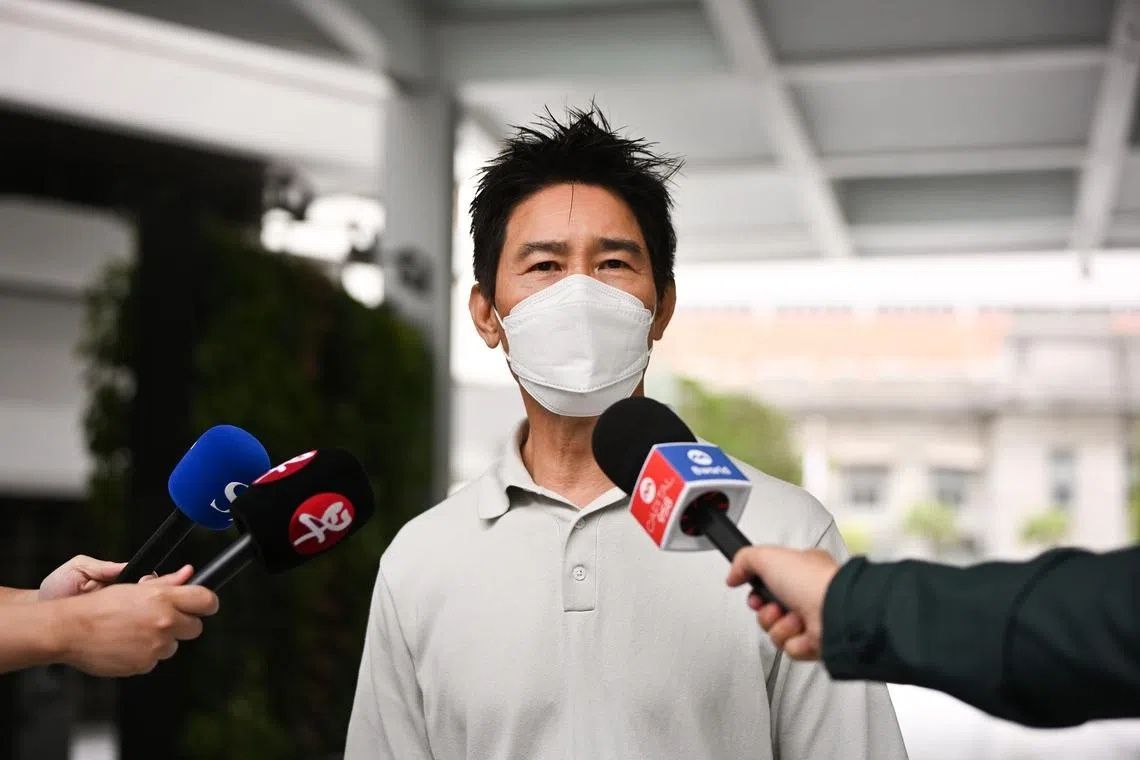
Edmund Chen, the 64-year-old former Singaporean actor whose real name is Tan Kai Yuan, has had his custodial sentence substantially reduced by the High Court following an appeal against his conviction in a motor vehicle accident. Justice Hri Kumar Nair delivered the judgment on Monday, July 20, cutting the original five-day jail term imposed by the district court to just one day, though maintaining other penalties including a five-year driving disqualification. The case highlights the appellate system's reassessment of proportionality in sentencing, particularly where custodial terms for traffic offences are concerned.
The incident itself occurred on the afternoon of March 4, 2025, along the Ayer Rajah Expressway as it approaches the Central Expressway. Chen, who was driving in the fourth lane, had decelerated significantly—nearly coming to a complete halt—before attempting to shift lanes toward the third lane. His intention was to access the CTE/SLE junction, but he had failed to position his vehicle in the appropriate lane ahead of the road split. A 21-year-old motorcyclist travelling behind Chen's vehicle collided with it despite executing an evasive manoeuvre, sustaining multiple wrist fractures in the collision. Notably, Chen stopped at the scene to provide assistance, and the victim was subsequently transported to Singapore General Hospital for surgical intervention performed under local anaesthesia.
Chen's initial conviction came with a guilty plea to a single charge of causing grievous hurt while operating a motor vehicle without due consideration for other road users. The district judge, rendering judgment on January 29, had imposed the five-day custodial sentence despite the prosecution itself recommending a financial penalty ranging from S$3,000 to S$5,000. This disjuncture between prosecutorial recommendation and judicial sentencing proved significant in the appeal process. The judge had also imposed the five-year driving ban alongside the jail time, treating the incident as sufficiently serious to warrant temporary incarceration despite the prosecution's more lenient position.
On appeal, Chen's newly engaged counsel—Senior Counsel Abraham Vergis of Providence Law Asia—mounted a vigorous challenge to the custodial element of the sentence. Vergis contended that the threshold for imprisonment had simply not been crossed in Chen's circumstances, and he sought to persuade the appellate court to impose the maximum permissible fine of S$5,000 coupled with the five-year driving disqualification. Justice Hri Kumar Nair's judgment acknowledged the tension inherent in the case: while he could not conclude that the district judge had erred in determining that a custodial threshold existed, he found the five-day term to be manifestly excessive in its quantum, necessitating appellate intervention.
Vergis's defence strategy centred on several factual elements emerging from the dashcam footage captured by Chen's vehicle. The lawyer highlighted that Chen had activated his indicator lights before changing lanes, suggesting a degree of procedural compliance despite the ultimately careless manoeuvre. Furthermore, Vergis noted that the motorcyclist had been obscured from Chen's direct line of sight by a passing vehicle negotiating the curve in the road at that moment. The footage also revealed that Chen had executed his lane change across white chevron markings on the road surface, which the district judge had treated as a breach of traffic regulations warranting enhanced punishment. The defence contended this breach alone did not justify imprisonment when a substantial fine would serve the same deterrent purpose.
A critical aspect of Vergis's submission involved characterising the victim's injuries as falling within the less severe spectrum of grievous hurt. The multiple wrist fractures, while undoubtedly serious, were localised to the extremities of the body rather than affecting vital organs or the central nervous system. The fact that surgical repair occurred under local rather than general anaesthesia suggested the medical complexity remained manageable. The victim spent only two days in hospital before being discharged with 99 days of hospitalisation leave, and importantly, no permanent disability resulted from the injuries. This medical framing proved influential in the appellate judgment, as the severity of injury is a standard sentencing consideration.
Deputy Public Prosecutor Ben Tan maintained the prosecution's original position during the appeal hearing, contending that a high fine approaching S$5,000 combined with the five-year driving ban remained appropriate. The DPP acknowledged that the district judge had positioned the sentence at the higher end of the sentencing spectrum for such offences, but argued this did not constitute an error sufficiently grave to warrant appellate reversal. The prosecutor drew the court's attention to the fact that drivers of two passing vehicles had sounded their horns to warn Chen of the dangerous manoeuvre, yet he had persisted regardless—a detail suggesting a degree of inattentiveness or deliberate disregard for warnings from other road users.
The case carries particular resonance given Chen's public profile and the renewed media attention surrounding his legal difficulties. Chen rose to prominence as a household name through appearances in multiple acclaimed television drama series including Star Maiden and Patrol, which were fixtures of Singapore's entertainment landscape. He had voluntarily withdrawn from show business around the year 2000 to focus on parenting his daughter, Chen Yixin, though he occasionally accepted acting roles in subsequent decades, including a 2017 appearance in Life Less Ordinary. His spouse is veteran actress Xiang Yun, recognised for iconic roles in classic local productions such as The Awakening, Double Happiness and The Little Nyonya, making this a prominent family within Singapore's entertainment sector.
The procedural history of Chen's legal representation also merits attention. Initially, Chen engaged Invictus Law's Josephus Tan and Cory Wong to handle his defence through the district court proceedings. Following the imposition of the five-day sentence, dissatisfied with the outcome, he retained additional counsel from Contigo Law—specifically Kelvin Ong and Dickson Chew—before ultimately engaging the prominent Senior Counsel Abraham Vergis of Providence Law Asia for the appellate stage. This progression through successive legal teams underscores the intensity with which Chen pursued appellate review and the significance he placed on reversing or substantially reducing the custodial component of his sentence.
Prior to the High Court hearing, Chen expressed considerable personal distress about his circumstances. He disclosed to reporters that he had prepared five days' worth of medication anticipating that he would be remanded into custody, and that both he and his family had been unable to sleep on the night before the hearing. These statements painted a picture of considerable psychological and emotional toll stemming from the conviction and imprisonment prospect. The dramatic reduction from five days to one day of custody, combined with the prospect that time served or other considerations might eliminate even this remaining term, represents a substantial vindication of his appeal strategy and a source of profound relief for Chen and his family.
The judgment reflects broader judicial principles about proportionality in sentencing, particularly the recognition that custodial terms should be reserved for circumstances where their necessity is genuinely established. The appellate court's intervention suggests that while traffic offences causing injury warrant serious punishment, the calibration of that punishment must remain proportionate to the circumstances. For Malaysian readers accustomed to Singapore's strict traffic enforcement regime, the case demonstrates that even within that framework, appellate courts will intervene where sentencing appears excessive relative to comparable cases and the particular facts. The reduction also underscores how appellate litigation can substantially alter outcomes, rewarding those with resources to pursue sophisticated legal challenges.
Looking forward, Chen's case will likely be cited in subsequent traffic injury matters where the severity of custodial sentences is contested. The judgment establishes important guidance that injuries localised to extremities, managed through surgery under local anaesthesia, and resulting in relatively brief hospitalisation without permanent disability, may not warrant custodial punishment when combined with substantial fines and driving disqualification. For road safety advocacy organisations, however, the case presents a more complex picture: while Chen's sentence was reduced, he remains convicted of causing grievous hurt, faces a five-year driving ban, and continues to bear the reputational and psychological consequences of the incident. The case ultimately reflects the balance appellate courts attempt to strike between accountability and proportionality within criminal justice systems.

