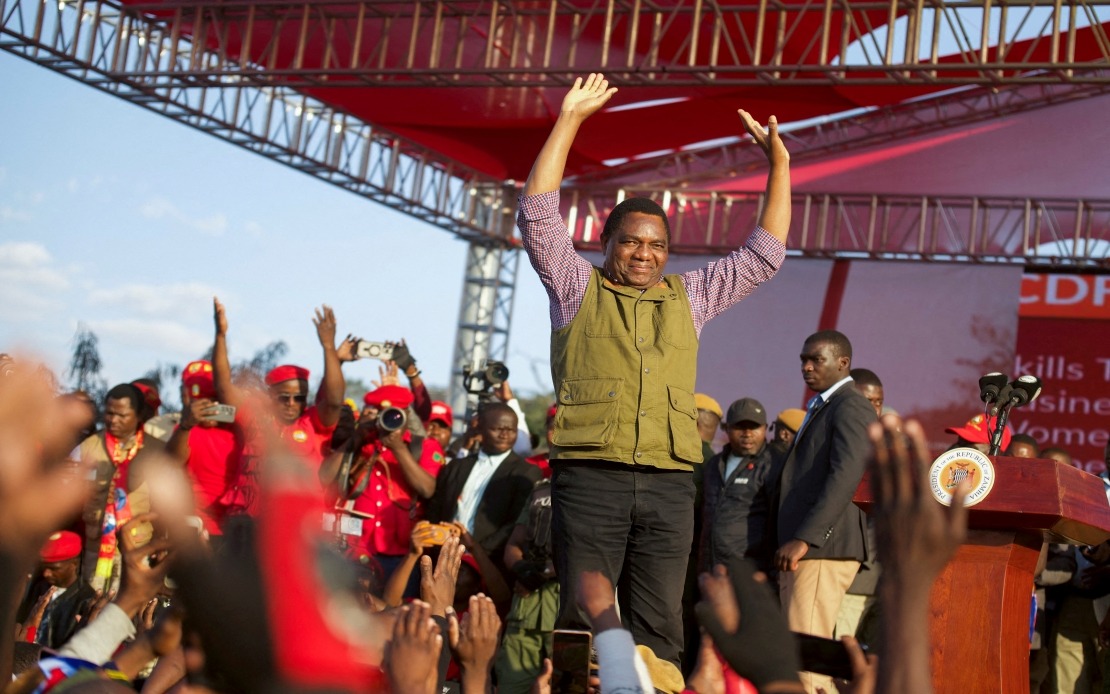
Zambian President Hakainde Hichilema has established a formidable position in his country's presidential contest, accumulating 1,544,140 votes across 135 of 226 constituencies that had been tallied by mid-August. The Electoral Commission of Zambia announced the consolidated tally at the National Election Results Centre in Lusaka, with Commission Chairperson Mwangala Zaloumis overseeing the disclosure of results that signal a decisive trajectory for the incumbent leader.
Hichilema, a 64-year-old economist and rancher contesting under the ruling United Party for National Development, has substantially outpaced his nearest rival. Brian Mundubile of the National Reconciliation Party for Unity and Prosperity trailed significantly with 1,030,662 votes, representing a gap of more than 500,000 ballots. This margin reflects Hichilema's broad appeal across multiple regions, though complete national tallies were still pending as counting continued across all 226 constituencies.
The constitutional framework governing Zambia's elections requires any winning candidate to secure more than 50 per cent of valid votes cast to claim the presidency outright. Should no contender achieve this threshold in the initial count—a scenario appearing increasingly unlikely given the incumbent's commanding position—the constitution mandates a second ballot between the top finishers. However, Hichilema's current vote share relative to his nearest challenger suggests he may well exceed this requirement when final results are certified.
For Malaysian observers of southern African political developments, Hichilema's trajectory holds particular interest as a case study in economic governance and electoral legitimacy in a developing democracy. His first term, which commenced in 2021 following a landslide victory over incumbent Edgar Lungu by a margin exceeding one million votes, established a foundation of popular support that appears to have endured. The consistency of backing across multiple election cycles often indicates genuine policy resonance rather than superficial popularity.
The Zambian leader has anchored his campaign messaging around tangible economic achievements undertaken during his initial administration. Most prominently, he emphasises the restructuring of the nation's historically excessive debt burden, a critical undertaking that has relevance for other African nations grappling with unsustainable fiscal obligations. This focus on macroeconomic stabilisation reflects priorities increasingly shared across the continent, where debt servicing has constrained public investment in essential services.
Beyond debt management, Hichilema's first-term record encompasses revival of Zambia's mining sector, historically the backbone of the national economy but subject to considerable volatility and mismanagement in previous administrations. His government's effort to restore stability and productivity in this crucial industry addresses not merely local concerns but resonates regionally, given the interconnected nature of mineral-dependent economies across southern Africa. Copper prices and production levels in Zambia directly influence regional economic dynamics.
Social sector expansion represents the third pillar of Hichilema's electoral platform. His administration introduced free education for students attending public primary and secondary schools, a populist measure that directly benefits millions of Zambian families whilst addressing long-term human capital development. Such welfare-oriented policies appeal particularly to younger voters and urban constituencies increasingly concerned with accessible quality education.
Mundubile's opposition alliance has nevertheless demonstrated competitive strength in specific geographic pockets, notably securing parliamentary representation in urbanised regions along Zambia's economic corridor centred on Lusaka and the Copperbelt mining zones. These areas, typically more cosmopolitan and politically volatile, suggest that opposition sentiment retains genuine roots in certain demographic segments. The distribution of opposition support across urbanised territories rather than rural constituencies implies the contest reflects real ideological and policy differences rather than purely personality-driven politics.
For regional observers in Southeast Asia, the Zambian election underscores broader patterns in contemporary African politics: the significance of incumbent performance on material issues such as debt, employment, and education; the persistence of meaningful electoral competition even when incumbents hold substantial advantages; and the continued importance of geographic constituencies in determining political outcomes. Hichilema's apparent trajectory toward a second term, should current trends hold through final tallying, would represent validation of his economic management approach by voters who experienced both the previous administration's governance and his own reform programme.
The election also reflects Zambia's institutional maturity in managing peaceful, transparent contests. The Electoral Commission's public announcement of consolidated results at designated centres, the constitutional clarity regarding majority requirements and runoff procedures, and the apparent acceptance of results by competing camps all indicate democratic institutions functioning credibly, a prerequisite often overlooked in assessments of southern African political development.
As counting continues across remaining constituencies, Hichilema's substantial lead suggests the direction of the ultimate outcome is unlikely to shift dramatically. Whether he ultimately exceeds the 50 per cent threshold in the initial count or requires a second ballot appears almost academic given his current margin. For Malaysian policymakers monitoring international governance trends, Hichilema's re-election would suggest that voters across diverse developing democracies reward governments demonstrating competence in macroeconomic management and expansion of essential social services, regardless of regional or cultural context.

