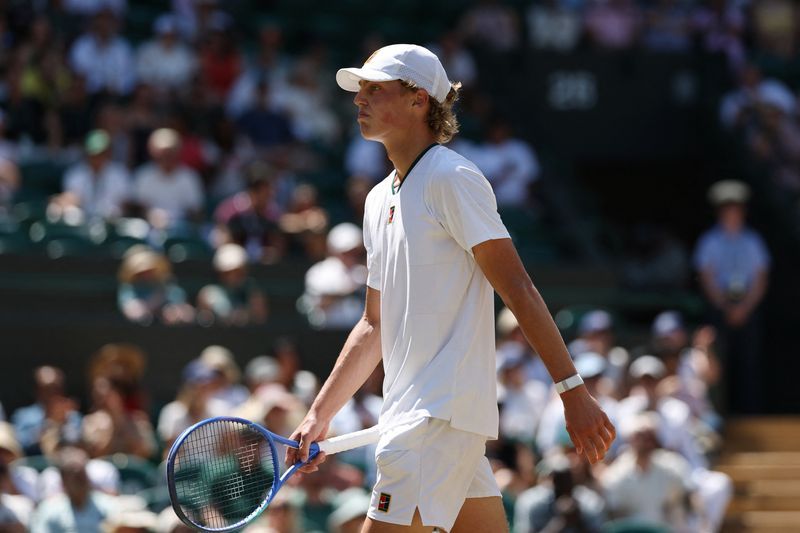
Cruz Hewitt, the 17-year-old son of former world number one Lleyton Hewitt, has announced himself on professional tennis's biggest stage by securing his maiden ATP Tour victory at the Washington Open. Playing as a qualifier in the ATP 500 event, the Australian teenager dismantled American Marcos Giron with a convincing 6-3 6-4 victory in the opening round on Tuesday, marking a transformative moment in what has already been a remarkable summer for the rising talent.
The timing of Cruz's breakthrough carries particular resonance given the venue. His father claimed the Washington Open title in 2004, meaning the younger Hewitt has now etched his name into the same tournament record books. For Cruz, the occasion transcended mere sporting achievement—the teenager described the experience as "surreal," acknowledging the weight of competing in a location so intertwined with his family's tennis legacy. The victory also represents a generational milestone, with Cruz becoming the youngest player to win a match at the Washington event since Kei Nishikori achieved the feat in 2007, a gap of sixteen years that underscores just how rare such precocious success proves at the professional level.
Cruz's ascent this summer has been nothing short of meteoric. Just weeks earlier, he reached the final of the Wimbledon boys' championship, finishing as runner-up to American Jordan Lee in a tournament where his father famously triumphed on the grass courts of London decades ago. Despite the disappointment of falling short in that prestigious junior event, Cruz demonstrated the mental resilience and technical proficiency expected of a player bearing the Hewitt name. The consecutive high-profile performances—a grand slam final followed immediately by a professional main draw victory—suggest the teenager possesses the temperament and consistency required to sustain a career at elite levels.
Currently ranked 612 in the world, Cruz enters the Washington tournament as an unlikely contender given his status as a qualifier. Qualifiers typically comprise lower-ranked players competing in preliminary rounds to secure one of the final spots in the main draw, making their victories over established professionals all the more impressive. That Cruz conquered this pathway and then defeated Giron, a more experienced competitor, validates the hype surrounding his potential and suggests the ranking will rise substantially in coming weeks and months.
In reflecting on his achievement, Cruz demonstrated mature perspective about the pressures accompanying professional tennis at such a young age. His father's counsel proved invaluable: the senior Hewitt advised his son to simply enjoy the occasion, to process each point individually rather than become overwhelmed by the magnitude of the moment. This philosophical approach—compartmentalising pressure, focusing on process over outcome—mirrors the mental frameworks that underpinned Lleyton Hewitt's own success during a career that included reaching the Australian Open final and ascending to world number one.
Cruz's victory adds another layer to a remarkable generational story within professional tennis. He becomes the fourth player born in 2008 or later to achieve an ATP Tour-level victory, joining Diego Dedura, Thijs Boogaard and Moise Kouame in this exclusive cohort. The emergence of multiple teenage victors suggests a shift in how younger players develop—improved coaching structures, better physical conditioning, and perhaps earlier exposure to elite competition are enabling teenagers to compete credibly against seasoned professionals.
Looking ahead to the second round, Cruz faces a fascinating potential matchup. His opponent will emerge from a contest between Greek superstar Stefanos Tsitsipas and fellow Australian Alex de Minaur. Should de Minaur advance, the Hewitt family would enjoy a compelling subplot: Cruz expressed genuine enthusiasm about the prospect of facing his compatriot, describing him as an older brother figure and acknowledging de Minaur's profound influence on his development. The two have shared homes during holidays and maintain a close personal bond extending beyond professional tennis, yet sporting competition would require them to temporarily set aside that relationship.
This narrative encapsulates what makes tennis compelling at the professional level—the convergence of personal relationships, family legacies, and individual ambition. For Malaysian and Southeast Asian observers, Cruz Hewitt's emergence holds particular relevance. The region has produced several promising junior talents in recent years, and Hewitt's pathway demonstrates what modern professional support systems can achieve. His success underscores that younger players from any nation can compete credibly on tennis's premier circuits, provided they possess adequate technical foundation, mental fortitude, and access to quality coaching.
The Washington Open victory also highlights the unpredictable nature of professional sports. Qualifying for ATP tournaments requires players to win multiple matches before even reaching the main draw proper. Cruz's progression through qualifying, then his first-round victory, represents the culmination of meticulous preparation and strategic development by his coaching team. His continued advancement through the tournament—should he defeat either Tsitsipas or de Minaur—would represent genuinely stunning progress for a player still in his teenage years.
Cruz's emergence as a legitimate professional competitor validates the patient, long-term approach to athlete development. Rather than pursuing early specialization exclusively, the Hewitt family appears to have invested in building comprehensive skills, mental resilience, and genuine love for the sport. These foundations, combined with his evident technical capability, suggest that Tuesday's victory represents merely the first chapter in what could become a compelling professional career.

