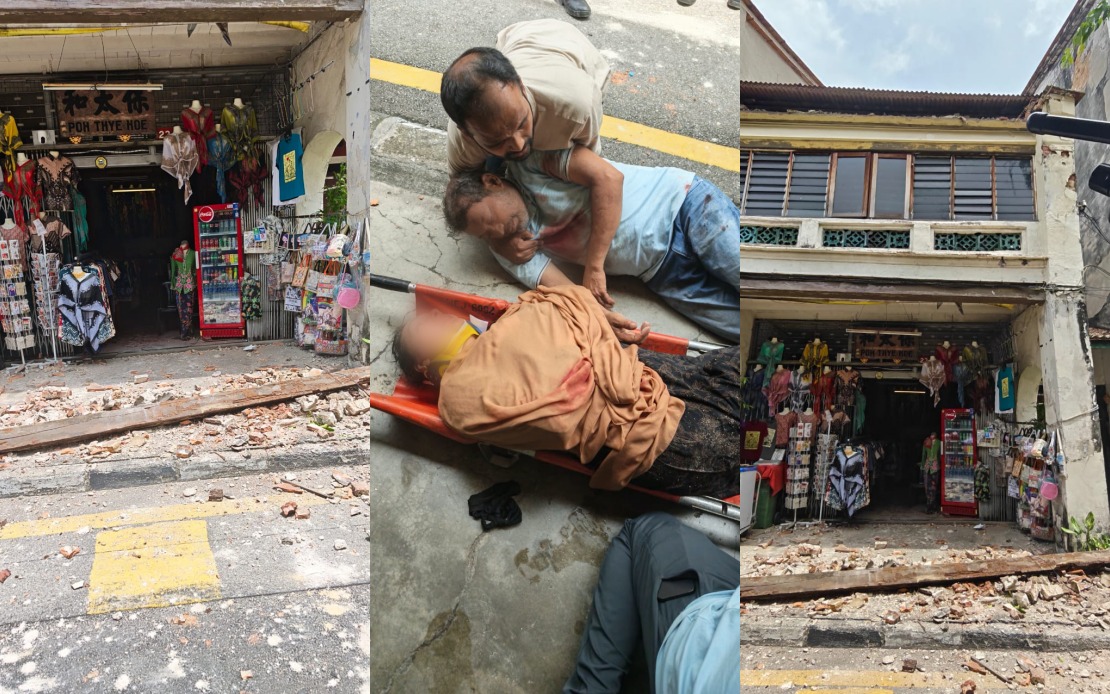
A structural failure at one of George Town's heritage buildings has raised fresh concerns about the safety of the enclave's aging architecture. Two tourists from Sri Lanka—Mohamad Ammtar, 66, and Fatimah, 55—were struck by falling debris comprising stones and timber from a first-floor beam as they walked along Armenian Street, one of the most frequented routes through the UNESCO World Heritage zone, on August 4. Emergency responders from the Lebuh Pantai Fire and Rescue Station arrived at the scene within minutes of receiving the distress call at 1.11 pm and rendered immediate medical assistance before both visitors were conveyed to Penang Hospital for further treatment.
The affected structure, located along the historic Armenian Street corridor, operates a ground-floor grocery business with upper floors that appeared unoccupied at the time of the incident. That the collapse occurred in such a visible and trafficked area underscores a vulnerability that has long concerned heritage conservation advocates across Southeast Asia. The timing was particularly inopportune for the two visitors, who had scheduled their departure to Sri Lanka for the following day, disrupting their travel plans and complicating their recovery process.
Penang's political leadership has responded with urgency to the incident, recognising that safety failures in heritage zones threaten not only visitor confidence but also the long-term viability of cultural tourism in the region. Wong Hon Wai, chairman of the State Tourism and Creative Economy Committee, visited the scene and subsequently announced that both the George Town World Heritage Incorporated (GTWHI) and the Penang City Council (MBPP) would be issuing formal advisories requiring all heritage building proprietors to undertake comprehensive structural safety assessments.
Wong's statement revealed the gravity with which state authorities are treating the matter, framing it not merely as an isolated accident but as a systemic challenge demanding immediate intervention. He emphasised that inspection protocols must extend across the entire heritage precinct rather than focus narrowly on the one structure that failed. This broadened approach reflects growing recognition that decades-old buildings, while architecturally significant and economically valuable as tourism assets, require proactive maintenance and monitoring to prevent catastrophic failures that could undermine both visitor safety and the reputation of heritage sites.
The condition of George Town's historic infrastructure has long presented a balancing act between conservation and pragmatism. Many structures in the enclave date from the 19th century, when construction standards differed markedly from modern requirements. The wooden beam systems and stone facades that define the area's aesthetic character are often more vulnerable to deterioration than contemporary building materials. Tropical climate conditions, including prolonged humidity and occasional structural settling, compound these vulnerabilities over time. Consequently, systematic monitoring becomes essential for maintaining both structural integrity and public safety.
The Penang government's decision to engage the Sri Lankan High Commission in Kuala Lumpur demonstrates an awareness of the diplomatic dimensions of incidents affecting international visitors. Such proactive coordination helps mitigate potential reputational damage and demonstrates commitment to visitor welfare. For heritage tourism destinations across Malaysia and the broader region, how state authorities respond to safety incidents shapes international perceptions of professionalism and visitor care. The willingness to provide immediate assistance and coordinate with foreign diplomatic missions signals confidence in institutional capacity to manage crises effectively.
The investigation into the underlying causes of the structural failure remains ongoing, with authorities awaiting comprehensive technical reports to establish whether the collapse resulted from poor maintenance, material degradation, inadequate previous repairs, or other factors. Understanding the root cause is essential not only for holding responsible parties accountable but also for informing the scope and nature of the mandated safety inspections. Different failure modes require different remedial approaches, and a precise diagnosis enables more targeted and cost-effective intervention across the broader building stock.
George Town's heritage district generates substantial economic returns through tourism, cultural events, and heritage-focused retail and hospitality establishments. Roughly two million visitors annually explore the precinct, making safety infrastructure paramount. A single significant incident involving tourist injuries can generate negative international media coverage that depresses visitor numbers for months or even longer. Conversely, demonstrable commitment to systematic safety protocols can reassure potential visitors that heritage sites are managed professionally and that their wellbeing is a priority.
The implications extend beyond Penang to other heritage preservation zones throughout Malaysia and Southeast Asia. Destinations such as Malacca, Ipoh, and Butterworth in Malaysia, as well as comparable heritage areas in Thailand, Vietnam, and Indonesia, face similar challenges managing aging structures that attract international tourism. The George Town incident provides a cautionary example and potentially a model for coordinated safety oversight. When one jurisdiction experiences a preventable accident, peers often adopt more rigorous inspection protocols in response, creating a ripple effect of improved safety standards across the region.
Moving forward, the Penang government's mandate for widespread structural assessments will require substantial coordination and resource allocation. Building owners must arrange inspections, implement remedial works where necessary, and potentially assume significant financial burdens. Balancing heritage preservation with safety compliance costs remains a persistent tension in conservation efforts. However, the alternative—continued deterioration leading to further incidents—is clearly untenable from both humanitarian and economic perspectives. The Sri Lankan tourists' injuries serve as a concrete reminder that heritage preservation ultimately must protect both the historical fabric and the people who engage with it.

