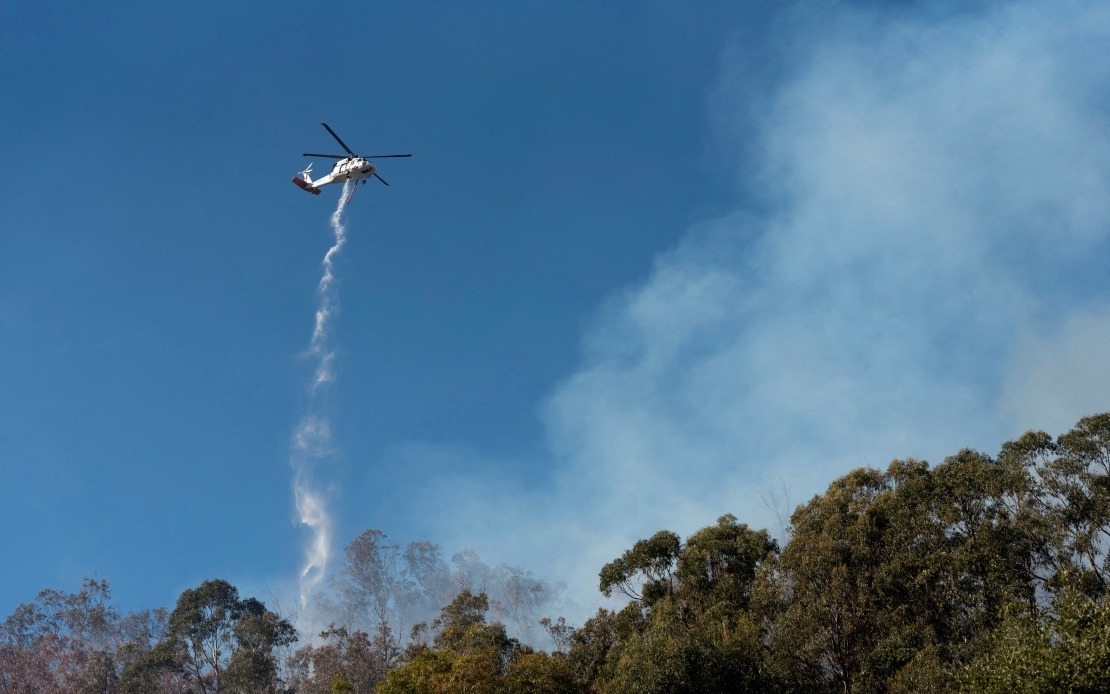
A tragic accident has claimed two lives in the ongoing battle against one of Utah's largest wildfires this year, with authorities confirming the deaths of a pilot and crew member when their firefighting helicopter came down in remote terrain near Richfield on Friday morning. The Sikorsky S-64 aircraft, operating under contract with the United States Forest Service, crashed at approximately 10 am local time while supporting suppression efforts on the Widemouth 2 Fire, according to the US National Interagency Fire Centre. Officials have withheld the identities of the two personnel pending notification of their families.
The Federal Aviation Administration reported the incident shortly after the aircraft went down in challenging terrain in central Utah. The National Transportation Safety Board has assumed leadership of the investigation into the crash, with preliminary findings suggesting the helicopter encountered unknown circumstances during active firefighting operations. The rugged landscape and ongoing fire activity in the area have complicated immediate recovery efforts, requiring responders to carefully assess approaches to the remote crash site.
The circumstances surrounding the accident presented cascading complications for emergency personnel on the ground. The impact itself triggered secondary fires in the vicinity, further restricting access to the wreckage and heightening safety concerns for rescue teams operating in an already hazardous environment. Fire officials emphasised that crews cannot safely reach the site until conditions permit, with priority given to containing the original fire while managing new flames sparked by the crash.
Utah Governor Spencer Cox publicly acknowledged the tragedy and its broader implications for wildland firefighting communities. In a statement released Saturday, Cox reflected on the inherent dangers that characterise this line of work, noting that wildland firefighting ranks among the world's most perilous occupations. He called on residents to extend patience to investigating authorities and emergency responders as they navigate the complex recovery process, recognising that meaningful investigation and response operations require time and unobstructed access.
The Widemouth 2 Fire itself represents a significant challenge to the state's fire management resources. The blaze originated on July 27 when lightning struck dry vegetation across the Fishlake National Forest near Kanosh, a rural community in the region. Subsequent weather patterns—characterised by prolonged drought conditions, elevated temperatures, and unpredictable wind behaviour—enabled the fire to spread with remarkable speed across the landscape.
The rapid expansion of the Widemouth 2 Fire forced authorities to implement evacuation orders for nearby communities and triggered deployment of substantial firefighting resources. At least six structures have been destroyed as the flames advanced through populated areas, and the fire has now consumed more than 114,000 acres, equivalent to approximately 461 square kilometres. Current containment efforts have achieved 24 per cent containment, according to Utah Fire Info, the state's interagency wildfire information system, indicating that suppression crews face significant work ahead.
For Malaysia and Southeast Asian observers, this incident underscores patterns emerging across fire-prone regions globally. The confluence of climatic factors—persistent heat, low humidity, strong winds—creates conditions where fire behaviour becomes increasingly unpredictable and challenging to manage. The technology employed, including specialist helicopters like the Sikorsky S-64, represents the sophisticated equipment required to combat massive wildfires in terrain where ground-based approaches prove insufficient or unsafe.
The tragedy also highlights workforce vulnerabilities in emergency services operating in extreme environments. Wildland firefighting demands exceptional physical capability, specialised training, and psychological resilience, yet personnel regularly face hazards that exceed conventional occupational safety parameters. Equipment failures, environmental unpredictability, and the inherent dangers of operating aircraft in smoky, turbulent conditions create compounding risks that even experienced professionals cannot entirely mitigate.
This event reflects broader challenges confronting firefighting agencies across North America and internationally. Climate change continues to alter fire seasons, extending burn periods and intensifying fire behaviour. States and provinces increasingly compete for specialised resources, including trained personnel and equipment like aerial platforms capable of operating in extreme conditions. The loss of skilled pilots and crew represents not merely personal tragedy but also depletion of scarce expertise within emergency response systems.
For the Widemouth 2 Fire itself, the crash investigation will necessarily pause or slow certain aerial operations, potentially affecting suppression strategy during a critical period. Ground-based crews will likely assume expanded responsibility for containment efforts, working in challenging terrain under dangerous fire conditions. The incident may prompt review protocols for helicopter operations in wildfire contexts, examining whether safety procedures require adjustment in light of what investigators discover.
The broader implications extend to how communities value and support wildland firefighting workforces. Governor Cox's statement reflects evolving recognition that these personnel shoulder extraordinary risk, often with limited public visibility. Their work protects critical infrastructure, private property, and natural resources while operating under extreme physical and psychological stress. The Widemouth 2 Fire tragedy will likely reignite discussions in Utah and beyond regarding compensation, training protocols, equipment standards, and systemic approaches to reducing hazards inherent to wildfire suppression.

