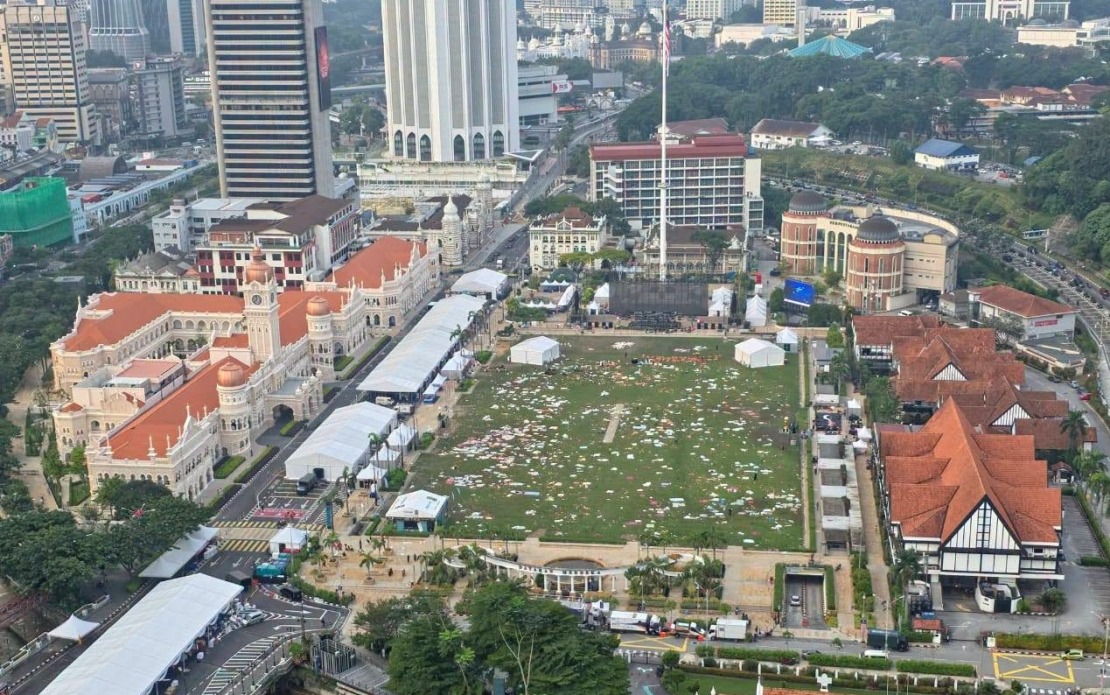
Hannah Yeoh, the Minister in the Prime Minister's Department overseeing Federal Territories, has publicly commended the dedication of Kuala Lumpur City Hall (DBKL) workers who undertook cleanup operations at Dataran Merdeka following the public screening of the 2026 FIFA World Cup final. The symbolic heart of Malaysia's capital had been left strewn with rubbish after the event, prompting the minister to address broader questions about civic consciousness and shared responsibility in maintaining public spaces.
In a Facebook post on July 20, Hannah articulated a nuanced perspective on the relationship between government service delivery and individual accountability. While acknowledging that taxpayers are entitled to quality public services and that DBKL has met its institutional obligations, she drew a critical distinction between what constitutes a government responsibility and what remains a fundamental civic duty. The minister's intervention represents a timely reminder that even as state agencies fulfill their mandate to maintain infrastructure, citizens must reciprocate through conscious behavioural choices.
The littering incident at Dataran Merdeka carries particular symbolic weight beyond the immediate cleanup challenge. As a historic landmark and the physical embodiment of Malaysia's independence, the venue represents more than a functional event space. Hannah emphasized that preserving the dignity and historical significance of Dataran Merdeka requires collective commitment rather than reliance on institutional mechanisms alone. This framing elevates the issue from mundane municipal management to a matter of national pride and custodianship.
Hannah's message directly challenges what might be termed a transactional understanding of citizenship, where taxpayers assume all responsibility lies with government entities in exchange for tax contributions. Her articulation—that throwing rubbish into bins constitutes a basic civic responsibility—deliberately repositions waste disposal as a personal moral choice rather than exclusively a public service provision matter. This philosophical stance reflects broader conversations emerging across Southeast Asia regarding the gap between infrastructure investment and behavioural change.
The minister linked her position to the Malaysia MADANI vision articulated by Prime Minister Datuk Seri Anwar Ibrahim. This governing framework explicitly encompasses more than economic growth and physical development; it incorporates societal values and the cultivation of responsible citizenry. Hannah interpreted the Dataran Merdeka incident through this lens, suggesting that national progress requires synchronization between institutional capacity and individual ethical conduct. The vision demands that Malaysians internalize ownership of shared spaces rather than defaulting to a service-provider mentality.
Hannah's reference to national dignity and the metaphor of home ownership carries particular resonance in Malaysian political discourse. By framing Kuala Lumpur as a collective home that belongs to all residents, she invited Malaysians to emotionally invest in the cleanliness and presentation of public spaces. This rhetorical approach attempts to bridge the gap between contractual obligations—what DBKL must do—and aspirational ideals about the kind of society Malaysians wish to inhabit and bequeath to future generations.
The incident also illuminates recurring challenges faced by major cities across Southeast Asia, where rapid urbanization and large public gatherings frequently result in environmental stress. The FIFA World Cup screening attracted significant crowds, and the subsequent littering reflects a pattern visible in major urban centres throughout the region where public event management intersects with civic consciousness. Hannah's intervention suggests that institutional responses alone, without corresponding cultural shifts, remain insufficient.
From a governance perspective, Hannah's statement represents a measured approach that avoids scapegoating either public workers or citizens while still holding both accountable. DBKL workers receive recognition for their diligence, yet the public is reminded that their efforts should not mask underlying irresponsibility. This balanced communication style attempts to build consensus around shared stewardship rather than fostering adversarial blame-shifting between government and populace.
The broader implications for Malaysia's urban development trajectory are significant. As the nation continues to host major international events and position itself as a regional hub, the capacity of public spaces to serve their intended functions depends on the quality of civic engagement. Dataran Merdeka's role as a venue for national celebrations and international spectacles requires that all participants—government agencies, event organizers, and attendees—maintain standards befitting its historical importance and contemporary significance.
Hannah's intervention also speaks to evolving expectations around environmental consciousness and urban stewardship. The casual littering of a historic national space following a sporting event contrasts sharply with aspirations to present Malaysia as a modern, environmentally aware nation. Her emphasis on personal responsibility suggests recognition that regulatory approaches and enforcement mechanisms, while necessary, remain insufficient without corresponding cultural transformation around public space maintenance.
Looking forward, the Dataran Merdeka incident offers a case study for how Malaysian institutions might better integrate environmental stewardship into public consciousness. Future major events might benefit from enhanced public communication preceding attendance, emphasizing civic responsibility alongside logistical arrangements. Hannah's statement indicates that policymakers recognize this challenge and are attempting to reframe public cleanliness not as a grudging municipal service but as an expression of national character and collective dignity.

