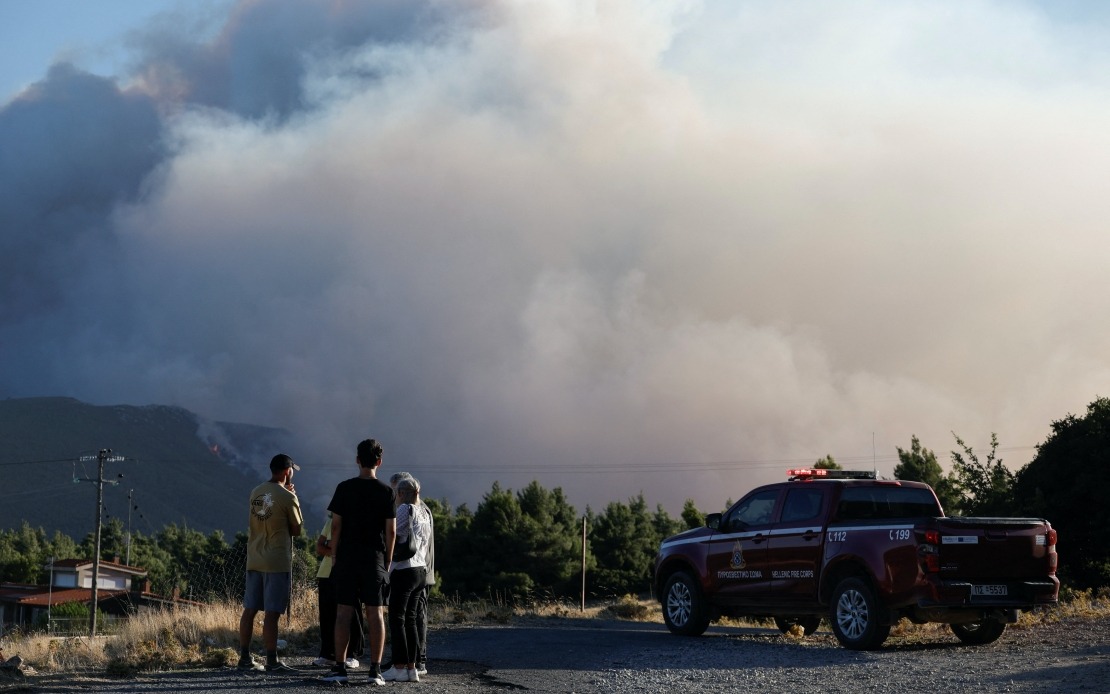
Greece deployed more than 500 firefighters backed by international reinforcements on Sunday as a massive wildfire tore through the landscape west of Athens, moving inexorably towards population centres in its path. The emergency response, coordinated through the night and resuming with aerial support at dawn, underscores the scale of the disaster unfolding across multiple fronts in the Mediterranean nation. Flames advancing through the Kithairon Mountains have transformed the emergency response into a multinational effort, with personnel from Romania and France joining Greek crews in a race against wind-driven spread and rugged terrain.
The primary fire, which has consumed approximately 10,000 hectares across the northwest and western Athens region according to meteorological estimates published by Protothema, presents an immediate threat to Megara, a city lying just a few kilometres away from the fire's current position. Located roughly 50 kilometres west of Athens, Megara represents a significant settlement with substantial population density, making its defence a critical priority for emergency authorities who have mobilised military vehicles, volunteer organisations, and specialist heavy equipment to the affected zone.
Meteorological conditions have severely complicated containment efforts throughout the operation. Strong winds have repeatedly accelerated the fire's advancement and altered its trajectory, preventing responders from establishing and maintaining defensive perimeters. The communities of Veniza and Psatha have absorbed particularly severe damage as the flames advanced through their immediate surroundings. The unpredictable nature of wind-driven fire behaviour means that even well-resourced response teams struggle to position assets effectively, forcing constant tactical adjustments as conditions shift.
The operational tempo intensified dramatically as daylight arrived, enabling firefighting aircraft and helicopters to resume coordinated bombing and water-dropping missions that ground crews cannot execute alone. State broadcaster ERT reported that these aerial operations commenced at dawn, introducing additional offensive capacity to challenge the fire's progression. The coordination between aerial assets and ground-based personnel represents a sophisticated response mechanism, though the scale of the wildfire strains even such comprehensive deployments across Greece's challenging topography.
The implications for Southeast Asian readers lie in understanding how developed nations with substantial resources struggle against natural disasters amplified by climate-related phenomena. Wildfires driven by intensifying wind patterns and elevated temperatures increasingly characterise Mediterranean summers, creating cascading crises that demand rapid mobilisation of regional and international support networks. Malaysia and other ASEAN member states face similar seasonal fire risks, particularly during dry seasons across Indonesia, Malaysia, and neighbouring regions, making the Greek experience instructive for emergency preparedness and regional cooperation protocols.
Investigations into fire origins have already yielded concerning results, with authorities arresting 13 individuals nationwide on negligent arson charges. This detail suggests that deliberate human action, whether through carelessness or intentional conduct, exacerbated the natural disaster. The identification of potential criminal activity alongside extreme weather conditions indicates that comprehensive disaster response must address both environmental factors and human behaviour simultaneously.
Separate conflagrations on the islands of Cephalonia and Crete have created a archipelagic crisis stretching emergency resources across multiple geographic zones. While the Cephalonia fire currently poses no immediate urban threat according to ERT reporting, the Crete situation has already necessitated civilian evacuations from threatened communities. Media sources indicate that approximately 200 homes have been destroyed in the Crete fires, though official government confirmation of this casualty figure remains pending, suggesting ongoing assessment of total property loss.
The containment of the Crete fires to largely extinguished status represents a partial success within an otherwise catastrophic period, but the resource diversion required to achieve that outcome has implications for managing the more acute threat approaching Megara. Emergency services operating across three major fire zones simultaneously face severe strain on personnel rotation, equipment availability, and command-and-control coordination. The international dimension, with Romanian and French responders deployed alongside Greek personnel, demonstrates the mutual aid protocols that function within the European Union framework during crisis situations.
For Malaysian observers, the scale of this response illustrates how transnational emergency collaboration operates in practice. Regional mechanisms such as ASEAN's Agreement on Disaster Management and Emergency Response establish similar principles, though actual implementation in Southeast Asia varies considerably based on national capacity and willingness to deploy resources across borders. Greece's mobilisation of multinational firefighting capability within hours suggests well-established protocols and pre-positioned agreements that enable rapid surge response.
The trajectory of the primary fire moving eastward toward major population centres like Megara demonstrates how wildfire dynamics create cascading crises requiring increasingly comprehensive response measures. Each advancement of the fire perimeter towards inhabited zones intensifies pressure on emergency commanders to escalate intervention levels, deploy additional personnel, and make difficult decisions about evacuation timing and resource allocation. The fluid situation ongoing during the article's reporting suggests that the full extent of ultimate damage and displacement remains unknown.
Climate-related amplification of fire intensity and spread represents an emerging challenge across the Mediterranean basin and globally, with profound implications for urban planning, emergency preparedness, and resource allocation. Greece's experience during this particular August episode will likely inform policy discussions about preventive measures, early warning systems, and inter-agency coordination mechanisms. For Malaysia and Southeast Asia, the demonstration of how sophisticated wealthy economies struggle against amplified natural hazards during seasonal extremes should inform regional strategic discussions about climate adaptation and disaster resilience investment.

