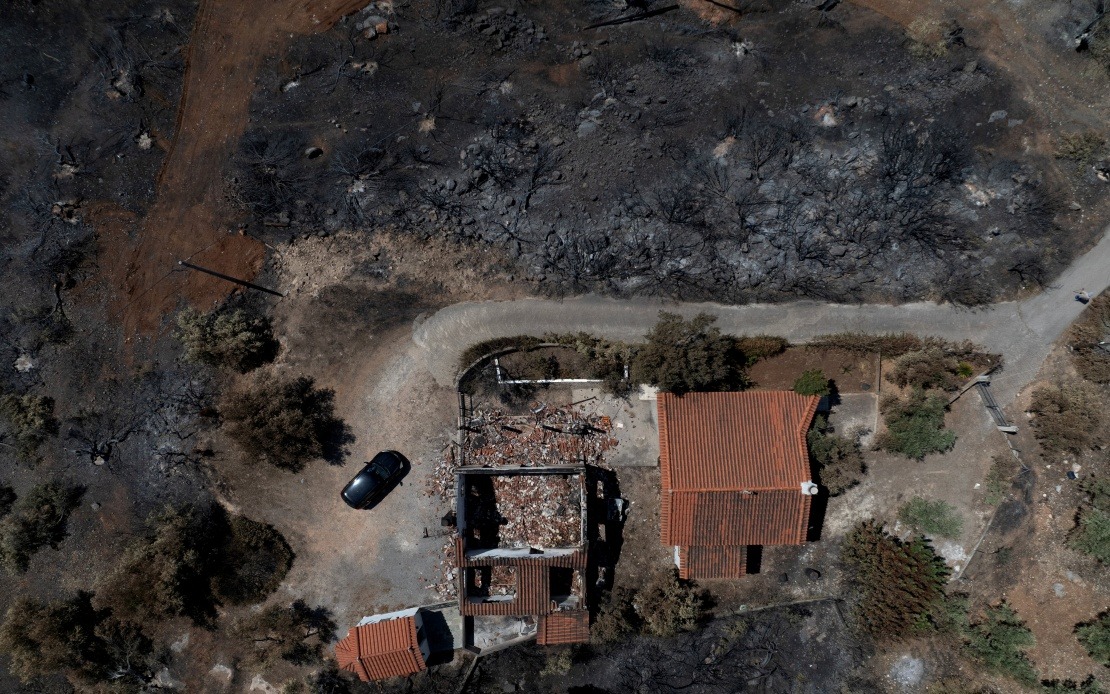
Greece's civil protection authorities escalated their alert status to the most severe level on Wednesday, warning of dangerously high wildfire conditions threatening the densely populated regions surrounding the capital. The General Secretariat for Civil Protection, under the Climate Crisis and Civil Protection Ministry, designated Attica, Viotia and Evia for a "red alert" classification on Thursday, August 6, reflecting what officials described as "very high" fire danger across these strategically important areas. The Category 4 designation—the highest on the government's risk scale—signals that conditions have become critical enough to warrant extraordinary emergency response measures and public precautions.
Under this maximum alert status, Greece's National Civil Protection Mechanism shifted into full operational mode, mobilizing substantial resources across ground and air assets. Fire service personnel, police units and armed forces personnel have been assigned to conduct continuous patrols using both conventional ground-based teams and aerial surveillance platforms to detect ignition sources before fires can establish themselves. The comprehensive deployment reflects the scale of concern among emergency planners, who understand that the convergence of geographical and meteorological factors creates windows of extreme vulnerability in these regions. Attica, which encompasses Athens and its sprawling metropolitan area home to millions, poses particular challenges given the proximity of dense residential zones to forested and scrubland areas where fires can ignite and spread with alarming speed.
The alert triggered implementation of stringent preventive restrictions designed to minimize human-caused ignition risks during the critical period. Traffic flowing through forests and sensitive vegetation zones has been curtailed, while access for visitors to vulnerable natural areas has been substantially restricted or prohibited entirely. Authorities issued direct appeals to residents to refrain from any activities with ignition potential, recognizing that even small inadvertencies during extreme fire weather conditions can cascade into major incidents. This proactive approach stems from hard-won experience: most destructive fires in Mediterranean regions originate from human activity, whether through negligence, accident or deliberate arson, making behavioural restrictions during high-risk periods a crucial component of prevention strategy.
The alert came as firefighting operations continued against an active blaze that broke out Wednesday afternoon near Koropi, located to the southeast of Athens in a strategically sensitive location. The fire initiated in low vegetation within the Driggia area at approximately 1:45 pm local time, triggering a rapid response that ultimately engaged at least 52 firefighting personnel including three specialized forest commando units equipped for challenging terrain operations. Fourteen ground vehicles supported the effort, while the aerial component included four helicopters and two dedicated water-dropping aircraft, with additional helicopter coordination managing the complex airspace during emergency operations. Supporting ground infrastructure provided by local authorities included water tankers deployed to supply firefighting teams at critical points, while the operations coordination centre maintained real-time monitoring using thermal imaging and optical drone cameras to track fire progression and direct resources to developing hot spots.
The investigation process began immediately, with an arson investigation team dispatched to the fire scene to determine whether the blaze resulted from accident, negligence or intentional setting. This systematic documentation serves multiple purposes: it contributes to prosecution efforts when criminal activity is confirmed, it identifies patterns in deliberate fire-setting that may inform prevention strategies, and it generates data helping authorities understand seasonal fire behaviour. The Koropi incident, while brought under control by Wednesday evening, demonstrated the state of constant readiness required during peak fire season in Greece's most vulnerable regions.
Parallel to this contained incident, firefighting teams maintained intensive operations against a far more destructive blaze that originated in Viotia the previous week and subsequently spread westward into Attica. According to satellite measurements from the European Union's Copernicus monitoring system, this major fire complex had consumed approximately 14,424 hectares of land, equivalent to roughly 35,642 acres, representing a scale of destruction that strains response capabilities and causes prolonged ecological damage. The geographic spread across two provinces indicates how rapidly these fires propagate under adverse weather conditions, overcoming initial containment efforts and threatening populated zones as the fire perimeter expands.
This ongoing operation has already exacted a tragic human cost. On Sunday during aerial firefighting operations against the Viotia-Attica blaze, two helicopter collided midair in a catastrophic accident that killed a Danish pilot and a Greek aerial coordinator. The incident underscores the extreme hazards facing emergency personnel who operate helicopters in challenging terrain under low visibility and high-stress conditions inherent to wildfire operations. Both nations mourned the loss, and the accident prompted immediate reviews of aerial coordination procedures to prevent similar tragedies.
For Malaysian and Southeast Asian observers, the Greek situation offers sobering lessons about wildfire governance in an era of climate stress. While Malaysia's tropical climate and monsoon patterns create different fire dynamics than Mediterranean conditions, the underlying principles of preparedness, resource allocation and public cooperation remain universally relevant. Greece's transparent use of clear alert categories and widespread public communication about restrictions demonstrates how democratic governments can implement emergency measures with social legitimacy. The investment in multi-agency coordination, specialized equipment and aerial assets reflects recognition that modern wildfires demand sophisticated responses beyond traditional ground-based firefighting.
The current alert also exemplifies how climate change is intensifying fire seasons across multiple regions simultaneously. When Mediterranean nations grapple with record-breaking fire conditions, it strains the pan-European mutual aid networks on which Greece and its neighbours depend for emergency support. This concentration of extreme events across broader geographic regions has implications for Southeast Asia, where increasing temperatures and changing rainfall patterns may alter historical fire seasons in Indonesia, Malaysia and other nations accustomed to managing fire-prone landscapes.
Greece's response framework—combining satellite monitoring, drone surveillance, interagency coordination and public restriction mechanisms—represents a technological and organizational approach that other nations are studying and adapting. The category-based alert system provides clear escalation pathways that help governments calibrate responses proportionally to actual conditions rather than defaulting to either complacency or panic. For regional policymakers considering wildfire governance improvements, the Greek model demonstrates how institutional preparedness and transparent communication can help populations understand emergency measures as rational responses to measurable threats rather than arbitrary impositions. As Mediterranean fire seasons extend and intensify, such systematic approaches to wildfire management become increasingly central to protecting both lives and critical ecosystems across vulnerable regions.

