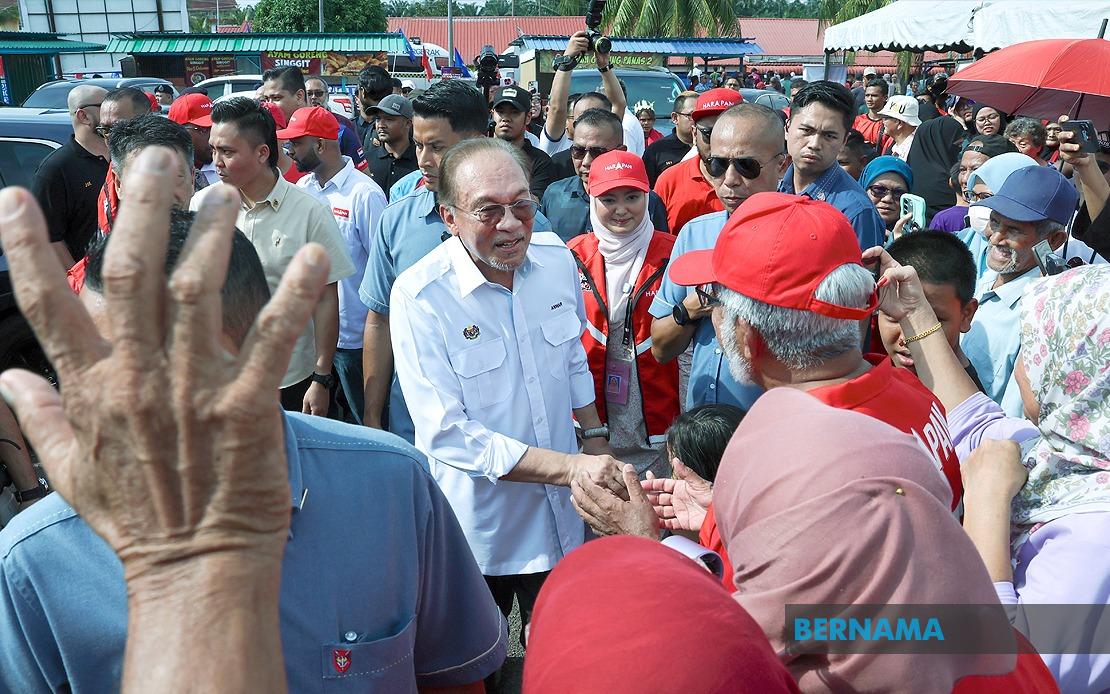
A grandmother's determination to fulfil her grandson's dream has resulted in a moment the young boy will treasure for years to come. Rosimah Mohammad, 58, from Kampung Pudu in Segamat, undertook an unconventional journey by riding a motorcycle through an oil palm estate with her nine-year-old grandson Muhammad Afif Ikhwan to attend a programme where Prime Minister Datuk Seri Anwar Ibrahim was scheduled to appear at Felda Palong Timur in Segamat on Sunday. What began as a simple quest to see his admired leader from afar evolved into a remarkable encounter that neither grandmother nor grandchild could have anticipated.
Young Muhammad Afif had harboured a long-standing wish to meet the Prime Minister, an aspiration that consumed his thoughts as the event drew near. The anticipation proved almost overwhelming for the child, who found it difficult to sleep in the nights leading up to the occasion, his mind preoccupied with the possibility of coming face-to-face with the person he so deeply admired. Such childhood dreams, though innocent, often require considerable effort and resourcefulness from parents and guardians to realise, and Rosimah's commitment to this goal demonstrates the lengths some family members will go to create meaningful memories for their young ones.
Upon reaching the venue, Rosimah and Muhammad Afif positioned themselves strategically near the pathway to the stage, calculating that this vantage point would offer the clearest opportunity for the boy to observe the Prime Minister during his movements through the crowd. The strategy proved effective when Anwar made his way towards the stage while extending greetings to gathered members of the public. Seizing the moment, Muhammad Afif navigated through the crowd with the determination befitting a child on a mission, extending his hand in hopes of a brief acknowledgement from the nation's leader.
What transpired next exceeded all expectations. Rather than simply accepting the handshake and moving on, Anwar took notice of the young boy's earnestness and invited Muhammad Afif onto the stage to join him during his address to the assembled crowd. This unexpected elevation from audience member to stage companion transformed the entire nature of the encounter, elevating it from a fleeting moment to something far more substantial and memorable. Rosimah recounted to Malaysian news agency Bernama the profound emotion of witnessing her grandson's joy at that precise instant, describing an overwhelming sense of happiness and surprise that emanated from the child as he found himself standing beside the Prime Minister.
The ripple effects of this chance meeting extended beyond the immediate moment. Anwar, learning subsequently about the backstory of the boy's journey and his long-cherished wish, appeared to have been touched by the narrative. Rather than allowing the encounter to fade into the routine of political engagements, the Prime Minister made a deliberate decision to extend the interaction further. Through PKR deputy information chief Siti Aishah Shaik Ismail, Anwar arranged a formal visit to Muhammad Afif's residence in Kampung Pudu, Segamat, the very community from which the boy and his grandmother had embarked on their oil palm estate journey.
This follow-up visit, undertaken as a special gesture of appreciation and explicitly requested by Anwar himself in his capacity as both Prime Minister and Pakatan Harapan chairman, signalled that the encounter held genuine significance beyond the customary interactions between political leaders and constituents. During the visit, Siti Aishah presented Muhammad Afif with several carefully selected gifts chosen specifically by Anwar: a bicycle, a school bag, and a new pair of shoes. Such gifts, while practical, also served a symbolic function—acknowledging the boy's determination and the family's effort in pursuing this meaningful encounter.
The emotional resonance of the experience continues to unfold in the days and weeks following the event. According to Rosimah, Muhammad Afif remains deeply affected by the memory, having developed a touching ritual of hugging the shirt he wore during his meeting with the Prime Minister each evening before sleep. This behaviour suggests that the encounter has achieved the status of a transformative moment in the child's consciousness, an experience he is actively preserving and cherishing in whatever ways a nine-year-old can manage. The shirt, now imbued with sentimental value far exceeding its material worth, has become a physical anchor to a memory that will likely shape the boy's perspective on leadership and possibility for years to come.
For Malaysian families, particularly those in rural communities, stories such as this carry particular resonance. The narrative of a grandmother's modest effort—simply riding a motorcycle through an agricultural estate—resulting in an extraordinary outcome speaks to themes of persistence, family devotion, and the possibility of meaningful political engagement even for ordinary citizens. In a country where oil palm cultivation represents a significant economic sector and rural communities often feel geographically or socially distant from national leadership, the accessibility demonstrated in this instance offers a refreshing counternarrative to perceptions of political hierarchy.
The incident also illuminates broader questions about political engagement and public service. Anwar's decision to follow up the chance meeting with a home visit and gifts demonstrates an approach to leadership that values individual stories and human connection. Rather than treating the encounter as a mere photo opportunity, the Prime Minister's office took deliberate steps to ensure that the boy's experience was honoured and extended. Such gestures, when genuine, can significantly shape public perception of political leaders and may encourage civic engagement among younger generations who witness the fruits of determination and respectful petition.
The journey through the oil palm estate, initially undertaken as a means to an end, has itself become embedded in the narrative of this memorable experience. The detail that Rosimah and Muhammad Afif traversed agricultural land to reach their destination adds a layer of authenticity and determination to the story, emphasising that this was not a casual outing but a purposeful mission requiring genuine effort and commitment. In doing so, the account reflects the realities of rural Malaysian life, where distances and terrain often pose genuine obstacles to accessing opportunities available to urban residents.
Looking forward, this encounter may well prove to be a formative moment in Muhammad Afif's development. Children who experience direct, positive interactions with national leaders often carry those memories into adulthood, influencing their civic participation and sense of connection to their country's governance. Whether the boy pursues public service, remains an engaged citizen, or simply carries forward the lesson that determination and respectful petition can yield results, the experience at Felda Palong Timur will likely remain a defining chapter in his personal narrative. Rosimah's motorcycling grandmother wisdom—that sometimes the most significant moments require unconventional effort—has translated into a memory that transcends the ordinary boundaries of political experience.

