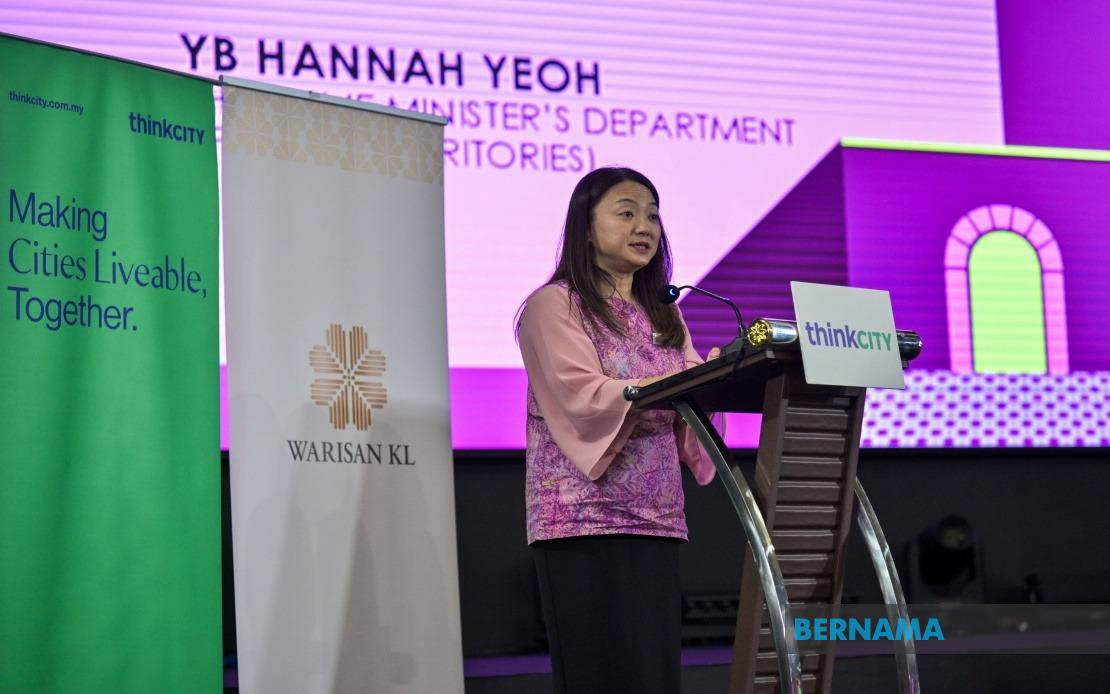
The federal government has unveiled a substantial financial commitment to revitalise downtown Kuala Lumpur, channelling RM1 million through a dedicated grants scheme designed to preserve the capital's heritage whilst stimulating urban renewal and economic activity. The Downtown Kuala Lumpur Grants Programme 2026 represents a strategic investment in the city's cultural and economic fabric, reflecting growing recognition that heritage preservation and contemporary development need not exist in tension but rather can reinforce one another in shaping vibrant urban communities.
Hannah Yeoh, Minister in the Prime Minister's Department (Federal Territories), announced the initiative while emphasising her vision of a downtown core that honours its historical significance whilst embracing future possibilities. The programme will distribute grants ranging from RM30,000 to RM100,000 for individual approved initiatives, creating accessible entry points for a diverse range of stakeholders including local entrepreneurs, cultural practitioners, heritage conservationists and community-based organisations seeking to activate public spaces and preserve architectural landmarks.
Yeoh articulated a philosophical framework underlying the initiative that extends beyond conventional urban development metrics. She stressed that a city's success cannot be measured solely through new construction and infrastructure projects, but rather through its capacity to retain and attract residents, workers, investors and visitors who find meaning and opportunity within its boundaries. This perspective suggests a deliberate pivot towards quality-of-life considerations and cultural vibrancy as primary drivers of urban competitiveness, particularly relevant for Southeast Asian cities competing for talent and investment in an increasingly globalised economy.
The minister drew explicit connections between cultural preservation and economic generation, citing Kuala Lumpur's 2020 designation as a UNESCO Creative City. This recognition positions culture not merely as a historical artifact to be maintained for posterity, but as a dynamic economic asset capable of generating employment, attracting domestic and international tourism, and contributing meaningfully to gross domestic product. The framework aligns with evidence from other Asian metropolitan areas where cultural quarters have become engines of economic activity and social vitality.
Yeoh indicated that funding for this scheme originates from the Ministry of Finance, signalling institutional commitment from the highest budgetary levels to position arts, culture and heritage as core economic drivers rather than peripheral amenities. This budgetary prioritisation carries significance for Malaysian policymakers, suggesting a potential recalibration of how federal resources are allocated across competing urban priorities and reflecting broader regional trends towards creative economy development.
A notable dimension of Yeoh's remarks concerned institutional reform at Kuala Lumpur City Hall (DBKL), which she described as requiring transformation from a perceived obstacle into an effective facilitator of urban economic activity. The minister's emphasis on changing DBKL's image and operational orientation suggests recognition that regulatory burden, bureaucratic complexity, or poor service orientation can undermine even well-intentioned policy initiatives. Her commitment to repositioning the city authority as entrepreneur-friendly and community-responsive addresses a recurrent criticism that has constrained grassroots activation of urban spaces in Malaysia.
Implementation of the programme will be coordinated by Think City, a strategic partner organisation selected to manage applications, establish eligibility criteria and oversee fund distribution. This institutional arrangement suggests a hybrid governance model combining government financing with specialist third-party administration, potentially bringing expertise in cultural project evaluation and community engagement that might otherwise be unavailable within traditional municipal bureaucracies. The choice of Think City signals confidence in non-governmental coordination capacity for culturally-sensitive urban initiatives.
Applications for the RM1 million fund will be assessed against criteria that Think City is preparing for imminent announcement. Yeoh's public call for submissions, particularly from innovators and those with unconventional ideas, suggests the programme intends to move beyond conservative heritage preservation towards more experimental and participatory approaches to downtown revitalisation. This openness may attract younger entrepreneurs, digital-native practitioners and community activists whose contributions have historically faced barriers within traditional municipal funding frameworks.
The initiative arrives at a moment when downtown Kuala Lumpur faces genuine challenges, including competition from newer commercial districts, retail sector transitions accelerated by e-commerce growth, and demographic shifts in resident and worker composition. A RM1 million allocation, whilst meaningful, remains modest relative to total municipal budgets and broader urban development expenditures, suggesting this programme should be understood as catalytic rather than comprehensive. Its real value may lie in signalling governmental intent, establishing proof-of-concept projects, and creating platforms for community-led innovations that generate momentum beyond initial funding.
For Malaysian policymakers and regional observers, this programme illustrates an emerging consensus that Southeast Asian cities must balance growth imperatives with livability, that cultural identity constitutes economic asset rather than obstacle to development, and that municipal governments function most effectively when positioned as enablers of community initiative rather than sole drivers of urban change. The scheme's success will likely hinge not merely on grant disbursement but on whether downstream institutional reform at DBKL genuinely materialises and whether the catalytic investments generate sustained momentum beyond the initial funding cycle.

