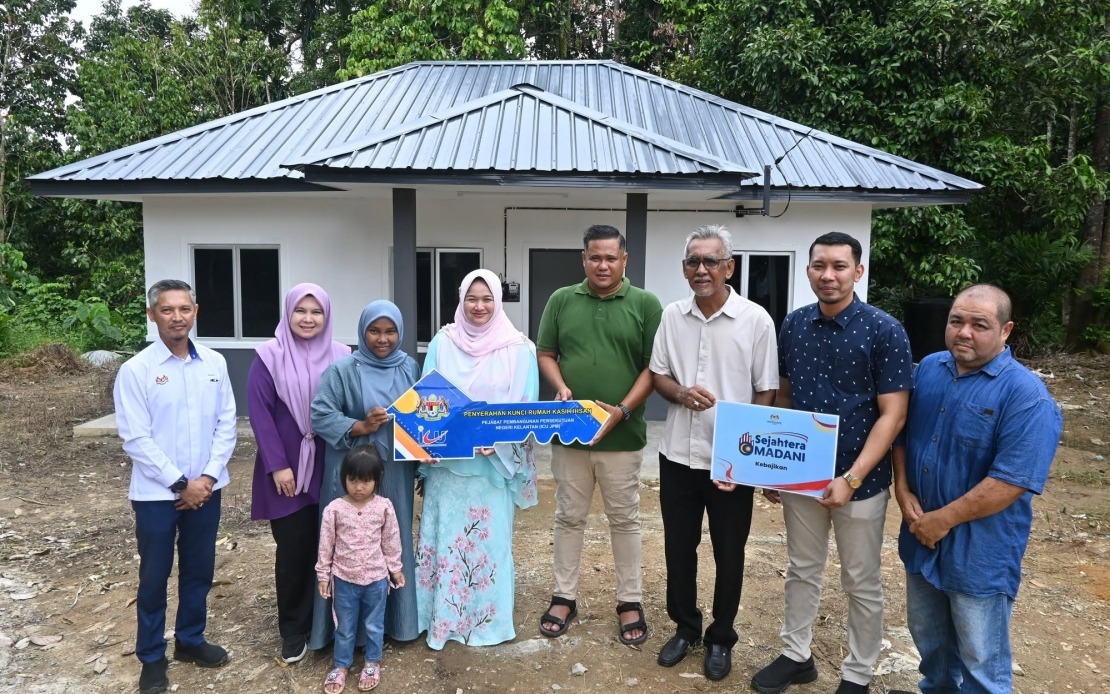
Prime Minister Datuk Seri Anwar Ibrahim's administration has intensified its commitment to lifting living standards among economically disadvantaged Malaysians, culminating in the distribution of Rumah Kasih Ihsan homes in Jeli, Kelantan. The initiative represents a tangible manifestation of the government's broader policy focus on addressing the fundamental human need for safe, dignified shelter across rural communities that often remain marginalised in national development discourse.
The Kelantan Implementation Coordination Unit under the Prime Minister's Department coordinated the handover ceremony, which benefited two households in the district. Dr Wan Nur Ibtisam Wan Ismail, the ICU director for Kelantan operations under JPM, presided over the formal transfer of housing assistance, signalling institutional commitment at the highest levels of federal coordination. This structured approach through the ICU reflects the government's strategy of embedding housing welfare programmes within coordinated administrative frameworks designed to track implementation and ensure accountability.
The first recipient, Yusof Mohamed Nawawi from Kampung Renyut, received formal acceptance of a newly constructed home that will replace his existing dwelling. This arrangement allows families in precarious housing situations—whether living in deteriorated structures or temporary accommodations—to transition into purpose-built residences designed to modern safety standards. The second beneficiary, Shamsul Bahri Che Musa, completed the transition immediately upon receiving his completed house, demonstrating the programme's operational capacity to deliver finished units within reasonable timeframes.
Beyond the provision of bricks and mortar, the government accompanied the housing transfers with supplementary welfare measures. Both recipients received food baskets, a gesture intended to acknowledge the broader material vulnerabilities that often accompany inadequate housing situations. This holistic approach recognises that housing insecurity frequently correlates with food insecurity and other deprivations, requiring simultaneous intervention across multiple dimensions of household welfare rather than isolated construction projects.
The philosophical underpinning of Rumah Kasih Ihsan reflects a conceptualisation of housing that extends beyond functional shelter. According to the Kelantan ICU, adequate housing constitutes the foundational infrastructure upon which families construct prospects for economic advancement, educational achievement, and social stability. This framing positions housing not merely as consumption but as productive infrastructure that enables human development—a perspective increasingly endorsed by development economists and social policy specialists worldwide.
Kelantan's persistent concentration of poverty-related challenges makes it a natural focus for such interventions. The state continues to grapple with among the highest poverty incidence rates nationally, with rural areas particularly affected by limited economic opportunities, agricultural sector fragility, and geographic isolation from urban employment centres. Housing quality in such contexts often reflects these broader structural disadvantages, with vulnerable households unable to afford substantial home improvements or relocations to better-served areas.
The PMX Coordination Team's involvement in executing the programme demonstrates administrative commitment to translating political priorities into ground-level delivery mechanisms. Such coordination structures have become increasingly central to Malaysian governance architecture, attempting to bridge the gap between federal policy formulation and state-level implementation capacity. The designation of specific coordination units reflects recognition that housing programmes require sustained attention and integrated effort across multiple bureaucratic hierarchies.
The timing and messaging of these handovers also serves broader political purposes within Malaysia's competitive electoral environment. Kelantan, governed by opposition political parties, remains a focal point of federal government initiatives ostensibly designed to demonstrate developmental commitment irrespective of state-level political alignments. Such initiatives potentially reshape electoral dynamics by making tangible welfare improvements visible to voters, though the extent to which they influence political preferences remains contested among analysts.
Looking forward, the sustainability of Rumah Kasih Ihsan depends on several critical factors beyond initial construction. Housing quality maintenance, access to financing for household improvements, proximity to economic opportunities, and integration of beneficiary communities into broader development planning remain essential considerations. Without such complementary investments, housing improvements risk becoming isolated interventions that fail to generate sustained improvements in household welfare trajectories.
For Southeast Asian observers, Malaysia's Rumah Kasih Ihsan programme reflects broader regional patterns in which governments are expanding targeted housing interventions directed at vulnerable populations. Thailand, Vietnam, and Indonesia have similarly implemented subsidised housing schemes, though implementation fidelity and targeting effectiveness vary substantially. Malaysia's emphasis on coordination structures and federal oversight potentially offers insights applicable to regional peer nations wrestling with housing affordability crises in their own rural hinterlands.
The programme also intersects with Malaysia's broader development agenda around reducing regional inequality and poverty incidence. Federal government investments in Kelantan housing, electricity access, water infrastructure, and economic diversification represent attempts to narrow the development gap separating the state from wealthier peninsular regions. Whether such targeted interventions prove sufficient to address structural disparities rooted in geographic, demographic, and economic factors remains an open empirical question that ongoing programme monitoring should illuminate.
As Malaysia navigates post-pandemic economic readjustment and inflation pressures, housing affordability has emerged as a pressing policy concern affecting multiple demographic groups. The Rumah Kasih Ihsan programme addresses the most acute manifestations of housing deprivation among the poorest households, yet broader middle-income affordability challenges remain largely unaddressed through existing policy mechanisms. This bifurcated approach—intensive support for the extremely poor alongside limited intervention for moderate-income groups—reflects persistent tensions in Malaysian social policy design.

