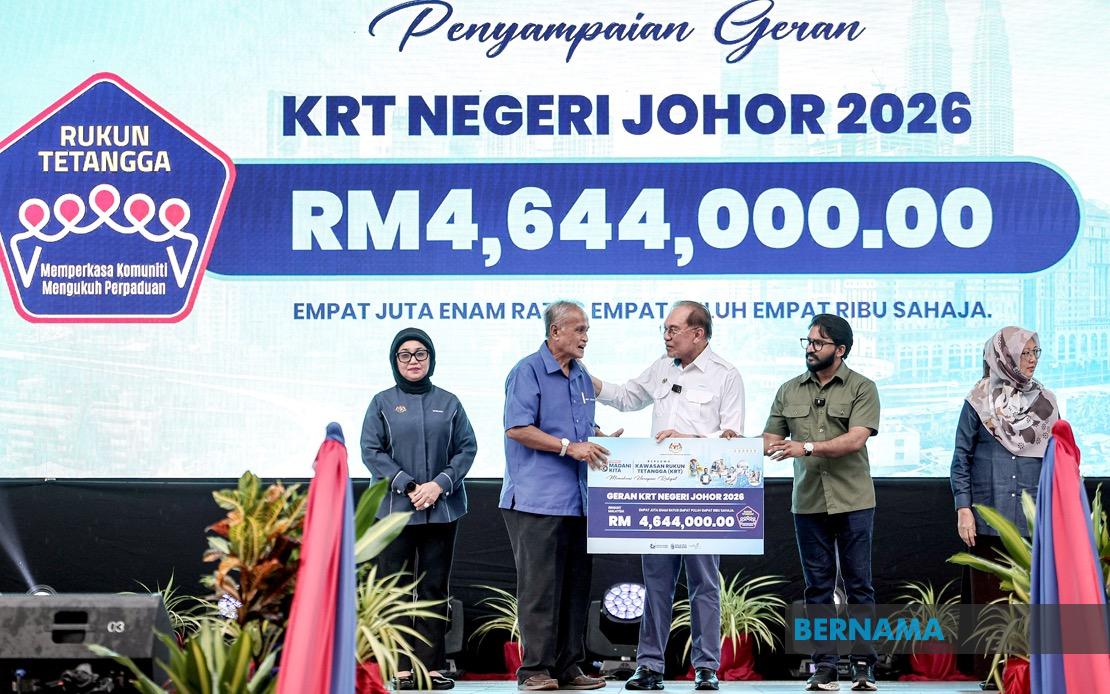
Prime Minister Datuk Seri Anwar Ibrahim has announced a substantial increase in funding for Neighbourhood Watch Areas (KRT) across the country, raising the annual grant from RM6,000 to RM10,000 in recognition of their expanded role in community development. The enhancement, which will take effect from January 1, 2027, addresses a long-overdue adjustment that has not been revised in a decade despite the organisations' critical importance in addressing grassroots challenges and maintaining social harmony.
The announcement came during the MADANI KITA Programme event held at Dataran Segamat in Johor, where the Prime Minister emphasised the government's commitment to strengthening community institutions that support national objectives. Anwar acknowledged that the financial allocation had stagnated at RM6,000 for ten years, a period during which the role of these neighbourhood organisations has only grown more significant in maintaining order and addressing local concerns. The decision to increase funding by 67 percent reflects the government's recognition that inflation and growing responsibilities have made the previous allocation insufficient.
The Prime Minister underscored the strategic importance of KRT organisations in sustaining Malaysia's distinctive model of social cohesion. He articulated that these grassroots institutions serve as vital conduits between communities and government agencies, enabling security personnel and administrative departments to respond more effectively to both security threats and welfare concerns. In a country where social stability underpins economic progress, the strengthening of community watch mechanisms represents an investment in preventive governance rather than reactive crisis management.
Anwar also emphasised Malaysia's foundational strength in its capacity to maintain harmony among diverse racial, cultural, and religious communities since independence. He cautioned against allowing differences to become divisive while advocating for the celebration of diversity as a national asset. This framing positions the KRT funding increase within a broader narrative about safeguarding communal peace, suggesting that neighbourhood watch organisations play a role beyond security by reinforcing the social bonds essential for national unity.
Beyond the KRT announcement, the Prime Minister unveiled additional resource allocations demonstrating the government's broader investment in community infrastructure. An immediate allocation of RM3.205 million was approved for 16 basic infrastructure repair projects targeting Islamic educational institutions throughout Johor, encompassing religious schools, madrasahs, study centres, and tahfiz facilities in districts including Batu Pahat, Muar, and Segamat. This investment programme aims to provide students with improved learning environments while acknowledging the role of Islamic educational institutions in the community.
The allocation for Islamic institutions reflects a deliberate policy choice to upgrade facilities at these establishments, recognising their significance in both educational and community contexts. By directing resources toward madrasahs and tahfiz centres, the government signals commitment to supporting diverse educational pathways and religious scholarship, areas that often operate with limited resources despite serving important social functions. The comprehensive nature of the repairs—spanning basic infrastructure upgrades—suggests these facilities had accumulated maintenance backlogs requiring systematic attention.
Additionally, Anwar approved an immediate RM1.0 million allocation for critical and urgent repair work at Royal Malaysian Police (PDRM) quarters in Johor. The Prime Minister framed this investment as integral to maintaining welfare standards for security personnel, linking adequate facilities to their capacity to perform national security functions effectively. This approach reflects an understanding that infrastructure quality directly impacts workforce morale and retention, particularly crucial for law enforcement agencies tasked with maintaining public order.
The three-pronged funding announcement—neighbourhood watch grants, educational facilities, and police quarters—reveals a strategic approach to community strengthening that operates across multiple institutional levels. Rather than concentrating resources at the federal or state administrative level, the government is distributing funds to grassroots organisations, educational institutions, and frontline security personnel. This decentralised allocation strategy acknowledges that sustainable development and social stability depend on investments distributed across the community ecosystem rather than concentrated in centralised structures.
For Malaysian readers, these developments carry implications for neighbourhood safety and community engagement. The enhanced KRT funding may enable more active and sustained neighbourhood watch operations, potentially improving responsiveness to local security concerns and strengthening informal social monitoring mechanisms that complement formal law enforcement. The increased resources could support additional training, equipment, or community engagement activities that enhance neighbourhood safety culture. However, the effectiveness of this funding increase will depend on how organisations utilise the additional resources and whether local communities actively participate in watch programmes.
The January 1, 2027 implementation date allows KRT organisations time to plan expenditures and align their activities with strategic objectives, though the immediate allocations for police and educational infrastructure suggest urgent priorities requiring faster disbursement. From a Southeast Asian perspective, Malaysia's investment in neighbourhood watch mechanisms offers lessons for regional counterparts seeking to balance community engagement with formal security structures. Many ASEAN nations grapple with similar challenges of maintaining social cohesion amidst diversity and addressing security concerns through community participation.
The government's emphasis on celebrating diversity while strengthening community institutions reflects a philosophy that social stability emerges from inclusive institutions rather than homogenisation. By empowering neighbourhood organisations that typically comprise diverse membership, the government creates platforms for inter-community dialogue and cooperation at the most local level. This grassroots approach to managing diversity contrasts with top-down integration strategies and may offer insights for nations with complex demographic compositions seeking to build social capital across community lines.
Deputy Minister of National Unity R. Yuneswaran and Deputy Minister of Domestic Trade and Cost of Living Datuk Dr Fuziah Salleh's presence at the Segamat event underscores the cross-portfolio importance of community strengthening initiatives. The involvement of multiple ministries suggests that KRT funding falls within broader whole-of-government approaches to national development, touching on unity, commerce, and community welfare simultaneously. This collaborative approach indicates that policymakers view neighbourhood organisations not merely as security institutions but as multi-functional community platforms serving diverse government objectives.