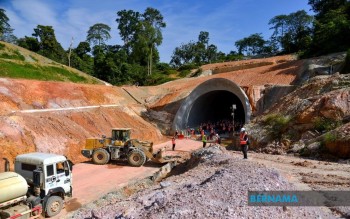
The Malaysian government has committed RM207.2 million to developing the Pasir Puteh parliamentary constituency in Kelantan through 46 approved projects planned for 2026, marking a significant investment aimed at transforming the region into a regional logistics and industrial hub. The initiative reflects Putrajaya's strategy to unlock economic value from major infrastructure investments, particularly the East Coast Rail Link (ECRL), by creating complementary industrial facilities that can attract investment and generate employment in a historically underperforming area.
Deputy Economy Minister Datuk Mohd Shahar Abdullah outlined the government's vision during Parliament's question-and-answer session, emphasising that the projects extend beyond basic infrastructure to encompass strategic downstream industrial development. Land preparation and infrastructure works for the Pasir Puteh downstream industrial area form the cornerstone of this effort, designed to harness the ECRL's cargo and logistics capabilities for regional advantage. The approach reflects a shift from viewing major transport projects in isolation towards integrating them with complementary economic zones that can maximise their impact.
The planning framework guiding this development is the ECRL Integrated Land Use Master Plan (PGTA-ECRL), which positions the Pasir Puteh station as a dual-purpose facility serving both passenger transport and cargo logistics operations. This designation is crucial for Kelantan, as it signals the state's integration into Malaysia's national logistics network rather than remaining peripheral to major economic corridors. By establishing the station as a cargo hub, the government aims to attract freight operators and supply chain companies that typically cluster around transport nodes, creating spillover employment and business opportunities.
Geographic proximity to the Tok Bali Supply Base significantly enhances Pasir Puteh's strategic value for logistics development. The supply base, an established offshore support facility, already generates economic activity and maintains specialised infrastructure and workforce capabilities. By positioning the new industrial zone between this existing hub and the ECRL station, planners aim to create synergies that could attract companies seeking integrated logistics solutions combining rail, port, and storage facilities. This geographic clustering effect is a recognised pattern in successful industrial development, where proximity to multiple transport modes and existing facilities reduces business costs and attracts investment.
Mohd Shahar stressed that government support extends beyond capital allocation to include strategic coordination between federal and state authorities. He highlighted that development spending is deliberately concentrated to address regional disparities, with the 13th Malaysia Plan (13MP) framework emphasising tailored investment based on each location's comparative advantages. For Pasir Puteh, this means prioritising logistics and downstream industrial development rather than pursuing generic infrastructure projects disconnected from regional economic strengths. This targeted approach reflects lessons from earlier development initiatives that failed when investment did not align with local assets and market opportunities.
The implementation timeline spans from 2026 through 2030, aligning with the broader 13MP framework that guides national development spending across the five-year period. This extended timeframe allows for sequenced development, beginning with foundational infrastructure before advancing to industrial facilities and support services. The phased approach also provides opportunity for course correction based on early results and market response, reducing the risk of large-scale misallocation common when entire packages are implemented simultaneously without real-world feedback.
Monitoring mechanisms represent an important governance element often overlooked in development announcements. The MyRMK system established for tracking project progress will generate regular reports to Parliament, creating transparency and accountability for how funds are deployed. This reporting framework allows legislators, particularly those representing affected constituencies, to scrutinise execution and identify bottlenecks. For Datuk Dr Nik Muhammad Zawawi Salleh, the Pasir Puteh member who posed the original question, this transparency provides mechanism to advocate for his constituents if implementation lags or priorities shift.
The broader context includes Malaysia's recognition that major infrastructure investments like the ECRL require complementary private sector activity to generate returns. Rail and port facilities alone do not guarantee economic growth without industrial zones, warehousing, and logistics operators utilising those facilities. By bundling infrastructure development with industrial land preparation, the government increases probability that the ECRL will become productive rather than remaining underutilised. This lesson has resonance across Southeast Asia, where similar transport megaprojects have sometimes failed to deliver expected economic benefits when neighbouring industrial development did not materialise.
For Southeast Asian observers, Pasir Puteh's development strategy offers insights into regional approaches to integrating transport infrastructure with industrial policy. The model positions the state as a connection point in international supply chains rather than merely a transit route, potentially attracting multinational logistics companies seeking regional distribution hubs. Success in Pasir Puteh could influence how other Malaysian states and regional neighbours approach ECRL station zones, potentially creating a network of integrated logistics hubs across the East Coast.
The allocation also reflects political considerations regarding development distribution. Kelantan, a Perikatan Nasional-held state, has historically received lower federal development spending during periods of political opposition. Approving substantial investment signals normalisation of centre-periphery relations and suggests that constituency-level development will not be weaponised based on state-level party affiliation. This represents important assurance for constituencies within opposition-held states, though sustained implementation across electoral cycles remains the actual test of this principle.
For Malaysian businesses, the Pasir Puteh initiative creates potential opportunities across multiple sectors. Logistics operators may find commercial advantage in positioning operations at this emerging hub, while construction and engineering firms will compete for contract awards during implementation phases. The downstream industrial designation suggests space for manufacturing, processing, and assembly operations seeking lower-cost locations than established industrial zones while maintaining transport connectivity. Competition for land plots and operating licenses will likely intensify as the project progresses and market participants recognise the strategic location.
Successful execution of the Pasir Puteh package hinges on factors beyond capital allocation, including effective inter-agency coordination, private sector engagement, and regulatory frameworks that facilitate investment. The government's role extends to creating environments where business can flourish, not merely providing infrastructure. If these enabling conditions materialise alongside the announced spending, Pasir Puteh could emerge as a model for transforming peripheral constituencies into competitive nodes within national economic networks. Conversely, implementation delays or insufficient private sector response would indicate that infrastructure spending alone cannot overcome structural disadvantages in regional development.

