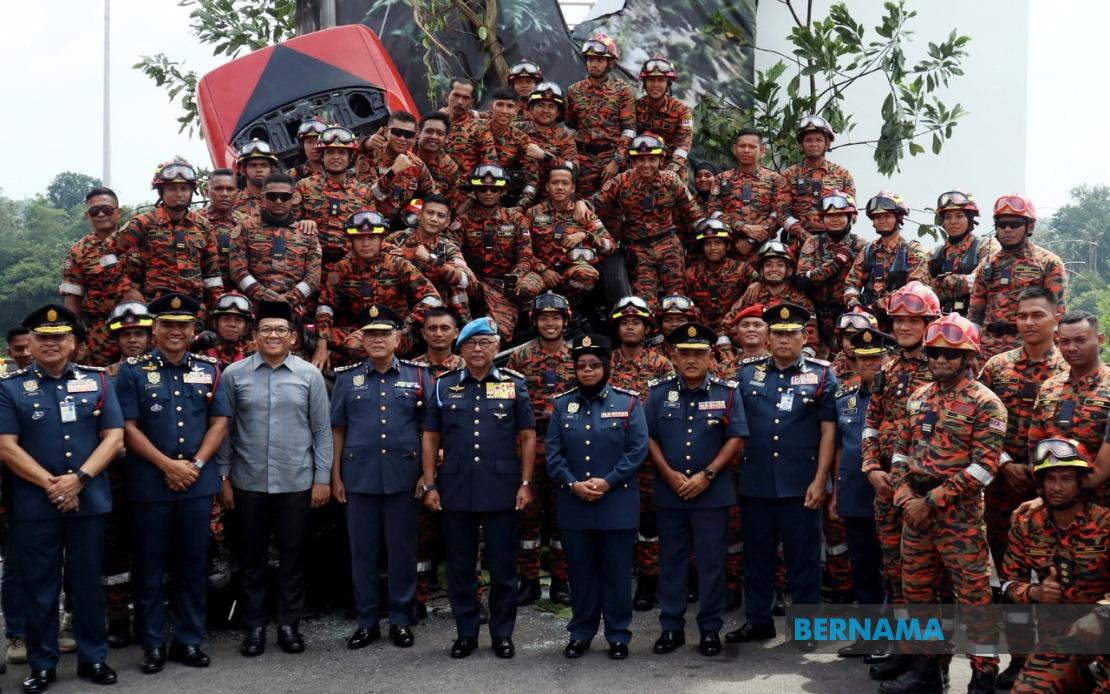
The Federal Government has committed RM278.9 million in annual development expenditure to advance the operational capabilities of the Malaysian Fire and Rescue Department (JBPM) through a comprehensive 86-project portfolio under the First Rolling Plan of the 13th Malaysia Plan. This allocation represents a significant infrastructure investment aimed at modernising emergency response infrastructure and closing service gaps across the nation. The funding breakdown encompasses 27 freshly initiated projects alongside 59 continuing undertakings that span the length and breadth of Malaysia, signalling the government's sustained commitment to strengthening public safety infrastructure beyond traditional urban centres.
Datuk Aiman Athirah Sabu, the Housing and Local Government deputy minister, outlined the scope of this investment during remarks delivered at the inauguration of the Sungai Lembing Fire and Rescue Station (BBP) in Pahang. Her emphasis on the breadth of the funding framework highlighted how the allocation reflects a strategic approach to balancing new facility development with the completion and enhancement of existing infrastructure. The decision to frontload resources for the current year demonstrates the government's urgency in addressing firefighting and rescue service deficiencies, particularly in localities that have historically experienced longer response times.
Pahang has emerged as a focal point for JBPM development initiatives under both the 12th Malaysia Plan and the current 13MP cycle. Seven distinct facility projects are underway throughout the state, reflecting deliberate geographic distribution of resources. These encompass the procurement and development of the Gohtong Jaya station facilities and accompanying residential quarters, construction of the Benta station, establishment of operations at Tioman island, and comprehensive upgrading of critical urban stations in Bentong and Kuantan. Additional work includes rebuilding the Triang facility and preparing foundation works for the anticipated Tanjung Lumpur station, demonstrating a multi-year development pipeline that addresses both capacity expansion and infrastructure modernisation.
The newly operational Sungai Lembing BBP stands as a tangible manifestation of this policy direction. Built at a cost of RM6 million on a seven-acre parcel, the facility represents the 29th fire and rescue station established in Pahang and commenced operational duties on February 15. The station's positioning within the Sungai Lembing township—serving approximately 15,000 residents and adjacent communities—addresses a critical service coverage gap that existed previously. For residents in this semi-rural locality historically dependent on stations in larger towns, the facility's establishment reduces emergency response times substantially and provides immediate access to firefighting and rescue capabilities.
Beyond its primary firefighting function, the Sungai Lembing station embodies an expanded vision for JBPM's societal role. The deputy minister characterised the facility as aspiring to become a comprehensive community safety hub, extending well beyond reactive emergency response to encompass proactive public education, technical skills training, and initiatives to cultivate citizen awareness of fire prevention and personal rescue capabilities. This conceptualisation reflects international trends in modern fire service delivery, wherein departments function as community partners in building culture-wide resilience rather than purely technical responders to emergencies. The emphasis on knowledge dissemination and capacity-building suggests a shift toward preventive approaches that could reduce demand for emergency services over time.
The Sungai Lembing station's inauguration occurred within a broader strategic context of heritage town revitalisation. Datuk Mohd Shahar Abdullah, the Deputy Economy Minister representing the Paya Besar constituency, framed the fire station investment as integral to a comprehensive ecosystem redesign for the locality. Sungai Lembing, a former tin-mining hub with considerable historical significance, is undergoing transformation through heritage preservation projects including restoration of the PCCL Cinema, ecotourism product development, establishment of a digital museum, and rehabilitation of the historic Sungai Lembing Tunnel. The township's candidacy for UNESCO World Heritage Site designation underscores the government's ambitions for the area's cultural and economic repositioning.
The integration of fire and rescue infrastructure within this broader development framework reflects sophisticated urban planning principles. Abdullah emphasised that advancement in physical heritage conservation, tourism infrastructure, and economic diversification achieves diminished value without corresponding investments in public safety systems. The fire station thus functions simultaneously as emergency response infrastructure and as a reassurance mechanism that development investments are occurring within a secure, modern township framework. For potential investors and heritage tourists, the presence of contemporary emergency services capabilities provides confidence that Sungai Lembing combines historical authenticity with contemporary operational standards.
The RM278.9 million allocation carries significance for understanding the government's budgetary priorities amid competing developmental demands. For context, this annual commitment to JBPM infrastructure positions firefighting services as a priority sector within the 13MP framework, suggesting policymakers recognise critical deficiencies in existing coverage and equipment. The substantial number of projects within this allocation—86 distinct undertakings—indicates systemic rather than marginal improvements are envisioned, likely involving facility construction, equipment procurement, and capacity enhancement across multiple states. This comprehensiveness suggests the allocation emerged from strategic assessments of unmet needs rather than incremental additions to existing budgets.
The Sungai Lembing inauguration drew participation from senior political leadership including the Sultan of Pahang Al-Sultan Abdullah Ri'ayatuddin Al-Mustafa Billah Shah, Pahang Menteri Besar Datuk Seri Wan Rosdy Wan Ismail, and State Legislative Assembly Speaker Datuk Seri Mohd Sharkar Shamsuddin. This ceremonial prominence underscores the political weight attached to the station opening, suggesting both state and federal governments view the Sungai Lembing facility as symbolically important for demonstrating equitable resource distribution beyond major urban centres. The attendance pattern also reflects constitutional protocols wherein fire services fall under federal jurisdiction but require state-level coordination for facility siting and community integration.
For Malaysian readers, the RM278.9 million allocation and the broader 86-project portfolio merit attention as indicators of government investment trajectories and societal safety priorities. The substantial commitment to facilities outside major metropolitan areas addresses historical disparities wherein emergency response infrastructure concentrated in urban commercial and industrial zones. Communities in semi-rural and heritage localities like Sungai Lembing have historically absorbed longer response times and reduced service reliability. The current allocation pattern suggests deliberate attempts to equalise service accessibility across diverse geographic contexts, potentially influencing property values, business investment decisions, and quality-of-life assessments in provincial townships.
The initiative's relevance extends to Southeast Asian policymaking contexts more broadly. As ASEAN nations grapple with balancing heritage conservation with modernisation, the Sungai Lembing model—wherein emergency services infrastructure anchors broader development strategies—offers a replicable approach. Other heritage towns throughout the region confronting similar pressures to maintain cultural authenticity whilst pursuing economic revitalisation could learn from Malaysia's integration of contemporary safety systems within historical preservation frameworks. The fire station functions not as a constraint on heritage development but as an enabling infrastructure that facilitates sustainable community advancement.
Moving forward, the success of the RM278.9 million allocation will depend substantially on implementation efficiency and operational effectiveness of the newly established and upgraded facilities. Performance metrics tracking response times, incident outcomes, and community safety indicators in regions receiving new stations will provide important data regarding the allocation's impact. For Sungai Lembing specifically, the transformation from isolated township to connected heritage destination served by modern emergency infrastructure represents a meaningful shift in development trajectory. Whether the fire station fulfils its envisioned role as a community safety centre rather than merely an emergency response facility will influence how successfully the broader heritage revitalisation initiative achieves its objectives of creating a safe, modern, and prosperous locality.

