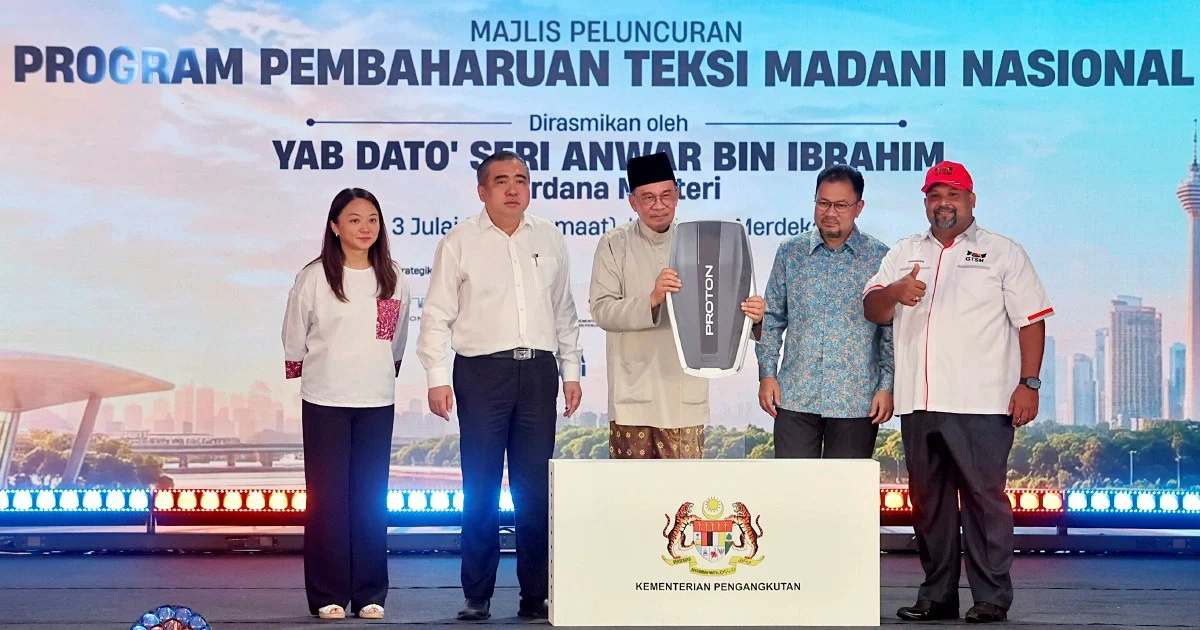
The Malaysian government has released RM10 million in fresh funding to support taxi operators transitioning away from older vehicles through a matching grant programme, Prime Minister Datuk Seri Anwar Ibrahim announced today. The allocation represents a significant commitment to modernising the country's taxi fleet, addressing long-standing concerns about vehicle condition and service standards across the sector.
The matching grant scheme operates on a cost-sharing principle, where government contributions complement investments made directly by taxi operators themselves. This structure encourages fleet owners to take ownership of modernisation efforts while reducing the financial burden of replacing vehicles that have often exceeded their optimal operational lifespan. By splitting costs between the public purse and private operators, the programme aims to make fleet renewal financially viable for mid-sized and smaller taxi businesses that might otherwise struggle to afford new vehicles.
For Malaysia's taxi industry, which remains a crucial component of urban and inter-city transportation infrastructure, the funding injection addresses persistent challenges. Many vehicles operating on roads across Kuala Lumpur, Selangor, Penang, and other major cities are decades old, contributing to concerns about passenger safety, vehicle reliability, and environmental emissions. Ageing taxis have been linked to increased breakdowns, higher maintenance costs, and passenger dissatisfaction—issues that the government programme directly targets through financial incentives for replacement.
The scheme's timing reflects broader government priorities around economic support for traditional sectors undergoing structural change. The taxi industry has faced mounting pressure from ride-hailing applications, changing consumer preferences, and post-pandemic recovery challenges. Rather than allowing conventional taxi services to decline, the government has positioned the matching grant as a tool to help operators remain competitive by operating newer, more reliable fleets that can meet contemporary passenger expectations.
Matching grant programmes of this nature have proven effective in other jurisdictions and sectors, as they create shared responsibility between government and beneficiaries. Taxi operators who invest their own capital demonstrate commitment to improvement, while government backing ensures the programme reaches operators across different financial circumstances. The RM10 million allocation, while substantial, underscores that modernisation is envisioned as a phased, ongoing process rather than a one-time overhaul.
Implementation of such schemes typically requires clear eligibility criteria, transparent application processes, and verification mechanisms to ensure funds reach intended beneficiaries efficiently. The government will likely work with relevant agencies and industry associations to establish guidelines determining which operators qualify, what vehicle standards replacements must meet, and how grant disbursement operates. Previous similar initiatives have benefited from setting benchmarks around vehicle age, registration status, and operator track records.
From a regional perspective, Malaysia's approach aligns with broader Southeast Asian trends toward modernising transport sectors. Countries across the region recognise that ageing taxi fleets pose economic inefficiency, safety risks, and environmental costs. By investing in modernisation, governments demonstrate commitment to both supporting traditional transport workers and advancing sustainability objectives—an important balance in diverse economies where large populations depend on conventional taxi services.
The RM10 million injection also carries economic multiplier effects beyond direct taxi replacement. Purchasing new vehicles generates demand within the automotive sector, supporting manufacturing, dealer networks, and related supply chains. For operators, newer taxis reduce fuel consumption and maintenance expenditure, freeing capital for wages, business expansion, and reinvestment. These secondary benefits extend the programme's impact across broader economic activity.
Environmental considerations add another dimension to this initiative. Modern vehicles typically incorporate improved emissions control technologies, better fuel efficiency, and lower carbon footprints compared to older models. As Malaysia works toward climate commitments and improved urban air quality, replacing aged taxis with current-generation vehicles contributes meaningfully to these objectives, particularly in congested metropolitan areas where taxi concentrations are highest.
Successful execution of the matching grant scheme will depend on operators' willingness and capacity to access available funds. The government will likely need to conduct public outreach, simplify application procedures, and potentially offer financing partnerships to maximise participation. Previous transport modernisation initiatives across Asia have sometimes faced uptake challenges when bureaucratic processes proved burdensome or when operators lacked awareness of available support.
The allocation also signals government recognition that urban mobility systems depend on healthy, functioning taxi sectors alongside emerging transport technologies. Rather than viewing ride-hailing and conventional taxis as purely competitive, policymakers increasingly recognise complementary roles within integrated transport ecosystems. Supporting taxi modernisation protects jobs, maintains alternative transport options, and preserves traditional livelihoods while accommodating technological change.
Looking forward, the RM10 million commitment may represent an initial tranche of a larger modernisation initiative. Depending on uptake rates, vehicle replacement costs, and evolving industry conditions, additional allocations could follow. The government's willingness to fund the scheme demonstrates sustained policy focus on transport sector development, worker support, and economic diversification across different segments of Malaysia's economy.

