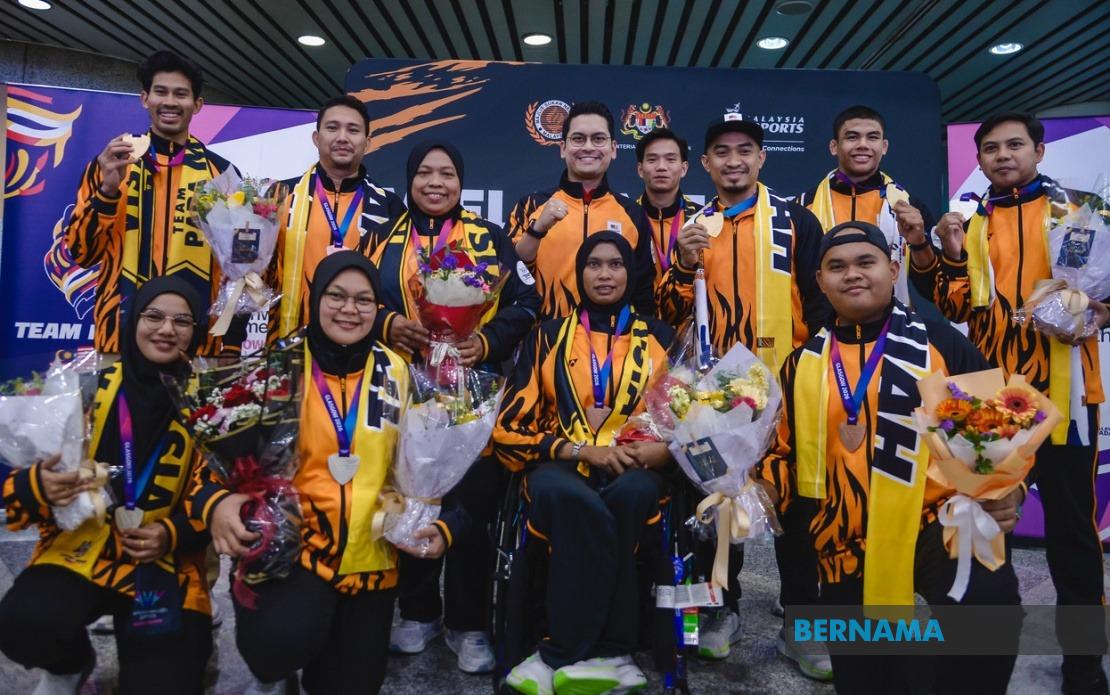
Malaysia's government has unveiled a RM1.1 million reward package for athletes who secure medals at the forthcoming 2026 Glasgow Commonwealth Games, marking a significant investment in national sporting talent under the National Sports Incentive Scheme (SHAKAM). Youth and Sports Minister Dr. Mohammed Taufiq Johari announced the initiative during a welcoming ceremony for medal winners at Kuala Lumpur International Airport, positioning the allocation as a tangible expression of gratitude for the pride and dedication athletes bring to the nation.
The incentive structure establishes clear financial motivation across all medal tiers, with gold medalists receiving RM80,000 as the primary reward. Those who accomplish the additional distinction of breaking games records will benefit from a supplementary RM10,000 bonus, bringing potential gold-medal earnings to RM90,000. Silver medalists qualify for RM40,000, while bronze medalists receive RM20,000, creating a tiered system that rewards excellence across competitive levels.
Dr. Mohammed Taufiq indicated that the current allocation represents a baseline figure rather than a ceiling, with the National Sports Council actively exploring mechanisms to enhance monetary rewards through corporate partnerships and sponsorship agreements. This dynamic approach suggests the government recognises potential for expansion as private sector engagement increases, potentially elevating incentives beyond existing commitments. Such supplementary funding models have proven effective in other Commonwealth nations and reflect a growing trend toward public-private collaboration in sports investment across Southeast Asia.
The minister attributed Malaysia's strong showing at Glasgow—which yielded eight gold, three silver, and five bronze medals—directly to a strategic shift introduced by his ministry that emphasises gold-medal acquisition through colour-specific targeting. This methodology diverges from traditional approaches that counted medals across all categories without hierarchical preference, instead concentrating athlete development and coaching resources toward maximising gold medal success. The performance exceeded the initial internal target of five gold medals, demonstrating the practical effectiveness of this concentrated approach.
The rationale underlying colour-based targeting extends beyond immediate competition outcomes, functioning instead as a foundational step toward Malaysia's longer-term ambition of claiming an Olympic gold medal. Dr. Mohammed Taufiq acknowledged initial concerns that such pressure-intensive targeting might adversely affect athlete performance, yet the Glasgow results validated the strategy's capacity to inspire rather than diminish athletic output. This contrarian finding reshapes conventional sports psychology wisdom within the Malaysian context and may influence talent development strategies across Southeast Asian nations considering similar models.
The colour-based medal framework emerged through extensive consultation involving sports associations, coaching bodies, and athletes themselves, ensuring that goal-setting reflected practical feasibility rather than arbitrary aspirations. This collaborative development process enhanced stakeholder buy-in and grounded targets in technical expertise, distinguishing the approach from top-down mandates that frequently generate resentment within athletic communities. The methodology exemplifies evidence-based policymaking in sports administration and provides a replicable model for neighbouring countries reviewing national sporting strategies.
Malaysia's Glasgow contingent was notably smaller than in previous Commonwealth Games iterations, yet Dr. Mohammed Taufiq characterised the medal haul as particularly meaningful precisely because it demonstrated qualitative improvement despite reduced numerical participation. This efficiency metric—achieving stronger outcomes with fewer athletes—suggests improved targeted recruitment, enhanced coaching standards, or superior resource allocation rather than broad-based expansion of participation. For Malaysian stakeholders, this indicates the government is pursuing elite-level excellence rather than mass participation growth, a distinction with significant implications for long-term investment priorities.
Chef de Mission Datuk Awalan Abdul Aziz, simultaneously serving as Malaysian Lawn Bowls Federation President, offered additional perspective on the tension between internal aspirations and formal target-setting. The lawn bowls contingent privately pursued gold medals without formally designating them as public objectives, ultimately delivering two silver and two bronze medals in Glasgow. This represents substantial improvement compared to the Birmingham 2022 Commonwealth Games, where the same sport contributed one silver and one bronze, suggesting enhanced preparation standards and athlete development trajectories despite fewer formal pressures.
The SHAKAM allocation assumes significance within Malaysia's broader sporting development context, where funding often lags regional competitors like Australia, Singapore, and India. The commitment to RM1.1 million exclusively for medal rewards—distinct from athlete training subsidies, facility development, or coaching allocations—indicates serious financial prioritisation of medal incentivisation. For Malaysian sports administrators and athletes, this signals governmental recognition that financial security removes performance anxiety and enables athletes to compete with full concentration rather than financial desperation.
The Glasgow performance's characterisation as one of Malaysia's strongest Commonwealth Games showings since 2010 provides temporal context for measuring progress. Tracking medal accumulation across decades reveals the impact of strategic interventions, equipment investment, and coaching development on national outcomes. The current administration's colour-based targeting represents a recent policy innovation, suggesting future games will generate valuable data on whether this approach sustains momentum or plateaus as competitors adapt and improve their own methodologies.
Beyond immediate medal recognition, the SHAKAM framework establishes precedent for systematic athlete support that extends beyond training phases into post-competition acknowledgment. This holistic approach addresses recruitment retention challenges, as emerging athletes observing established medalists receiving substantial rewards develop enhanced motivation for pursuing elite competition. Within Malaysian sports culture, where financial precarity often prevents talented individuals from pursuing athletic careers exclusively, reward structures that offer tangible post-achievement security prove pivotal for talent pipeline development.
The minister's emphasis on continuing colour-based targeting in future competitions signals institutional commitment to this strategic direction regardless of immediate political leadership changes. When policy anchors institutional practice rather than depending on individual leader preferences, sporting continuity improves and long-term athletes can plan career trajectories with confidence. Malaysia's experience with this approach will likely inform regional discussions as other Commonwealth nations evaluate medal-targeting methodologies and reward allocation philosophies.

