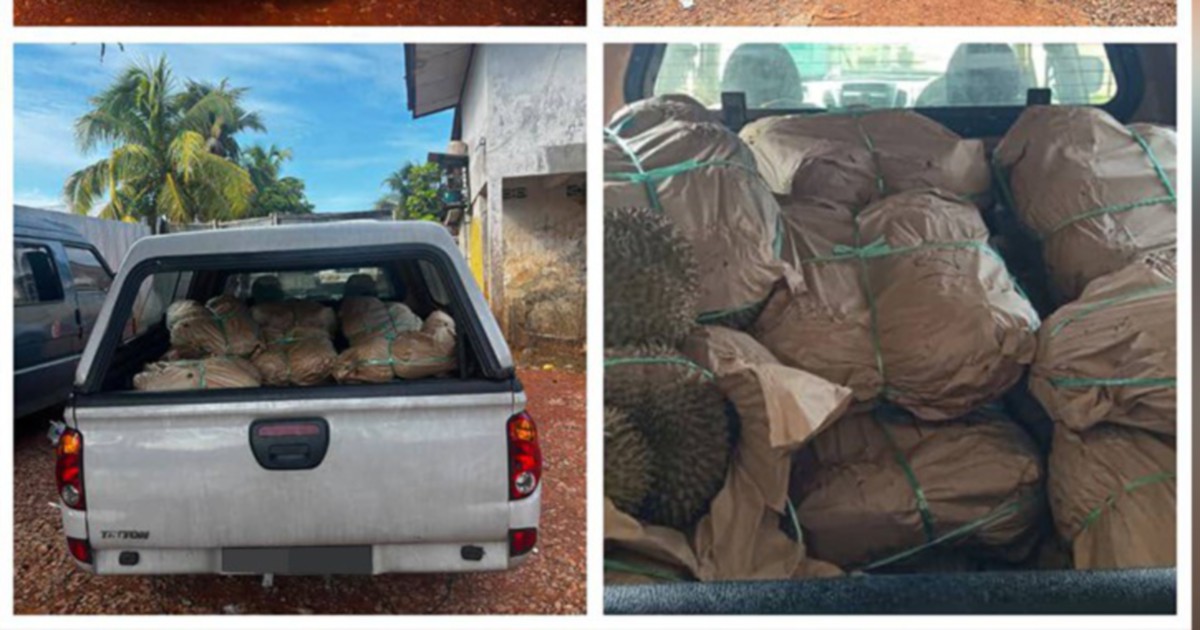
The General Operations Force scored another significant victory in its ongoing battle against smuggling operations when personnel raided an unauthorised landing point near Rantau Panjang in Kelantan yesterday. In a coordinated enforcement action at the Abe Li Posmen illegal jetty, officers apprehended a 20-year-old driver and recovered a substantial cache of contraband durians along with the vehicle used to transport the illicit cargo. The seizure, which netted approximately 350 kilograms of the prized fruit, represents the latest in a string of interceptions targeting the cross-border movement of agricultural products in one of Malaysia's key maritime trafficking corridors.
The confiscated four-wheel-drive vehicle, estimated to be worth more than RM50,000, now stands as evidence in what authorities are treating as a serious smuggling operation. Beyond the immediate recovery of goods, the seizure underscores the resourcefulness of smuggling networks that operate in the borderlands between Malaysian and Thai territory. These underground operations exploit the porous maritime boundary and the remote geography of coastal Kelantan to move high-value commodities that would otherwise attract duty and taxation through official channels.
The arrest of the young driver raises questions about the recruitment patterns within smuggling organisations. That individuals in their early twenties are being tasked with operating valuable transport assets suggests a deliberate strategy by smuggling syndicates to use expendable personnel for high-risk operations, insulating organisational leadership from direct law enforcement exposure. The driver's relative youth also points to how smuggling networks have adapted to enforcement pressures by cycling through lower-level operatives, making disruption of supply chains considerably more challenging for authorities.
Durian, Malaysia's iconic "king of fruits," commands premium prices in regional markets, particularly in Singapore and Thailand, where demand consistently outpaces domestic supply. The fruit's high market value, combined with its seasonal availability and the export restrictions that govern legitimate international trade, create powerful incentives for smuggling operations. A 350-kilogramme haul represents not merely agricultural contraband but a deliberate effort to capture margin by circumventing formal trade channels that include quality inspections, phytosanitary certification, and export taxes.
The Rantau Panjang area has long featured prominently in the government's smuggling enforcement operations. The district's location along the Golok River, which forms the natural border between Kelantan and Thailand's Narathiwat province, creates inherent vulnerabilities that criminal networks have systematically exploited. The proximity of illegal jetties like Abe Li Posmen to populated areas, combined with the difficulty of maintaining permanent surveillance over sprawling waterfront zones, means that smugglers retain significant operational flexibility despite increased patrols and checkpoints.
The GOF's role in this interception highlights the institutional division of labour that has evolved within Malaysia's law enforcement apparatus. While regular police handle most domestic crime, specialised paramilitary units like the GOF focus on border security, smuggling interdiction, and operations in maritime zones. This specialisation, though administratively distinct from customs enforcement, creates overlapping jurisdictions that occasionally generate intelligence advantages when coordinated effectively across agencies.
From a regional trade perspective, the interception reflects the broader tension between free movement aspirations within Southeast Asia and the necessity of border controls to protect tax revenues and combat organised crime. Thailand's consistent need for durian supplies creates natural demand that drives smuggling; Malaysia's restrictions on fruit exports, while designed to maintain domestic supply and regulate quality, inadvertently generate profit opportunities for illicit traders. This dynamic has persisted across multiple administrations and trade policy cycles, suggesting that enforcement alone cannot resolve the underlying structural incentives.
The confiscation of the vehicle itself carries significant implications for the economics of smuggling operations. A RM50,000 asset loss, when multiplied across multiple enforcement actions annually, imposes genuine costs on smuggling networks. Yet the scale of those costs relative to projected profits from successful runs remains the critical calculation that determines operational frequency. If smugglers anticipate recovering confiscated vehicles through legal remedies or replacing them through established procurement networks, then seizures function merely as friction rather than genuine deterrence.
Forensic investigation into the vehicle's ownership and the driver's connections to larger trafficking organisations could yield intelligence about the organisational structure of durian smuggling rings. Law enforcement agencies are increasingly focused on mapping these networks to identify coordinators and financiers rather than pursuing only street-level operators. The 20-year-old detainee, should he cooperate, potentially offers investigators pathways toward higher-level targets, though the incentive structures within smuggling organisations typically discourage such cooperation.
Looking ahead, the Rantau Panjang enforcement operation illustrates the resource-intensive nature of effective border control. Successful interceptions require consistent intelligence gathering, opportune patrolling, and rapid response capabilities that stretch enforcement budgets across maritime jurisdictions extending hundreds of kilometres. As smuggling networks adapt tactics and routes, the enforcement agencies must correspondingly evolve their strategies, suggesting that sporadic seizures, while symbolically important, represent only incremental progress in controlling illicit agricultural trade flows that remain deeply embedded in cross-border commerce patterns throughout Southeast Asia.

