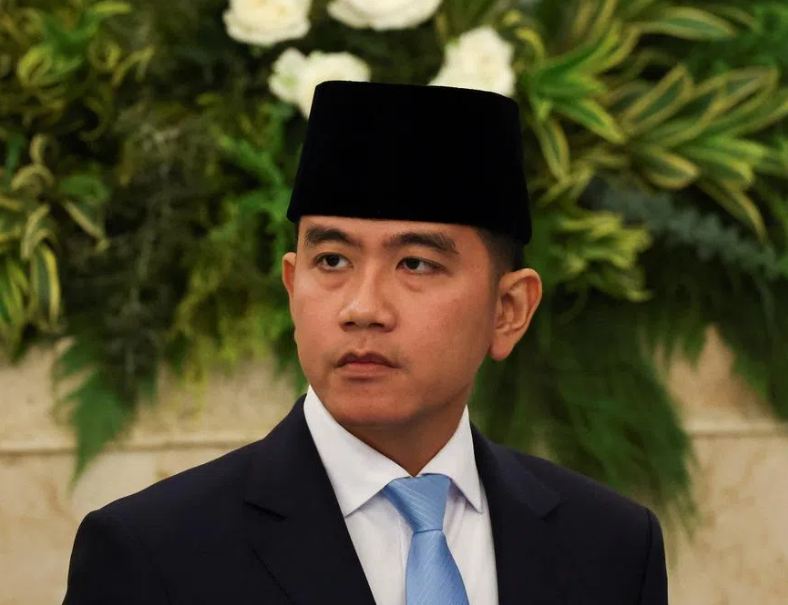
Vice-President Gibran Rakabuming Raka has begun a visible public engagement campaign with student activists protesting against flagship government programmes, inviting five university representatives aboard his official aircraft for a four-day working visit to eastern Indonesia in mid-June. This outreach occurred merely three days after a closed-door presidential meeting with student leaders who had been demonstrating against the free meals scheme and Red and White Cooperative initiative — two of President Prabowo Subianto's most ambitious and contentious policy undertakings. The move has elevated the 38-year-old vice-president's profile while simultaneously raising questions about whether he is genuinely addressing public concerns or performing calculated political theatre ahead of Indonesia's 2029 presidential elections.
At the palace gathering, Bung Karno University student leader Muhammad Abdi Maludin reported that Gibran demonstrated openness to the students' research and concerns, pledging to audit their findings and relay them to President Subianto. This receptive posture contrasted sharply with the mixed online reactions to Gibran's Instagram documentation of the encounter. Several social media commenters questioned the credibility of the engagement, noting that the selected students represented less prominent institutions rather than Indonesia's largest universities. One observer suggested the meeting appeared choreographed rather than organically driven, while another dismissed it outright as a "show" rather than substantive dialogue.
Analysts at Jakarta-based think tanks interpret Gibran's activism as a deliberate positioning strategy. Nicky Fahrizal from the Center for Strategic and International Studies characterises the persona on display as that of an accessible, communicative leader willing to hear from ordinary citizens and students — an image Gibran appears to be cultivating deliberately while momentum from the ongoing student movement provides political oxygen. The timing and framing suggest a longer-term calculation: building name recognition and demonstrating executive responsiveness well ahead of the next presidential contest. Some political observers have speculated that Gibran may seek the presidency in 2029, though he has not publicly confirmed such intentions.
Gibran's positioning as an intermediary between public discontent and government policy marks a significant shift in his public role. Since assuming office alongside Prabowo in October 2024, the eldest son of former president Joko Widodo has struggled to carve out a clearly defined governmental function. Despite nominal associations with high-priority assignments such as Papua's development and the new capital Nusantara, he has largely remained peripheral to major policy decisions. Unlike several of his predecessors in the vice-presidency, he has not been granted a substantial policy portfolio, and most flagship government initiatives are controlled directly by ministries, agencies, and officials reporting to the president. This peripheral positioning appears to have motivated his recent student outreach efforts.
The actual scope of Gibran's influence over the two programmes drawing student criticism remains sharply constrained. The National Nutrition Agency, which oversees the free meals initiative, reports directly to President Subianto rather than through the vice-presidency. The Red and White Cooperative scheme operates as a presidential priority programme coordinated across multiple ministries and agencies, similarly beyond Gibran's direct purview. Irman Lanti, a political analyst at Padjadjaran University, points out that all available evidence suggests Gibran played no substantive role in formulating either programme. He argues that both initiatives operate under the effective control of military and police institutional structures, leaving the vice-president's claimed interest in their improvement as essentially superficial engagement rather than meaningful intervention.
The free meals programme had become particularly vulnerable to public criticism following corruption allegations at its implementing agency. In June, National Nutrition Agency chief Dadan Hindayana was replaced and subsequently arrested alongside two former deputies as authorities investigated alleged procurement irregularities. During his eastern Indonesia visit, Gibran visited a primary school and publicly acknowledged shortcomings in the programme's governance, calling for improvements in its administration following the scandal. He instructed officials to expedite implementation in areas where infrastructure had already been established and committed to following up on local concerns. These gestures, while publicly visible, remain largely symbolic given his peripheral role in actually steering the programme's operations.
Moreover, questions have emerged regarding the authenticity of the student engagement itself. Local news outlets Kompas and Tribunnews reported in late June that students attending the presidential meeting received substantial monetary sums afterwards — one Bung Karno University student leader received 20 million rupiah, while other attendees acknowledged receiving between 2 and 2.5 million rupiah each. The source and purpose of these payments remain unexplained, and the Presidential Palace indicated it was investigating the matter. These revelations lend credence to critics' suggestions that the student engagement was meticulously orchestrated rather than genuinely representative of broader campus opinion, particularly given that the selected participants came from less prominent universities rather than Indonesia's largest institutions.
Edbert Gani Suryahudaya, from CSIS' Department of Politics and Social Change, characterises Gibran's approach as a "deliberate strategy" to appease public anger, while acknowledging that such engagement is unlikely to generate meaningful policy changes. He observes that the vice-president appears to be employing relatively "simple" and low-cost visibility tactics to maintain public attention amid widespread criticism directed at the government and its officials. The performative engagement with students requires minimal institutional apparatus or political capital while generating media coverage and conveying an impression of responsiveness. For a vice-president seeking to establish relevance within an administration where his actual authority remains circumscribed, such tactics offer an efficient mechanism for building public recognition and cultivating a leadership image distinct from his current marginal policy role.
The broader pattern suggests that Gibran is consciously constructing a public identity independent of substantive governmental responsibility — positioning himself as a bridge between citizen concerns and executive authority while avoiding the accountability that would accompany genuine policy control. This strategy carries implications for Southeast Asian political dynamics more broadly, as vice-presidential roles across the region increasingly become vehicles for political positioning and image-building among ambitious figures constrained by limited institutional authority. By engaging visible constituencies like student protesters while maintaining plausible distance from unpopular programme outcomes, Gibran demonstrates how political actors navigate the tension between demonstrating leadership capability and avoiding association with governance failures.
Gibran's calculated engagement with student activists ultimately reflects the structural peculiarities of his vice-presidential position within Prabowo's administration. Having inherited a largely ceremonial role without a clearly defined policy portfolio, he has seized upon public discontent to establish a distinctive public presence ahead of potential future electoral contests. Analysts agree this visibility strategy, while politically astute, cannot translate into substantial programme modifications given his actual limited influence over their administration. The incident therefore illuminates how contemporary Indonesian politics increasingly operates through performative engagement and media-mediated images of leadership rather than through formal institutional authority — a pattern that carries significant implications for the transparency and accountability of governance across the region.