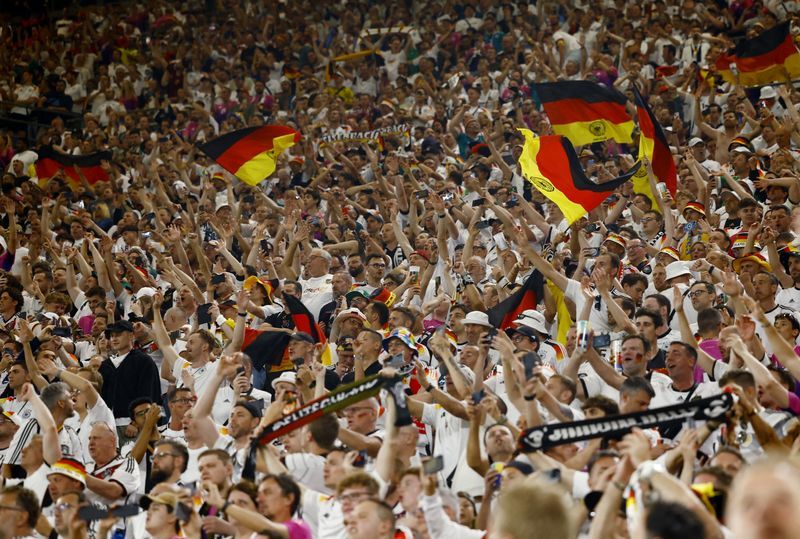
German authorities conducted sweeping investigative raids across the country on Wednesday, targeting the headquarters of the German Football Association (DFB) as part of a widening probe into alleged improper distribution of tickets and hospitality packages surrounding the 2024 European Championship. The coordinated operation marks a significant escalation in what has emerged as a complex scheme involving the misallocation of thousands of match tickets to favoured individuals ahead of the tournament, which Germany hosted across ten major cities earlier this year.
According to reports from the Bild newspaper, the investigation centers on suspected violations involving both ticketing protocols and hospitality arrangements that may have circumvented proper channels during the Euro 2024 preparations. The searches were prompted by evidence pointing to at least one German national and a French national among others under investigation, suggesting the alleged irregularities may have involved coordinated activity across international borders. This cross-border dimension adds complexity to what prosecutors are treating as a serious administrative and potentially criminal matter.
Official confirmation of the raids came through a joint statement issued by prosecutors based in Bochum and the North Rhine-Westphalia state criminal office, which acknowledged that searches were being conducted at multiple locations throughout Germany without explicitly naming the DFB in their public remarks. However, Bild's reporting that the association's headquarters was included in the operation indicates that investigators view the DFB as central to understanding how institutional structures may have facilitated or permitted the alleged misconduct.
The specific allegations paint a picture of systematic mishandling of scarce tournament assets. According to investigators, several thousand tickets destined for public distribution through legitimate channels appear instead to have been diverted to preferred guests and individuals with connections to tournament organizers. These ticket distributions were frequently bundled with hotel accommodations and travel benefits, creating an illegal parallel economy of hospitality arrangements that bypassed official allocation procedures.
One documented case illustrates the scale of suspected impropriety. A municipal employee based in Gelsenkirchen—one of the ten host cities for the tournament—was identified as receiving tickets, travel arrangements, and hotel benefits valued at approximately €2,400. This individual, a German national, exemplifies the pattern prosecutors believe extended across multiple beneficiaries, suggesting this was not an isolated incident but part of a broader practice. Gelsenkirchen's status as a tournament host city raises questions about whether local government officials may have been involved in or aware of ticket distribution irregularities.
The prosecution statement characterised the suspected wrongdoing as involving "unauthorized advantages, including a visit to an international football match," language that deliberately downplays what appears to be a systematic diversion of public sporting assets for private benefit. The careful wording reflects prosecutors' effort to maintain investigative confidentiality while signalling to the public the seriousness with which they regard the matter. For Malaysian and broader Southeast Asian readers, this scandal highlights how major sporting events, regardless of host nation, require robust governance frameworks to prevent corruption in ticketing and hospitality distribution.
The timing of the investigation—conducted months after the tournament concluded—suggests that authorities relied on careful accumulation of evidence and documentation rather than acting on immediate suspicions. This methodical approach, while thorough, also indicates that improprieties may have persisted throughout the tournament period without immediate detection, raising questions about oversight mechanisms that existed during Euro 2024 itself. The delay between the tournament and the raids underscores how such schemes can operate within institutional environments for extended periods.
The DFB's initial lack of public response, combined with UEFA's silence, suggests that both organizations may be coordinating with investigators or preparing carefully crafted statements. The absence of immediate denial or explanation is notable in an era of rapid institutional response to public criticism. This hesitation may indicate that preliminary findings have already implicated DFB personnel or systemic failures in institutional controls, making defensive statements inadvisable until the investigation progresses further.
For Malaysian sports administrators and football governance bodies in Southeast Asia, this case serves as an instructive cautionary tale about tournament management standards. Major sporting events—whether the AFC Asian Cup, ASEAN Football Federation Championships, or other regional competitions—require transparent ticketing systems with clear audit trails, segregated responsibilities between distribution and verification functions, and independent oversight mechanisms. The Euro 2024 scandal demonstrates that even in wealthy, administratively sophisticated nations with robust legal systems, the combination of high-demand assets, decentralized authority, and weak internal controls can create opportunities for systematic misappropriation.
The investigation's scope and coordination across multiple German jurisdictions indicates that prosecutors view this as a matter of significant public importance rather than minor administrative irregularity. The involvement of Bochum prosecutors and the North Rhine-Westphalia criminal office suggests resource commitment befitting a complex financial and organizational crime. This institutional response signals to tournament organizers everywhere that governments increasingly hold sporting bodies accountable for asset management, even when violations involve relatively modest individual amounts like the €2,400 identified in the Gelsenkirchen case.
Going forward, the investigation's outcome will likely influence how future major tournaments—including those potentially hosted in Southeast Asia—structure their ticketing and hospitality governance. If DFB officials or institutional failures are conclusively identified, tournament organizing committees throughout the region may face pressure from their respective governments and international sports bodies to implement stricter controls. Conversely, if the investigation concludes that the violations were perpetrated by individuals acting against organizational policy, it may paradoxically reduce external pressure for systemic reforms, though the reputational damage to Euro 2024 and the DFB will persist regardless of investigative findings.

