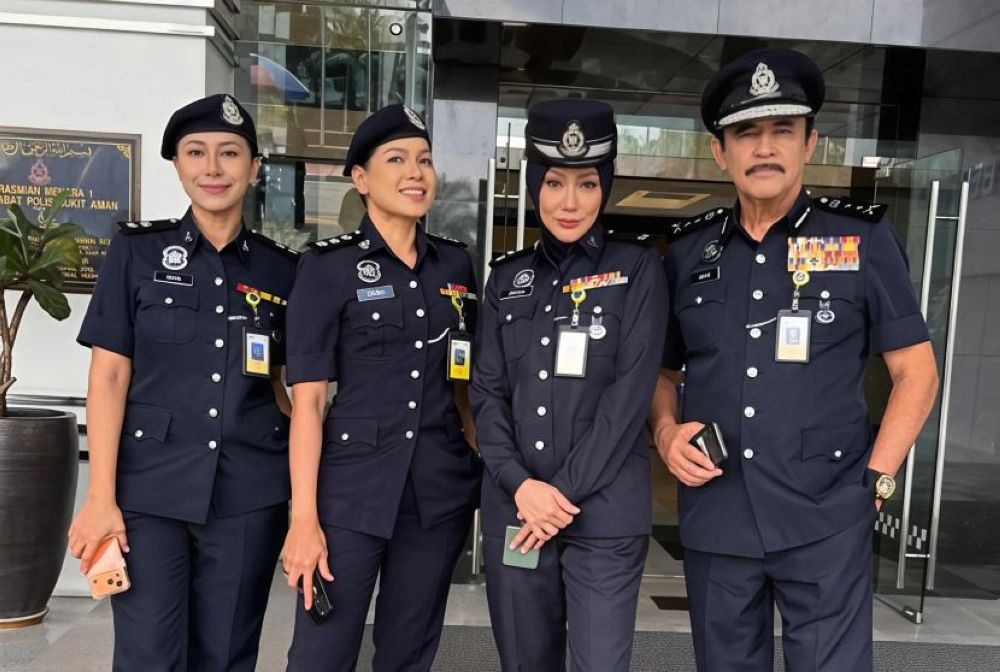
The production of Gerak Khas 2.0, the anticipated sequel to Malaysia's iconic police drama franchise, has taken a significant turn following the arrest of one of its actresses on drug-related charges. Just days after the series premiered, producer Datuk Yusof Haslam announced that the actress has been removed entirely from the remaining episodes, marking a decisive intervention aimed at protecting the show's credibility and its association with the Royal Malaysia Police.
The decision came after the actress was apprehended during a raid conducted by officers from the Dang Wangi district police headquarters on July 7. During the operation, she tested positive for three categories of controlled substances, prompting swift action from the production team. Despite this late-stage complication, Yusof revealed that filming for the 26-episode series has already advanced to the 90 percent completion mark, leaving just approximately two weeks of production work remaining on the overall project.
The producer disclosed that the dismissed actress still had scenes scheduled across episodes 23 and 24 of the total series, all of which have now been cancelled. Yusof explained that the timing of the incident, occurring so late in the production cycle, had limited the disruption to the overall shooting schedule. The decision to remove her entirely from the remaining footage was framed not as a hasty reaction but as a deliberate choice to maintain what he termed the "integrity" of the production and its relationship with Malaysia's police force.
Yusof emphasised that his production company would have made a fundamentally different casting decision had the information about the actress's legal troubles emerged earlier. He noted that the cast member had previously worked on other Skop Production projects without any issues, making the incident an unexpected development rather than a continuation of existing concerns. The producer acknowledged that the firm response was designed to send a message extending well beyond the individual actress involved, serving as a cautionary tale for the entire cast and crew assembled for this high-profile revival of the beloved franchise.
From the project's inception, Yusof had stressed the importance of professional conduct and ethical behaviour among all participants, particularly given the series' subject matter and its connection to law enforcement. He reiterated that he had repeatedly reminded cast and crew members to avoid activities or venues that could generate negative publicity or damage the police force's image. The arrest represented a dramatic breach of these carefully articulated expectations, forcing the producer to take definitive action that would underscore the seriousness with which such violations are treated within the production hierarchy.
The producer adopted an notably uncompromising stance when addressing the actress's response to her dismissal. Yusof stated plainly that he rejected any appeals, explanations, or excuses she may have offered to retain her position within the series. He told her directly that the moment for remediation had passed, characterising the removal as a life lesson about the permanent consequences of missteps in public-facing careers. This austere messaging reflected Yusof's view that professional reputation, once damaged through serious transgressions, cannot be easily restored through negotiation or apology.
Yusof's comments touched on broader themes about public perception and the particular vulnerabilities faced by female performers in the Malaysian entertainment industry. He observed that societal attitudes often judge women more harshly than their male counterparts, and that the association with certain venues or activities carries amplified reputational risk for actresses compared to other professionals. This observation highlighted the asymmetrical pressures that operate within Malaysia's entertainment ecosystem, where personal conduct standards are frequently calibrated differently depending on gender.
The removal also underscores the practical challenges that arise when high-profile productions must navigate unexpected crises involving cast members. Yusof's comparison to parental responsibility—suggesting that even careful oversight cannot guarantee that every individual will avoid problems—conveyed a sense of frustration about the limits of institutional control over personal choices. Despite contractual relationships and explicit warnings, he implied, production houses ultimately lack the authority to prevent talented professionals from making decisions that jeopardise their careers and professional relationships.
Gerak Khas 2.0 represents a significant investment by Skop Production, bringing together a roster of established Malaysian performers. The cast includes Hans Isaac, Erra Fazira, C. Kumaresan, and Salina Saibi, alongside police inspector characters portrayed by Tisha Shamsir, Nabiha Aimi, and Emily Elizabeth. The franchise has maintained tremendous cultural resonance within Malaysia, with the original Gerak Khas series occupying an important place in the nation's television history. The sequel thus carries substantial expectations regarding quality and reputation management.
The incident raises questions about the risk management protocols employed during casting and throughout production timelines. Industry observers in Malaysia and across Southeast Asia will likely examine whether existing vetting procedures adequately identify potential liabilities, or whether the entertainment sector requires enhanced due diligence frameworks. The decision to proceed with the series despite the last-minute personnel disruption demonstrates both the production's confidence in its remaining footage and its determination to preserve the considerable investment already committed to the project.
Yusof's handling of the crisis reflects a calculated balancing act between enforcing professional standards and maintaining production momentum. By removing the actress but allowing the series to continue substantially as planned, he has signalled that individual misconduct will not be tolerated while simultaneously demonstrating that the production's integrity ultimately depends on factors extending beyond any single performer. This approach may serve as a template for similar situations within Malaysia's entertainment industry, where such scandals periodically emerge and require decisive institutional responses.

