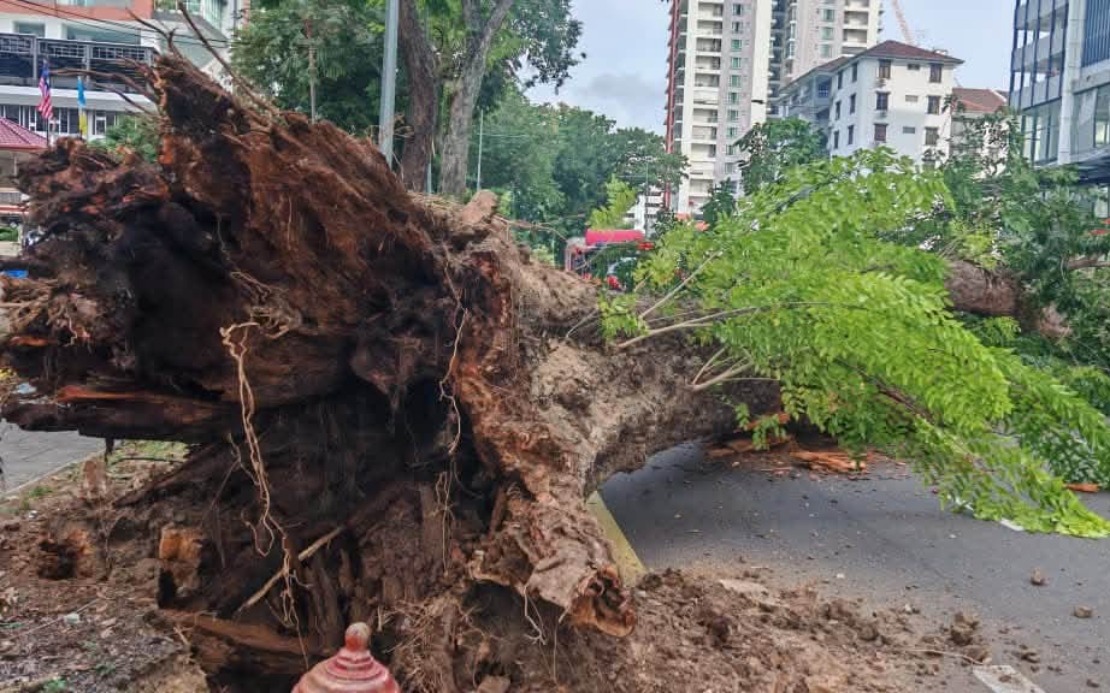
A towering 28-metre Angsana tree that has stood for nine decades along Jalan Macalister in George Town fell without warning on August 9, striking a Perodua Ativa vehicle and leaving three occupants injured. The incident prompted urgent questions about urban tree management in Penang's capital, even as the Penang City Council (MBPP) released a detailed technical assessment explaining the natural processes that undermined the centuries-old specimen's structural integrity.
MBPP Mayor Datuk A. Rajendran provided a comprehensive breakdown of the tree's deterioration, revealing that the Pterocarpus indicus had suffered approximately 30 per cent root rot whilst cavity decay occupied roughly 40 per cent of the base trunk's cross-section. The combination of these two independent failure mechanisms created a critical vulnerability that neither modern infrastructure nor typical maintenance protocols could have reliably detected in advance. The tree stood in a challenging urban environment, where infrastructure upgrading works, chronic soil compaction from decades of foot and vehicular traffic, and severely restricted rooting space had collectively diminished its resilience against structural failure.
What distinguishes this incident from typical tree disasters is the absence of obvious triggering factors. Rajendran explicitly noted that no heavy rainfall or strong winds accompanied the collapse, suggesting that the tree's internal degradation had simply reached a tipping point where the remaining structural capacity could no longer support its considerable mass. The timing appeared essentially random from a meteorological perspective, though the tree's condition had been steadily deteriorating for years undetected beneath its still-verdant canopy. This underscores a persistent challenge in urban forestry: assessing the health of large trees requires specialized techniques that municipal authorities often lack resources to deploy systematically.
The city council's post-incident response demonstrates both organizational capacity and implicit acknowledgment of systemic vulnerability. MBPP commenced removal operations at 9.41 am and fully reopened the road by 2.20 pm, indicating well-established protocols for managing tree emergencies. However, the broader context reveals that this incident occurred despite MBPP having conducted comprehensive assessments of mature and aged trees along Jalan Macalister in 2024, during which thirteen specimens were flagged for removal and subsequently felled. That this particular tree was not among those identified suggests either that its internal degradation accelerated beyond earlier assessments or that current diagnostic methods carry inherent limitations.
Tree maintenance records add another layer to the analysis. The last recorded maintenance work on Jalan Macalister occurred on January 29, 2024, whilst a remote sensing study commissioned the previous year had determined that trees along the corridor were in satisfactory condition with no discernible warning signals. Remote sensing technology, which typically employs aerial imaging and spectral analysis, evidently failed to identify the extensive cavity decay and root rot that subsequently claimed this tree. This suggests that municipalities relying on remote sensing as a primary diagnostic tool may face significant blind spots when assessing internal tree pathology.
Beyond the immediate incident, the numbers surrounding MBPP's annual tree management programme illuminate the scale of urban forestry challenges confronting George Town. The council approved 179 high-risk trees for felling during 2024, of which 148 have been removed, whilst 247 trees were felled across the first nine months of the year. These removals served multiple functions: eliminating drainage obstructions, clearing dead or dangerously leaning specimens, removing trees posing structural collapse risks, facilitating development projects, clearing road and river rights-of-way, and relocating trees encroaching on Penang Water Supply Corporation (PBAPP) pipeline routes. The diversity of reasons reflects the competing pressures that urban trees face in densely developed areas.
A comprehensive 2023 inventory identified 2,535 trees requiring various forms of management intervention across MBPP's jurisdiction. This inventory categorized issues as drainage obstruction in 45 cases, confirmed dead trees numbering 138, trees assessed as presenting risk or falling into other categories comprising 2,242 specimens, and trees affected by development or infrastructure projects totalling 110. The sheer volume suggests that MBPP operates within a framework of ongoing triage rather than preventative whole-of-population health management. In other words, the council responds to identified problems rather than systematically monitoring all significant trees to intercept failures before they occur.
Following the Jalan Macalister collapse, MBPP has instructed its appointed contractor to accelerate work on height reduction and felling of trees presenting elevated collapse risks throughout the corridor, with decisions guided by assessments conducted by certified arborists. This represents a shift toward more aggressive intervention, presumably reflecting a heightened risk appetite following the August incident. However, the decision to prioritize trees already identified as problematic through arborist assessment does not necessarily address the underlying challenge: detecting internal decay in apparently healthy specimens before catastrophic failure occurs.
For Malaysian and Southeast Asian urban planners, this incident illustrates a broader tension inherent in managing heritage urban forests. Angsana trees, widely planted throughout Malaysia and the region during the colonial and early independence periods, are valued for their aesthetic qualities, shade provision, and ecological contribution. Yet many of these specimens have now reached venerable ages within intensely developed urban environments never contemplated when they were planted. Their shallow roots compete with underground infrastructure, their crowns tower above congested streets where falling branches or entire trees present acute risks, and their internal conditions remain opaque until failure becomes imminent.
The incident also raises questions about liability and responsibility frameworks governing local authorities. Whilst MBPP's detailed explanation demonstrates organizational transparency and technical competence, it simultaneously reveals that even systematic assessment protocols may fail to prevent disasters. Insurance considerations, legal exposure, and public confidence in municipal tree management may all be affected by incidents perceived as unpredictable. This creates incentives toward conservative tree removal policies that prioritize risk elimination over urban forest preservation.
Moving forward, the challenge for George Town and comparable Malaysian cities involves balancing several competing objectives: maintaining valued urban canopy, protecting public safety, accommodating infrastructure development, and managing costs within constrained municipal budgets. Enhanced diagnostic technologies such as sonic tomography, which can detect internal cavities and wood density variations, represent potential improvements over current remote sensing approaches. However, deploying such technologies across thousands of trees demands significant investment. Ultimately, the Jalan Macalister collapse highlights that urban tree management in densely built environments requires ongoing evolution in assessment methodologies, maintenance protocols, and public communication about both the benefits and inherent risks of maintaining large heritage trees in cities.

