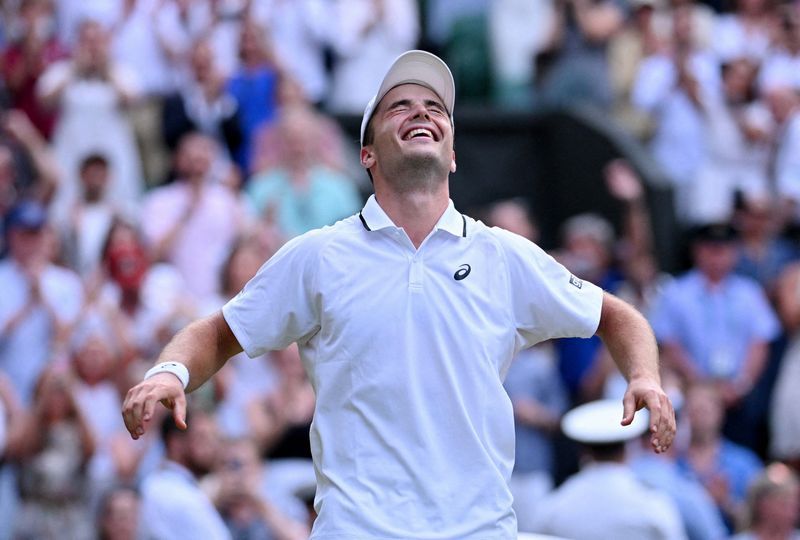
Arthur Fery's run at Wimbledon reads like a screenplay rejected for being implausibly far-fetched. The 23-year-old British wildcard has navigated his way to the semi-finals of tennis's most prestigious tournament, boasting a world ranking of 114th and entering the competition with merely two previous Grand Slam match victories. His unlikely ascent has captivated a nation starved of homegrown success at its showpiece sporting event, transforming an unknown quantity into the face of British tennis at the Championships.
Fery's journey takes on even more remarkable dimensions when one considers the specifics of his position heading into Friday's semi-final against French Open champion and second seed Alexander Zverev. A victory would propel him into Sunday's final, where he would play on his 24th birthday. More intriguingly, should he claim the title, Fery would become only the second player in history to win the Wimbledon singles championship as a wildcard entry, matching the achievement of Goran Ivanisevic from 2001. The parallels between their stories—an outsider defying astronomical odds—have not been lost on observers of the sport.
The path to this point demonstrates both Fery's resilience and his tactical acuity in navigating professional tennis. His demolition of ninth seed Flavio Cobolli on Wednesday proved particularly instructive, resulting in a convincing 6-4, 7-6(4), 6-0 victory on Centre Court before watching royalty. Queen Camilla observed from the Royal Box, later congratulating him at match's end, whilst Princess Kate had cheered his progress in an earlier round against Otto Virtanen. For a player who grew up within walking distance of the very court where these encounters unfolded, the symbolic weight of such moments cannot be overstated.
What distinguished the Cobolli encounter was not merely the scoreline but the manner of Fery's performance. Despite standing just 5ft 9in tall, he displayed an uncanny ability to retrieve balls that seemed beyond reasonable reach, constructing points with precision and capitalising on the energy radiating from a packed, sweltering Centre Court. His positioning and court awareness belied his ranking, suggesting that statistics alone fail to capture his capabilities. Roger Federer, the eight-time Wimbledon champion, acknowledged his progress during an earlier five-set thriller against Grigor Dimitrov in the fourth round, lending a degree of legitimacy that transcends headline-grabbing narratives.
Fery's composure throughout this whirlwind tournament distinguishes him from many players who might be overwhelmed by sudden fame and expectation. When confronted with questions from eager journalists seeking sensational quotes, he responds with measured consideration, mirroring the calmness he exhibits during matches. His pragmatic observation that consecutive matches leave little time for mental buildup reflects a maturity often absent in younger players thrust into the spotlight. Rather than viewing the rapid succession of contests as pressure, he reframes them as beneficial momentum-builders, a perspective revealing his psychological resilience.
This mental fortitude has been cultivated through an unconventional career path. Rather than pursuing full-time professional tennis immediately after junior success, Fery opted to pursue tertiary education at Stanford University, where he majored in science, technology and society whilst simultaneously achieving the top collegiate ranking in the nation. This decision to balance intellectual development with sporting ambition speaks to a family culture valuing education alongside athletic excellence. His choice to defer immediate professional pressures has arguably sharpened his competitive instincts, granting him maturity beyond his years.
The geographic and cultural dimensions of Fery's story add further layers to its narrative appeal across Britain and Europe. Born in Sevres, a suburb of Paris, near Roland Garros, he arrives from a family with deep French tennis connections—his mother Olivia was a professional player herself, whilst his father Loic, a multi-millionaire hedge fund manager, owns French soccer club Lorient. Despite these Gallic roots and a junior career representing France, Fery's British credentials have proven unassailable. He relocated to London as a child, attended King's College School in Wimbledon, progressed through the British tennis development system, and requires no reflection when questioned about his national allegiance.
Loic Fery has articulated the naturalness of his son's identification with Britain through comparison that resonates particularly in European tennis circles. Speaking to French sports daily L'Equipe, he observed that Arthur's situation parallels someone growing up in Boulogne playing at Roland Garros—proximity creating identity rather than mere circumstance. Arthur spent his formative years five minutes from Wimbledon's gates, navigating its streets to school, absorbing its culture and atmosphere. For French authorities, this represents a talent that got away, though Fery himself clearly harbours no regrets about his representational choices.
Fery's emergence as Britain's unlikely standard bearer gains particular resonance given the early tournament disappointment that has engulfed the home contingent. Of the nineteen British singles participants, fifteen exited during the first round, leaving the nation without conventional hope of generating a genuinely competitive homegrown story at the Championships. Fery's unexpected trajectory has thus filled a void that many feared would characterise this year's tournament from a British perspective. He has become the narrative through which the nation experiences Wimbledon, transforming what might have been a tournament of disappointment into one of genuine possibility.
The confrontation with Zverev on Friday represents an enormous step up in class compared to his quarterfinal opponent. The German second seed possesses Grand Slam pedigree, having triumphed at Roland Garros, along with the ranking consistency befitting a player occupying the upper echelons of world tennis. Yet Fery arrives at this juncture having proven that ranking points and seeding allocations do not necessarily predict outcomes within Wimbledon's grass-court ecosystem. His performances thus far suggest a player capable of adapting to challenge, drawing energy from opposition quality, and constructing tactically sophisticated approaches to seemingly overwhelming opponents.
As Fery maintains his philosophical approach of taking events as they arrive, resisting the temptation to become overwhelmed by what might transpire, the broader implications of his tournament extend beyond individual achievement. For Southeast Asian and regional tennis enthusiasts, his progression demonstrates that the sport's highest honours remain genuinely open to those willing to combine talent with unconventional pathways and mental fortitude. His Stanford education, deliberate career planning, and strategic use of wildcard opportunities offer a template diverging from traditional early professionalism approaches.

