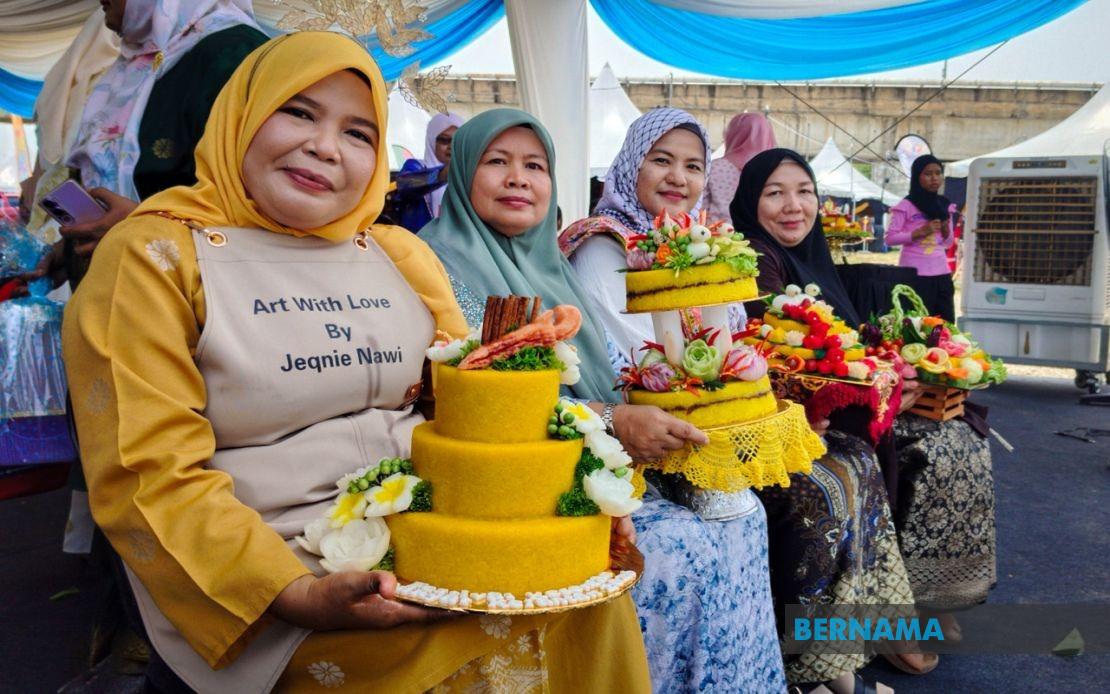
Nortiny Nawi's journey from resort marketing officer to celebrated food artisan reflects a growing trend among Malaysian entrepreneurs who are monetising traditional culinary skills in the digital age. After spending four years in the hospitality sector, the 46-year-old entrepreneur based in Kampung Gong Cokoh, Pasir Puteh has successfully established a home-based enterprise centred on the creation of intricate pulut kuning arrangements, transforming what began as a personal hobby into a sustainable livelihood that generates nearly daily orders.
The recognition of her talents came recently when Nortiny clinched the top prize at the Kelantan Folk Arts Festival (FKRK) in Tok Bali, where she showcased an eight-kilogramme pulut kuning arrangement embellished with delicate white radish carvings. This accolade underscores the commercial and cultural value of preserving traditional food presentation techniques whilst adapting them to contemporary market demands. Her win demonstrates how time-honoured culinary artistry continues to find relevance and profitability in modern Malaysia, even as younger generations increasingly distance themselves from heritage crafts.
The business model itself reflects shifting consumer preferences towards personalised, artisanal offerings for significant life events. Nortiny's customer base spans individuals marking personal milestones, educational institutions, and government departments throughout Kelantan. Each arrangement carries a price tag ranging from RM100 to RM280, determined by the weight of the glutinous rice and the intricacy of the design specifications. This pricing structure demonstrates that there exists sufficient market demand and consumer willingness to invest in handcrafted food presentations, particularly for occasions such as thanksgiving celebrations, birthday gatherings, and formal bridal dinners (makan beradab), where visual presentation carries social significance.
The path to entrepreneurship was neither sudden nor entirely planned. During her employment at a resort, Nortiny cultivated her passion by observing professional kitchen operations during breaks, gradually deepening her understanding of culinary techniques and presentation. This informal apprenticeship, born from genuine curiosity rather than formal training, eventually prompted her decision to pursue the craft independently. Her transition reflects a broader phenomenon whereby individuals leverage workplace exposure and personal interests to establish micro-enterprises, particularly in regions like Kelantan where traditional food crafts retain cultural importance and tourist appeal.
Operating from her home represents both an advantage and a constraint for the growing business. The familiar, intimate setting allows Nortiny to maintain quality control and flexibility in responding to client requests. However, her stated aspiration to relocate to larger premises indicates that current capacity constraints limit her ability to scale operations further. At present, she can accommodate up to six orders daily, though the feasibility depends entirely on design complexity, suggesting that demand may outpace her production capabilities as her reputation spreads.
The production process itself demands exceptional commitment and discipline. Unlike conventional baked goods that can be prepared in batches and refrigerated for extended periods, pulut kuning requires careful timing and fresh preparation. Nortiny's typical day commences at 3 am, when she begins steaming glutinous rice, followed by kneading, cooling, and sculpting the material into decorative forms. This labour-intensive schedule, sustained almost daily, demands not merely technical skill but psychological resilience. The early mornings and repetitive manual work could easily deter less motivated practitioners, yet Nortiny frames the physical demands as secondary to the emotional satisfaction derived from customer appreciation and continuous improvement.
The economic implications of her enterprise extend beyond individual income generation. Nortiny's success validates the market viability of preserving and commercialising traditional Malaysian food arts at a time when industrial mass production and international cuisine dominate consumer consciousness. Her business model offers a replicable pathway for other home-based entrepreneurs seeking to establish income streams grounded in cultural heritage. Furthermore, her work contributes to cultural preservation by ensuring that younger Malaysians encounter pulut kuning in contemporary contexts, potentially inspiring generational transmission of these culinary skills.
The psychological dimension of her entrepreneurial journey warrants attention. Transitioning from formal employment to self-employment involves financial uncertainty, yet Nortiny's daily bookings suggest she has successfully navigated this transition and established market credibility. Her assertion that customer compliments serve as primary motivation reveals how intrinsic rewards—recognition, creative expression, and autonomy—matter profoundly alongside financial returns. This motivation structure may prove more sustainable than purely income-driven enterprises, particularly during market fluctuations or seasonal demand variations.
Looking forward, Nortiny's plans to expand into larger premises signal confidence in sustained market demand and her ability to manage operational growth. Should she successfully transition from home-based production to commercial kitchen facilities, the operational dynamics would shift considerably. Increased overhead costs would necessitate higher pricing or increased production volumes, potentially altering her customer relationship dynamics. Yet the fundamental appeal of handcrafted, personalised pulut kuning arrangements rooted in traditional technique should endure, provided she maintains the quality standards and customer-centric approach that currently distinguish her offerings.
Nortiny Nawi's narrative encapsulates contemporary Malaysian entrepreneurship where cultural preservation intersects with economic aspiration. Her success demonstrates that traditional food arts command genuine market value, that passion-driven enterprises can generate sustainable income, and that female entrepreneurs in provincial Malaysia can build respected businesses serving diverse customer segments. As Malaysia navigates broader conversations about economic diversification and heritage preservation, stories like hers offer practical evidence that these objectives need not conflict—indeed, they can mutually reinforce one another, creating livelihoods whilst safeguarding cultural practices for future generations.

